• HOME
  • NEWS
  • EXPLORE
    • CAREER
      • Companies
      • Jobs
    • EVENTS
    • iGEM
      • News
      • Team
    • PHOTOS
    • VIDEO
    • WIKI
  • BLOG
  • COMMUNITY
    • FACEBOOK
    • INSTAGRAM
    • TWITTER
Saturday, February 7, 2026
BIOENGINEER.ORG
No Result
View All Result
  • Login
  • HOME
  • NEWS
  • EXPLORE
    • CAREER
      • Companies
      • Jobs
        • Lecturer
        • PhD Studentship
        • Postdoc
        • Research Assistant
    • EVENTS
    • iGEM
      • News
      • Team
    • PHOTOS
    • VIDEO
    • WIKI
  • BLOG
  • COMMUNITY
    • FACEBOOK
    • INSTAGRAM
    • TWITTER
  • HOME
  • NEWS
  • EXPLORE
    • CAREER
      • Companies
      • Jobs
        • Lecturer
        • PhD Studentship
        • Postdoc
        • Research Assistant
    • EVENTS
    • iGEM
      • News
      • Team
    • PHOTOS
    • VIDEO
    • WIKI
  • BLOG
  • COMMUNITY
    • FACEBOOK
    • INSTAGRAM
    • TWITTER
No Result
View All Result
Bioengineer.org
No Result
View All Result
Home NEWS Science News Biology

KU Leuven researchers unravel protein mystery of three brain diseases

Bioengineer by Bioengineer
April 30, 2020
in Biology
Reading Time: 3 mins read
0
IMAGE
Share on FacebookShare on TwitterShare on LinkedinShare on RedditShare on Telegram

IMAGE

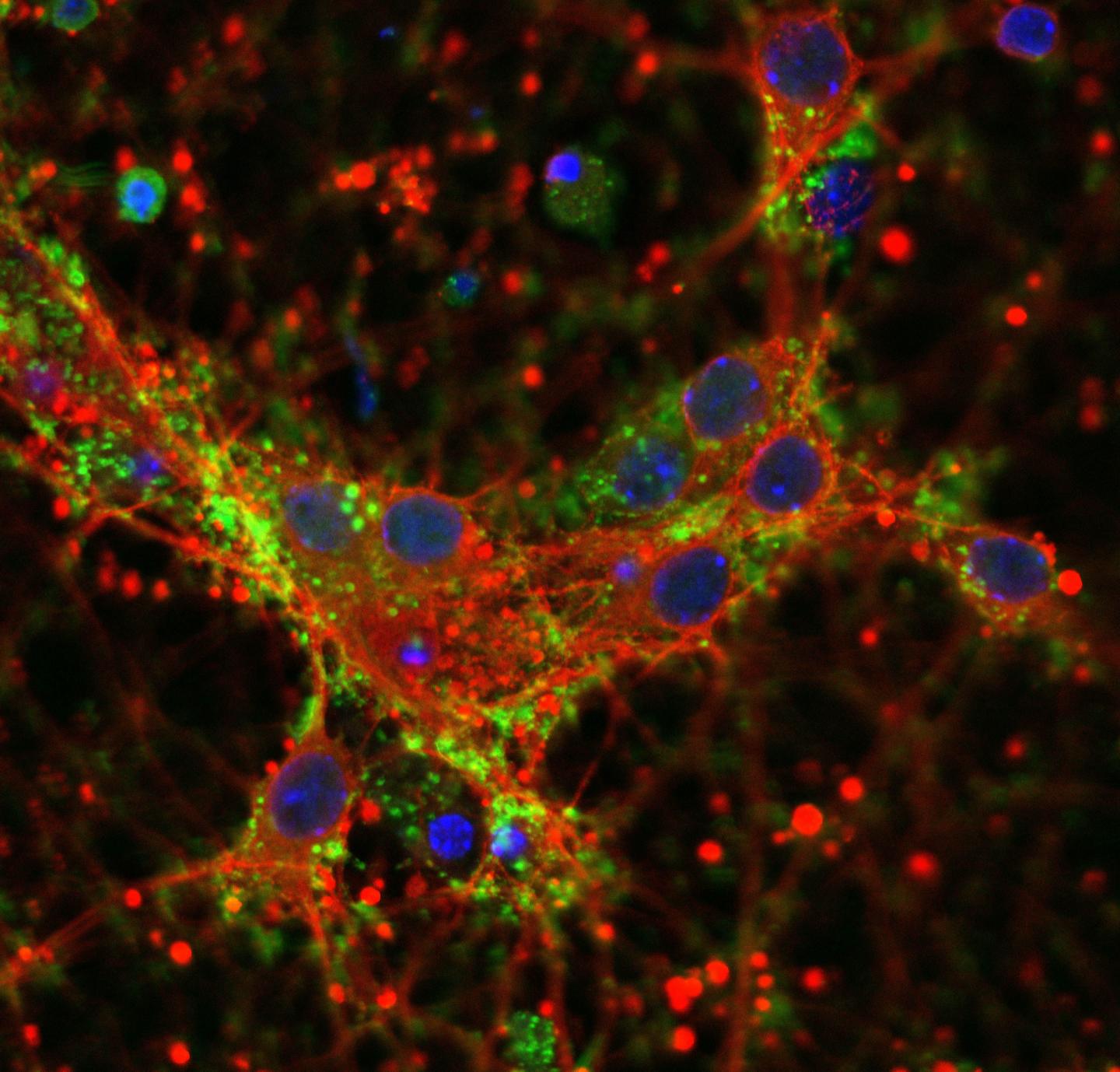
Credit: Microscopy by Anke Van der Perren

The accumulation of one particular protein in the brain is at the basis of three very different age-related conditions. Until recently, nobody understood how this was possible. Research by the Laboratory for Neurobiology and Gene Therapy (KU Leuven) now reveals that the shape of the protein determines the clinical picture.

The presence of α-synuclein protein deposits in the brain is characteristic for three different diseases: Parkinson’s disease (PD), multiple system atrophy (MSA) and dementia with Lewy bodies (DLB). Although these disorders are part of the same family, they are clinically and pathologically very different.

Parkinson’s disease affects around two percent of the population over 60. The condition manifests itself mainly in motor problems. Dementia with Lewy bodies is less common (0.4 percent of people over 65), but is still the second most common form of dementia, after Alzheimer’s disease. Multiple system atrophy is a rare but extremely aggressive disease for which there is virtually no treatment. It causes a variety of health issues, including general pain, bladder problems and low blood pressure, as well as motor problems. Most patients succumb to the disease within five to ten years.

Simulating disease processes

In collaboration with their colleagues from the French National Centre for Scientific Research (CNRS) and Imperial College London, researchers of the KU Leuven Laboratory for Neurobiology and Gene Therapy isolated the α-synuclein protein from brain tissue of deceased PD, MSA and DLB patients. This protein was then multiplied and reproduced with a technique that was specifically designed for this purpose. The different protein shapes were carefully studied in the lab and introduced in lab animals to simulate the disease processes.

The researchers were able to identify two shapes of the protein: a helical one in MSA and Parkinson’s disease, and a cylindrical one in DLB. The shape also determined the severity of the disease symptoms: in MSA the symptoms occurred more quickly and aggressively, while in DLB they were more moderate.

“Previously, it was a mystery why one and the same protein caused three different brain diseases,” says research coordinator Dr Anke Van der Perren. “Now, for the first time, we’ve been able to identify different shapes of α-synuclein protein deposits in patients. Depending on the shape, a different disorder and, thus, a different clinical picture occurs.”

Earlier and better diagnosis

The new insights on the origin and structure of the protein shapes may, in time, lead to an earlier and better diagnosis, says Professor Veerle Baekelandt. “To this day, it’s very difficult to diagnose these three brain disorders. We want to further unravel the complex process of the protein deposits to gain a better understanding of how the diseases develop. In time, we hope that we’ll be able to detect these harmful protein shapes and that a specific treatment can be found to slow down or even stop the disease process.”

###

Media Contact
Anke Van der Perren

[email protected]

Original Source

https://nieuws.kuleuven.be/en/content/2020/leuven-researchers-unravel-protein-mystery-of-three-brain-diseases

Related Journal Article

http://dx.doi.org/10.1007/s00401-020-02157-3

Tags: AgingGeneticsGerontologyMedicine/HealthneurobiologyParkinson
Share12Tweet8Share2ShareShareShare2

Related Posts

Florida Cane Toad: Complex Spread and Selective Evolution

Florida Cane Toad: Complex Spread and Selective Evolution

February 7, 2026
New Study Uncovers Mechanism Behind Burn Pit Particulate Matter–Induced Lung Inflammation

New Study Uncovers Mechanism Behind Burn Pit Particulate Matter–Induced Lung Inflammation

February 6, 2026

DeepBlastoid: Advancing Automated and Efficient Evaluation of Human Blastoids with Deep Learning

February 6, 2026

Navigating the Gut: The Role of Formic Acid in the Microbiome

February 6, 2026
Please login to join discussion

POPULAR NEWS

  • Robotic Ureteral Reconstruction: A Novel Approach

    Robotic Ureteral Reconstruction: A Novel Approach

    82 shares
    Share 33 Tweet 21
  • Digital Privacy: Health Data Control in Incarceration

    63 shares
    Share 25 Tweet 16
  • Study Reveals Lipid Accumulation in ME/CFS Cells

    57 shares
    Share 23 Tweet 14
  • Breakthrough in RNA Research Accelerates Medical Innovations Timeline

    53 shares
    Share 21 Tweet 13

About

We bring you the latest biotechnology news from best research centers and universities around the world. Check our website.

Follow us

Recent News

Phage-Antibiotic Combo Beats Resistant Peritoneal Infection

Boosting Remote Healthcare: Stepped-Wedge Trial Insights

Barriers and Boosters of Seniors’ Physical Activity in Karachi

Subscribe to Blog via Email

Enter your email address to subscribe to this blog and receive notifications of new posts by email.

Join 73 other subscribers
  • Contact Us

Bioengineer.org © Copyright 2023 All Rights Reserved.

Welcome Back!

Login to your account below

Forgotten Password?

Retrieve your password

Please enter your username or email address to reset your password.

Log In
No Result
View All Result
  • Homepages
    • Home Page 1
    • Home Page 2
  • News
  • National
  • Business
  • Health
  • Lifestyle
  • Science

Bioengineer.org © Copyright 2023 All Rights Reserved.