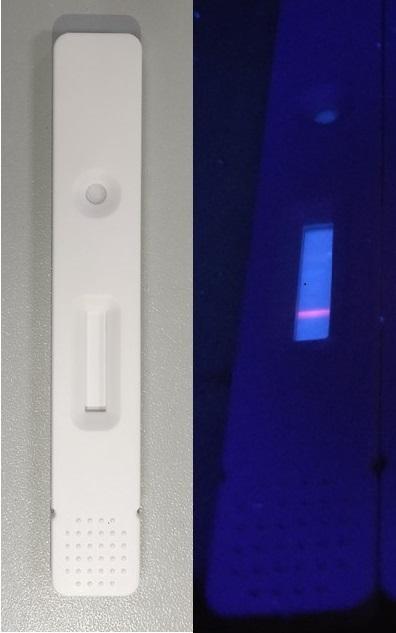
Credit: Guanfeng Lin
As the COVID-19 curve shows signs of flattening in the U.S. and elsewhere, public health officials are trying to grasp just how many people have been infected. Now, a proof-of-concept study in ACS’ Analytical Chemistry describes a quick, sensitive test for antibodies against the coronavirus in human blood. The test could help doctors track a person’s exposure to the disease, as well as confirm suspected COVID-19 cases that tested negative by other methods.
Because COVID-19 symptoms range from mild to severe, with some people apparently having no symptoms, the number of people who have been infected with the SARS-CoV-2 virus at some point is likely much higher than the number of confirmed cases. As U.S. states begin to ease lockdown restrictions, widespread testing of the general population will be important to identify people at early stages of disease, or people who lack symptoms but can still infect others. Also, although more research needs to be done, it is possible that people with antibodies to the virus could be immune to future COVID-19 outbreaks. To help identify people with current or past exposure to SARS-CoV-2, Lei Yu, Yingsong Wu, Guanfeng Lin and colleagues wanted to develop a fast, sensitive antibody test.
The researchers based their test on a technique called a lateral flow immunoassay (LFA); a home pregnancy test is an example of this kind of assay. They attached a viral coat protein to a specific region on a strip of nitrocellulose, and then added human serum. The serum flowed from one end of the strip to the other, and any antibodies against the viral protein bound to that region on the strip. Then, the team detected the anti-SARS-CoV-2 antibodies with a fluorescently labeled antibody. This fluorescence-based detection is much more sensitive than some other LFAs, such as pregnancy tests, that can be read by the naked eye. The researchers tested the new assay on seven serum samples from COVID-19 patients and 12 samples from people who had tested negative for the disease by reverse transcriptase-polymerase chain reaction (RT-PCR), a common diagnostic test that occasionally fails to detect positive cases. The new assay correctly diagnosed all seven samples as positive — as well as an additional “negative” case that had suspicious clinical symptoms — in only 10 minutes per sample. The immunoassay could be helpful in confirming negative diagnoses, monitoring a patient’s recovery, studying past exposures, and identifying recovered individuals with high levels of antibodies as potential convalescent plasma donors, the researchers say.
###
The authors acknowledge funding from the National Natural Science Foundation of China and the China Postdoctoral Science Foundation.
The abstract that accompanies this paper can be viewed here.
The American Chemical Society (ACS) is a nonprofit organization chartered by the U.S. Congress. ACS’ mission is to advance the broader chemistry enterprise and its practitioners for the benefit of Earth and its people. The Society is a global leader in providing access to chemistry-related information and research through its multiple research solutions, peer-reviewed journals, scientific conferences, eBooks and weekly news periodical Chemical & Engineering News. ACS journals are among the most cited, most trusted and most read within the scientific literature; however, ACS itself does not conduct chemical research. As a specialist in scientific information solutions (including SciFinder® and STN®), its CAS division powers global research, discovery and innovation. ACS’ main offices are in Washington, D.C., and Columbus, Ohio.
To automatically receive news releases from the American Chemical Society, contact [email protected].
Follow us: Twitter | Facebook
Media Contact
Katie Cottingham
[email protected]