• HOME
  • NEWS
  • EXPLORE
    • CAREER
      • Companies
      • Jobs
    • EVENTS
    • iGEM
      • News
      • Team
    • PHOTOS
    • VIDEO
    • WIKI
  • BLOG
  • COMMUNITY
    • FACEBOOK
    • INSTAGRAM
    • TWITTER
Friday, January 16, 2026
BIOENGINEER.ORG
No Result
View All Result
  • Login
  • HOME
  • NEWS
  • EXPLORE
    • CAREER
      • Companies
      • Jobs
        • Lecturer
        • PhD Studentship
        • Postdoc
        • Research Assistant
    • EVENTS
    • iGEM
      • News
      • Team
    • PHOTOS
    • VIDEO
    • WIKI
  • BLOG
  • COMMUNITY
    • FACEBOOK
    • INSTAGRAM
    • TWITTER
  • HOME
  • NEWS
  • EXPLORE
    • CAREER
      • Companies
      • Jobs
        • Lecturer
        • PhD Studentship
        • Postdoc
        • Research Assistant
    • EVENTS
    • iGEM
      • News
      • Team
    • PHOTOS
    • VIDEO
    • WIKI
  • BLOG
  • COMMUNITY
    • FACEBOOK
    • INSTAGRAM
    • TWITTER
No Result
View All Result
Bioengineer.org
No Result
View All Result
Home NEWS Science News

Fused-ring electron acceptor with 3D exciton and charge transport

Bioengineer by Bioengineer
April 28, 2020
in Science News
Reading Time: 2 mins read
0
IMAGE
Share on FacebookShare on TwitterShare on LinkedinShare on RedditShare on Telegram

IMAGE

Credit: Zhan Xiaowei

Recently, Professor Zhan Xiaowei’s group from the College of Engineering at Peking University made new progress in non-fullerene acceptors for organic solar cells (OSCs). They developed a new fluorinated fused-ring electron acceptor (FREA) with 3D stacking and exciton and charge transport (Adv. Mater., DOI: 10.1002/adma.202000645).

In 2015, the Zhan group pioneered the concept of FREA and invented the landmark molecule ITIC (Adv. Mater., 2015, 27, 1170-1174, cited 1590 times). In 2017, they firstly introduced fluorinated 2-(3-oxo-2,3-dihydroinden-1-ylidene) -malononitrile, 1FIC and 2FIC, in FREAs (J. Am. Chem. Soc., 2017, 139, 1336-1343, cited 547 times; Adv. Mater., 2017, 29, 1700144, cited 549 times). Now, all the best non-fullerene acceptors are based on 1FIC/2FIC.

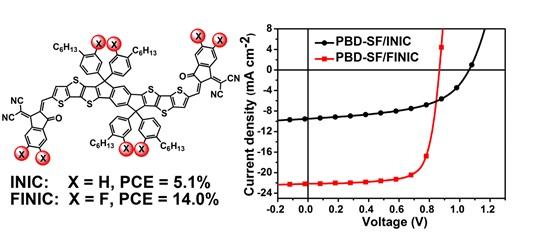
Most recently, they proposed a new design strategy to construct FREAs via fluorination of both end-groups and side-chains. Close 3D stacking network is formed due to 3D non-covalent interactions caused by F atoms on both end-groups and side-chains, which is beneficial to efficient 3D exciton and charge transport. The OSCs based on FINIC with fluorinated end-groups and side-chains show an efficiency of 14.0%, much higher than that of the nonfluorinated INIC-based cells (5.1%).

The research work was supported by the National Nature Science Foundation of China and Basic Research Promotion Project of Peking University.

###

Media Contact
Huang Weijian
[email protected]

Original Source

http://newsen.pku.edu.cn/news_events/news/research/9699.htm

Related Journal Article

http://dx.doi.org/10.1002/adma.202000645

Tags: Electrical Engineering/ElectronicsResearch/DevelopmentTechnology/Engineering/Computer Science
Share12Tweet8Share2ShareShareShare2

Related Posts

Carbon Fiber Boosts Zirconium Diboride in 3D Printing

Carbon Fiber Boosts Zirconium Diboride in 3D Printing

January 16, 2026

Revolutionary Support Program for Families of Cancer Patients

January 16, 2026

Spatial Multiomics Uncovers Immune Dysfunction in Parkinson’s, IBD

January 16, 2026

Psychiatric Nurses’ Views on AI in Care

January 16, 2026
Please login to join discussion

POPULAR NEWS

  • Enhancing Spiritual Care Education in Nursing Programs

    155 shares
    Share 62 Tweet 39
  • PTSD, Depression, Anxiety in Childhood Cancer Survivors, Parents

    147 shares
    Share 59 Tweet 37
  • Robotic Ureteral Reconstruction: A Novel Approach

    76 shares
    Share 30 Tweet 19
  • Study Reveals Lipid Accumulation in ME/CFS Cells

    53 shares
    Share 21 Tweet 13

About

We bring you the latest biotechnology news from best research centers and universities around the world. Check our website.

Follow us

Recent News

Carbon Fiber Boosts Zirconium Diboride in 3D Printing

Revolutionary Support Program for Families of Cancer Patients

Spatial Multiomics Uncovers Immune Dysfunction in Parkinson’s, IBD

Subscribe to Blog via Email

Success! An email was just sent to confirm your subscription. Please find the email now and click 'Confirm' to start subscribing.

Join 71 other subscribers
  • Contact Us

Bioengineer.org © Copyright 2023 All Rights Reserved.

Welcome Back!

Login to your account below

Forgotten Password?

Retrieve your password

Please enter your username or email address to reset your password.

Log In
No Result
View All Result
  • Homepages
    • Home Page 1
    • Home Page 2
  • News
  • National
  • Business
  • Health
  • Lifestyle
  • Science

Bioengineer.org © Copyright 2023 All Rights Reserved.