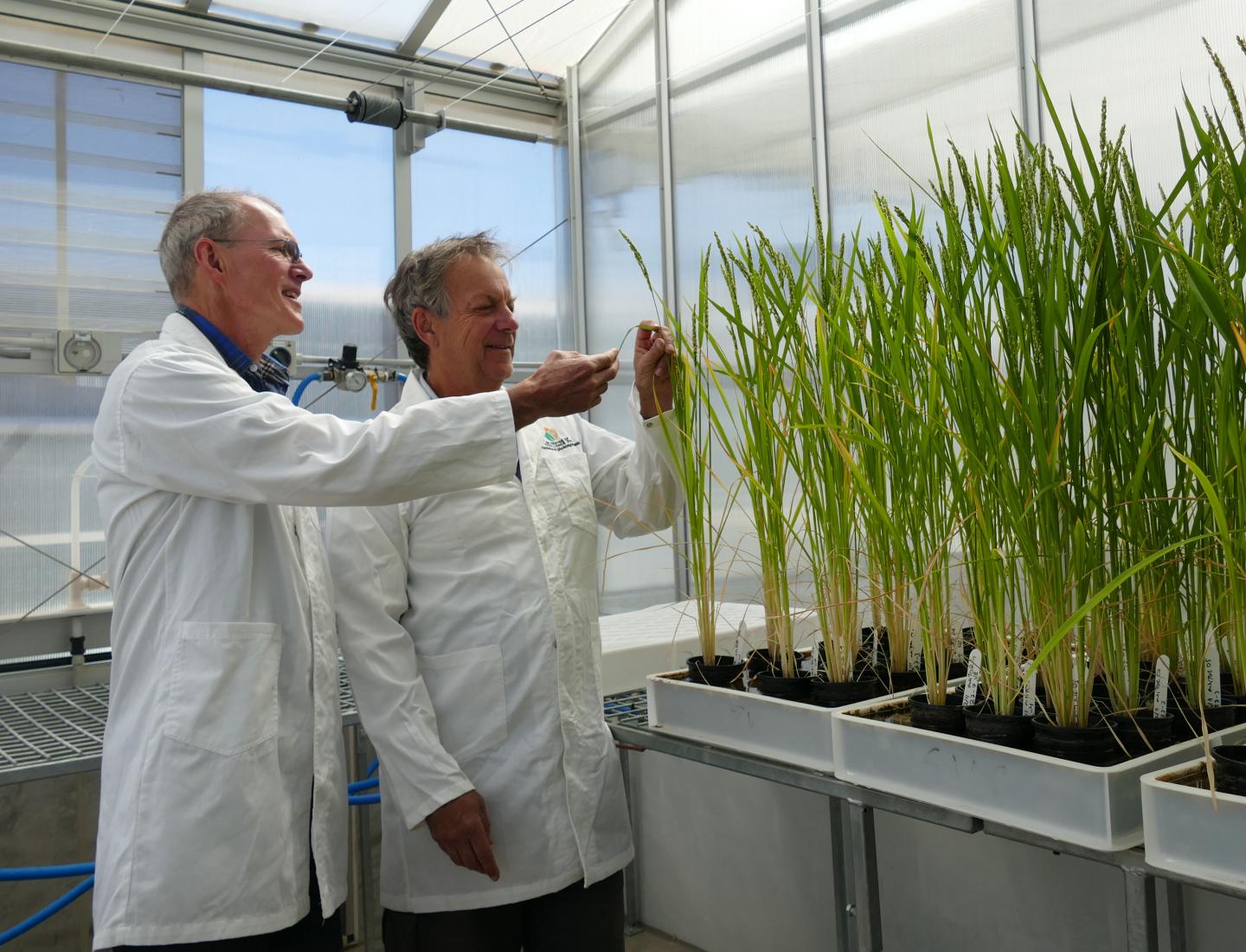
Credit: Natalia Bateman, ARC Centre of Excellence for Translational Photosynthesis
During the past few weeks, empty supermarket shelves, without pasta, rice and flour due to panic buying, has caused public concerns about the possibility of running out of food. Australian farmers have reassured consumers saying that the country produces enough food to feed three times its population. However, will this statement remain true in ten to twenty years in a country severely affected by climate change? The answer is yes, if we are prepared for this and if there is continuous funding towards creating solutions to increase crop production.
“Plant scientists are punching above their weight by participating in global, interdisciplinary efforts to find ways to increase crop production under future climate change conditions. We essentially need to double the production of major cereals before 2050 to secure food availability for the rapidly growing world population,” says ANU Professor Robert Furbank from the ARC Centre of Excellence for Translational Photosynthesis (CoETP).
“It is similar to finding a virus vaccine to solve a pandemic, it doesn’t happen overnight. We know that Australia’s agriculture is going to be one area of the world that is most affected by climate extremes, so we are preparing to have a toolbox of plant innovations ready to ensure global food security in a decade or so, but to do this we need research funding to continue,” Professor Furbank says.
Several examples of these innovative solutions were published recently in a special issue on Food Security Innovations in Agriculture in the Journal of Experimental Botany, including five reviews and five research articles.
Co-editor of the Special Issue, ANU Professor John Evans, says that this publication highlights the now widely accepted view that improving photosynthesis – the process by which plants convert sunlight, water and CO2 into organic matter – is a new way to increase crop production that is being developed.
“We are working on improving photosynthesis on different fronts, as the articles included in this special issue show, from finding crop varieties that need less water, to tweaking parts of the process in order to capture more carbon dioxide and sunlight. We know that there is a delay of at least a decade to get these solutions to the breeders and farmers, so we need to start developing new opportunities now before we run out of options,” says Professor Evans, CoETP Chief Investigator.
The special issue includes research solutions that range from traditional breeding approaches to ambitious genetic engineering projects using completely different ends of the technological spectrum; from robot tractors, to synthetic biology. All these efforts are focused on finding ways to make crops more resistant to drought and extreme climate conditions and being more efficient in the use of land and fertilisers.
“Our research is contributing to providing food security in a global context, and people often ask what that has to do with Australian farmers and my answer is everything. Aside from the fact that economy and agriculture are globally inter-connected, if Australian farmers have a more productive resilient and stable crop variety, they are able to plan for the future, which turns into a better agribusiness and at the same time, ensures global security across the world,” says Professor Furbank.
###
This research has been funded by the Australian Research Council (ARC) Centre of Excellence for Translational Photosynthesis (CoETP), led by the Australian National University, which aims to improve the process of photosynthesis to increase the production of major food crops such as sorghum, wheat and rice.
This research is published in the Journal of Experimental Botany Special issue on Innovations in Agriculture for Food Security (Volume 71, Issue 7, April 2020)
Journalists who want to link to the Journal of Experimental Special issue and associated papers in their stories can use the following link: https:/
Media Contact
Natalia Bateman
[email protected]
Original Source
https:/
Related Journal Article
http://dx.