• HOME
  • NEWS
  • EXPLORE
    • CAREER
      • Companies
      • Jobs
    • EVENTS
    • iGEM
      • News
      • Team
    • PHOTOS
    • VIDEO
    • WIKI
  • BLOG
  • COMMUNITY
    • FACEBOOK
    • INSTAGRAM
    • TWITTER
Saturday, February 7, 2026
BIOENGINEER.ORG
No Result
View All Result
  • Login
  • HOME
  • NEWS
  • EXPLORE
    • CAREER
      • Companies
      • Jobs
        • Lecturer
        • PhD Studentship
        • Postdoc
        • Research Assistant
    • EVENTS
    • iGEM
      • News
      • Team
    • PHOTOS
    • VIDEO
    • WIKI
  • BLOG
  • COMMUNITY
    • FACEBOOK
    • INSTAGRAM
    • TWITTER
  • HOME
  • NEWS
  • EXPLORE
    • CAREER
      • Companies
      • Jobs
        • Lecturer
        • PhD Studentship
        • Postdoc
        • Research Assistant
    • EVENTS
    • iGEM
      • News
      • Team
    • PHOTOS
    • VIDEO
    • WIKI
  • BLOG
  • COMMUNITY
    • FACEBOOK
    • INSTAGRAM
    • TWITTER
No Result
View All Result
Bioengineer.org
No Result
View All Result
Home NEWS Science News Chemistry

MSU professor collaborates with international colleagues in Reviews of Modern Physics journal article

Bioengineer by Bioengineer
April 23, 2020
in Chemistry
Reading Time: 2 mins read
0
IMAGE
Share on FacebookShare on TwitterShare on LinkedinShare on RedditShare on Telegram

Probes advancements laboratories like Facility for Rare Isotope Beams will enable
IMAGE

Credit: Facility for Rare Isotope Beams

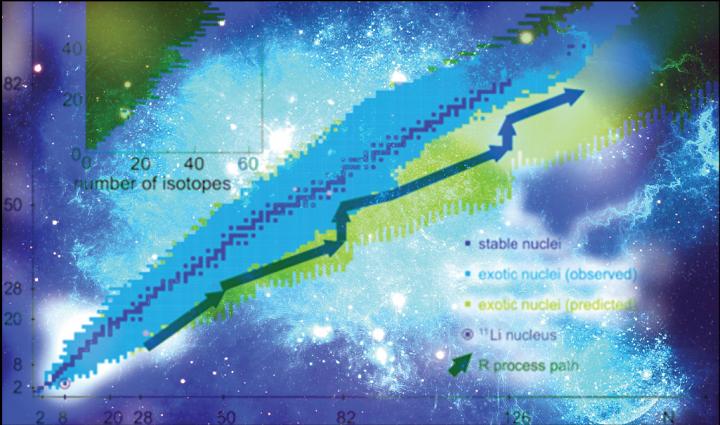
In an atomic nucleus, protons and neutrons, collectively called nucleons, are bound together by nuclear forces. These forces describe the interactions between nucleons, which cause them to occupy states grouped in shells, where each shell has a different energy and can host a certain number of nucleons. A nucleus is said to be magic when the neutron or protons happen to exactly fill up their respective shells up to the rim. Such magic nuclei are especially well bound and have properties that make them stand out. In fact, the variation of the properties of nuclei with nucleon number led to the formulation of the celebrated nuclear shell model some 70 years ago, with its magic numbers 2, 8, 20, 28, 50, 82 and 126, which has had spectacular success in describing many of the properties of the stable nuclei that make up the world around us.

With the advent of particle accelerator facilities, short-lived nuclei – so-called rare isotopes – that have, for example, many more neutrons than protons, can be produced and subjected to experimentation. Studies on such exotic nuclei revealed that the magic numbers are not as immutable as one might have expected from the rare isotope’s stable cousins with less neutrons. New magic numbers were found and the ones known from stable nuclei can be absent for some short-lived nuclei. This is referred to as shell evolution.

On Earth, such exotic short-lived nuclei only exist for a fleeting moment produced at accelerator facilities. In the Universe, however, they are constantly formed in stars, e.g., in explosions on the surface of neutron stars, in supernovae, or in the violent collisions of neutron stars. In fact, the reactions and decays of the rare isotopes determine the elemental abundances observed in the Universe. If we ever want to understand how the visible matter around us came to be, we must understand and be able to model the properties of the exotic nuclei.

Michigan State University Professor Alexandra Gade collaborated with colleagues from Japan and France on an extensive review article in the prestigious Reviews of Modern Physics journal on the forces behind the observed shell evolution of exotic nuclei. The article reviews the state of the field and connects experimental observations to theoretical advancements in the description of rare isotopes.

In the future, advancements on the experimental and theoretical fronts are expected through new powerful laboratories, such as the Facility for Rare Isotope Beams at MSU, and high-performance computing, for example. The impact of understanding shell evolution stretches beyond nuclear astrophysics and extends to applications such as nuclear reactors, nuclear security, or nuclear medicine.

###

Gade’s research is now supported by a $5.45 million grant from the U.S. Department of Energy Office of Science.

MSU is establishing FRIB as a user facility for the Office of Nuclear Physics in the U.S. Department of Energy Office of Science.

Media Contact
Karen King
[email protected]

Original Source

https://frib.msu.edu/news/2020/gade-rmp.html

Tags: Atomic PhysicsAtomic/Molecular/Particle PhysicsChemistry/Physics/Materials SciencesNuclear Physics
Share12Tweet8Share2ShareShareShare2

Related Posts

blank

Breakthrough in Environmental Cleanup: Scientists Develop Solar-Activated Biochar for Faster Remediation

February 7, 2026
blank

Cutting Costs: Making Hydrogen Fuel Cells More Affordable

February 6, 2026

Scientists Develop Hand-Held “Levitating” Time Crystals

February 6, 2026

Observing a Key Green-Energy Catalyst Dissolve Atom by Atom

February 6, 2026
Please login to join discussion

POPULAR NEWS

  • Robotic Ureteral Reconstruction: A Novel Approach

    Robotic Ureteral Reconstruction: A Novel Approach

    82 shares
    Share 33 Tweet 21
  • Digital Privacy: Health Data Control in Incarceration

    63 shares
    Share 25 Tweet 16
  • Study Reveals Lipid Accumulation in ME/CFS Cells

    57 shares
    Share 23 Tweet 14
  • Breakthrough in RNA Research Accelerates Medical Innovations Timeline

    53 shares
    Share 21 Tweet 13

About

We bring you the latest biotechnology news from best research centers and universities around the world. Check our website.

Follow us

Recent News

Evaluating Pediatric Emergency Care Quality in Ethiopia

TPMT Expression Predictions Linked to Azathioprine Side Effects

Improving Dementia Care with Enhanced Activity Kits

Subscribe to Blog via Email

Success! An email was just sent to confirm your subscription. Please find the email now and click 'Confirm' to start subscribing.

Join 73 other subscribers
  • Contact Us

Bioengineer.org © Copyright 2023 All Rights Reserved.

Welcome Back!

Login to your account below

Forgotten Password?

Retrieve your password

Please enter your username or email address to reset your password.

Log In
No Result
View All Result
  • Homepages
    • Home Page 1
    • Home Page 2
  • News
  • National
  • Business
  • Health
  • Lifestyle
  • Science

Bioengineer.org © Copyright 2023 All Rights Reserved.