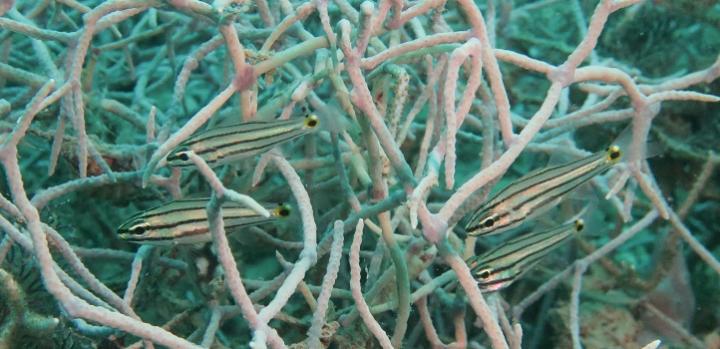
Credit: Moises Bernal 2020
Reef fish species uniquely respond to climate change, with some more vulnerable than others.
Five Great Barrier Reef fish species each activated different genetic responses to a marine heatwave in the Australian summer of 2015-16. This finding could help further understanding of climate change impacts on wild fish distributions.
“Scientists have extensively studied heatwave impacts on coral reefs because they are very sensitive to temperature and can easily bleach in warming conditions,” says former KAUST postdoc, Moisés Bernal, now an assistant professor at Auburn University, USA. “Previous studies have measured the effects of heatwaves on fish as a side effect of coral bleaching. Our study is novel in that it applies molecular techniques to directly understand the mechanisms used by different fish to cope with elevated temperatures.”
Bernal worked with international and KAUST colleagues to sequence RNA from the livers of fish species from reefs of Lizard Island, Australia. Samples were collected from fish before (December 2015), during (February and March 2016) and after (July 2016) the heatwave. The researchers aimed to find out which genes were turned on at different times during the heatwave in different fish species. Samples were taken from two damselfish species, the spiny chromis damselfish and the lemon damselfish, and from three cardinalfish species, the yellow-striped, Doederlein’s and five-lined cardinalfish.
“Unexpectedly, we found that all species reacted differently, using different genes to respond to warming conditions,” says former postdoc Celia Schunter, now at the University of Hong Kong. “There was an overlap, however, in the functions performed by these genes.”
The team found, for example, that the spiny chromis damselfish had the largest number of differentially expressed genes (3000) across the four time points, while the five-lined cardinalfish had the smallest (992). All five species, however, had activated molecular pathways associated with increased oxygen uptake, the energy-generating electron transport chain in cells, and cellular stress responses.
“Another surprising result was that there were large differences in the genes that were activated in February and March,” adds Schunter. “These two time points were separated by four weeks, but experienced similar temperatures, suggesting that both the intensity and duration of a heatwave are important for evaluating the responses of marine organisms.”
The study’s findings suggest that some species are more sensitive to climate change, while others are more resistant, possibly as a result of differences in their geographic ranges and evolutionary histories.
The study does, however, have some limitations. For example, the researchers did not have a baseline reference for liver gene expression in the five fish species from previous years. Also, the heatwave affected seasonal food availability, which could also influence gene expression.
Further studies could investigate how repeated heatwaves influence fish fitness and their long-term adaptation.
###
References
Bernal, M.A., Schunter, C., Lehmann, R., Lightfoot, D.J., Allan, B.J.M., Veilleux, H.D., Rummer, J.L., Munday, P.L., Ravasi, T. Species-specific molecular responses of wild coral reef fishes during a marine heatwave. Science Advances 6, eaay3423 (2020).| article
About the first authors
Moisés Bernal and Celia Schunter
Alum
Moisés (left) and Celia are former KAUST postdocs whose work on understanding the ecological and evolutionary traits that determine how fish populations respond to natural and human-induced stressors continue as assistant professors at Auburn University, U.S. and the University of Hong Kong, respectively.
Media Contact
Carolyn Unck
[email protected]