Results from the collaboration with scientists from the Air Force Research Laboratory could have applications in the aerospace, automotive and defense industries
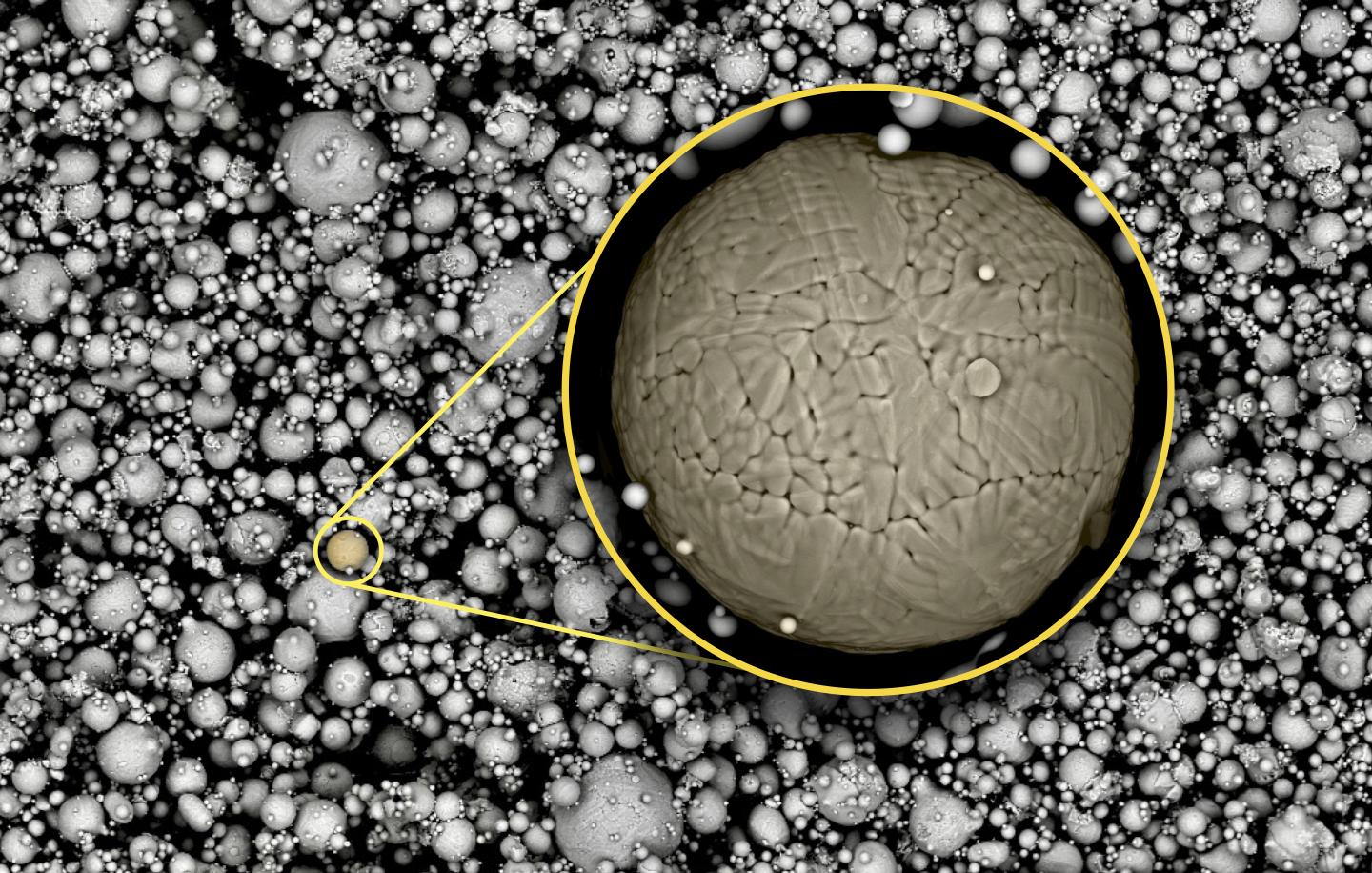
Credit: Raiyan Seede/Texas A&M University College of Engineering
For millennia, metallurgists have been meticulously tweaking the ingredients of steel to enhance its properties. As a result, several variants of steel exist today; but one type, called martensitic steel, stands out from its steel cousins as stronger and more cost-effective to produce. Hence, martensitic steels naturally lend themselves to applications in the aerospace, automotive and defense industries, among others, where high-strength, lightweight parts need to be manufactured without boosting the cost.
However, for these and other applications, the metals have to be built into complex structures with minimal loss of strength and durability. Researchers from Texas A&M University, in collaboration with scientists in the Air Force Research Laboratory, have now developed guidelines that allow 3D printing of martensitic steels into very sturdy, defect-free objects of nearly any shape.
“Strong and tough steels have tremendous applications but the strongest ones are usually expensive — the one exception being martensitic steels that are relatively inexpensive, costing less than a dollar per pound,” said Dr. Ibrahim Karaman, Chevron Professor I and head of the Department of Materials Science and Engineering. “We have developed a framework so that 3D printing of these hard steels is possible into any desired geometry and the final object will be virtually defect-free.”
Although the procedure developed was initially for martensitic steels, researchers from the Texas A&M said they have made their guidelines general enough so that the same 3D printing pipeline can be used to build intricate objects from other metals and alloys as well.
The findings of the study were reported in the December issue of the journal Acta Materialia.
Steels are made of iron and a small quantity of other elements, including carbon. Martensite steels are formed when steels are heated to extremely high temperatures and then rapidly cooled. The sudden cooling unnaturally confines carbon atoms within iron crystals, giving martensitic steel its signature strength.
To have diverse applications, martensitic steels, particularly a type called low-alloy martensitic steels, need to be assembled into objects of different shapes and sizes depending on a particular application. That’s when additive manufacturing, more commonly known as 3D printing, provides a practical solution. Using this technology, complex items can be built layer by layer by heating and melting a single layer of metal powder along a pattern with a sharp laser beam. Each of these layers joined and stacked creates the final 3D-printed object.
However, 3D printing martensitic steels using lasers can introduce unintended defects in the form of pores within the material.
“Porosities are tiny holes that can sharply reduce the strength of the final 3D-printed object, even if the raw material used for the 3D printing is very strong,” said Karaman. “To find practical applications for the new martensitic steel, we needed to go back to the drawing board and investigate which laser settings could prevent these defects.”
For their experiments, Karaman and the Texas A&M team first chose an existing mathematical model inspired from welding to predict how a single layer of martensitic steel powder would melt for different settings for laser speed and power. By comparing the type and number of defects they observed in a single track of melted powder with the model’s predictions, they were able to change their existing framework slightly so that subsequent predictions improved.
After a few such iterations, their framework could correctly forecast, without needing additional experiments, if a new, untested set of laser settings would lead to defects in the martensitic steel. The researchers said this procedure is more time-efficient.
“Testing the entire range of laser setting possibilities to evaluate which ones may lead to defects is extremely time-consuming, and at times, even impractical,” said Raiyan Seede, a graduate student in the College of Engineering and the primary author of the study. “By combining experiments and modeling, we were able to develop a simple, quick, step-by-step procedure that can be used to determine which setting would work best for 3D printing of martensitic steels.”
Seede also noted that although their guidelines were developed to ensure that martensitic steels can be printed devoid of deformities, their framework can be used to print with any other metal. He said this expanded application is because their framework can be adapted to match the observations from single-track experiments for any given metal.
“Although we started with a focus on 3D printing of martensitic steels, we have since created a more universal printing pipeline,” said Karaman. “Also, our guidelines simplify the art of 3D printing metals so that the final product is without porosities, which is an important development for all type of metal additive manufacturing industries that make parts as simple as screws to more complex ones like landing gears, gearboxes or turbines.”
###
Other contributors to the research include Austin Whitt and Dr. Raymundo Arróyave from the Texas A&M Department of Materials Science and Engineering; David Shoukr, Bing Zhang and Dr. Alaa Elwany from the Texas A&M Department of Industrial and Systems Engineering; and Dr. Sean Gibbons and Dr. Philip Flater from the Air Force Research Laboratory, Florida.
Media Contact
Amy Halbert
[email protected]
Original Source
https:/
Related Journal Article
http://dx.