Credit: Virginia Tech
What do you get when you cross a novel approach to water harvesting with a light fog? The answer: a lot more water than you expected.
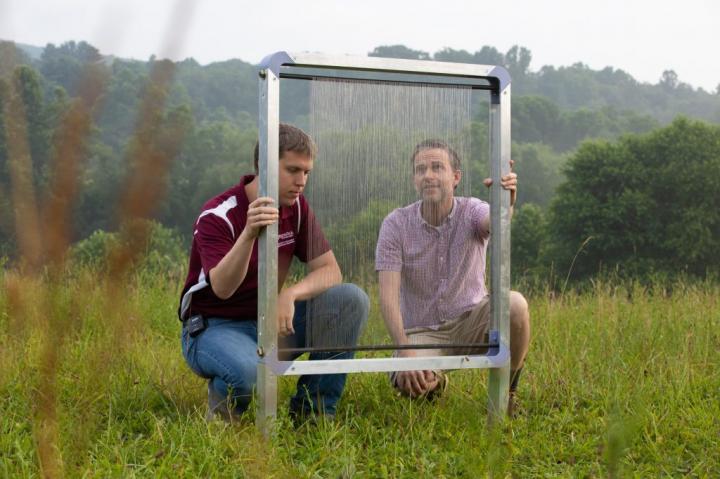
The development of the fog harp, a Virginia Tech interdisciplinary pairing of engineering with biomimetic design, was first reported in 2018. The hope behind the fog harp’s development was simple: in areas of the world where water is scarce but fog is present, pulling usable water from fog could become a sustainable option. While fog nets are already in use, the superior efficiency of the fog harp could dramatically increase the number of regions worldwide where fog harvesting is viable. The difference comes in the fog harp’s uncanny ability to derive water from less dense fog than its predecessors.
The partnered approach has been a combination of new design with existing science. The science initiated with Assistant Professor Jonathan Boreyko from the Department of Mechanical Engineering within the College of Engineering. His group hypothesized the harp approach and characterized the performance of the harp prototypes. Design development has been led by Associate Professor Brook Kennedy from the Department of Industrial Design in the College of Architecture and Urban Studies. Kennedy’s product development and materials knowledge brought the project to the point where it could be prototyped and tested in real-world environments. Early funding came from the Institute for Creativity, Arts, and Technology.
“Billions of people face water scarcity worldwide,” Kennedy said. “We feel that the fog harp is a great example of a relatively simple, low-tech invention that leverages insight from nature to help communities meet their most basic needs.”
The “harp” design uses parallel wires to collect ambient water from fog, whereas current technology in use around the globe relies primarily on a screen mesh. The lab-proven theory for the new device was that parallel wires are more efficient at gathering water, avoiding clogs and enhancing drainage into the collector. The researchers’ small-scale early tests showed that in high-fog conditions, their harps outpaced those with meshes by a factor of two to one.
Testing then literally moved to the field. In the open fields of Virginia Tech’s Kentland Farm, then-undergraduate Brandon Hart built roofed structures to prevent rainfall from impacting findings. Under these coverings, fog harps were placed side-by-side with three different mesh harvesters: one with wire diameters equivalent to the harp, one with a wire size more optimal to harvesting, and one using Raschel mesh — a mesh made of flat-panel ribbons in v-shaped arrays between horizontal supports. This v-shaped mesh is currently the most popular among fog harvesting sites around the world.
Whereas heavy fog conditions were used in the lab, the actual fog conditions surrounding Virginia Tech are generally much lighter. As field tests began, Boreyko and Kennedy were skeptical that the available fog would provide the feedback they needed to do adequate testing. They were pleasantly surprised.
As fog began rolling over the hills of the New River Valley, the fog harps always showed results. In thin fog, the collection pipes of the mesh collectors were completely devoid of drips. Even as fog density increased, the harps continued outperforming their companions. Depending on the density of the fog, this ranged from twice as much output to almost 20 times.
Bringing together lab studies and field data, researchers determined that collection potential is the result of multiple factors. Greatest among these is the size of collectable water droplets between mesh and harp. To be harvested in both cases, water must be caught on the mesh or harp as air passes through, traveling downward into collection points by gravity. Fog harps use only vertical wires, creating an unimpeded path for mobile drops. Mesh collectors, by contrast, have both horizontal and vertical construction, and water droplets must be significantly larger to cross the horizontal pieces. In field tests, mesh collectors routinely required droplets reaching a size roughly 100 times larger than those on harps before descending. Water that never drops will simply evaporate and cannot be collected.
“We already knew that in heavy fog, we can get at least two times as much water,” said Boreyko. “But realizing in our field tests that we can get up to 20 times more water on average in a moderate fog gives us hope we can dramatically enhance the breadth of regions where fog harvesting is a viable tool for getting decentralized, fresh water.”
###
Full publication of the field tests have been accepted by Advanced Sustainable Systems, written by lead author Weiwei Shi.
Media Contact
Suzanne Irby
[email protected]
Original Source
https:/
Related Journal Article
http://dx.