Identification of the origin source and the fermentation characteristics of lactic acid bacteria responsible for kimchi fermentation
Credit: World Institute of Kimchi (WiKim)
The World Institute of Kimchi (hereinafter “WiKim”) (Acting Director Dr. Choi, Hak-Jong) announced that it had identified the origin source of lactic acid bacteria involved in the fermentation of kimchi and the characteristics of the fermentation process depending on the strains of lactic acid bacteria.
Kimchi, a traditional Korean fermented vegetable food, is fermented by lactic acid bacteria derived from raw ingredients, such as kimchi cabbage, garlic, ginger, and red pepper. Lactic acid bacteria produce various metabolites during fermentation in response to the type of ingredients and storage temperature, and the metabolites determine the flavor and quality of kimchi.
Controlling complicated fermentation processes involving microorganisms present in kimchi is still a scientific and industrial challenge. Although the raw ingredients for kimchi have been recognized as one of the important environmental factors influencing the fermentation of kimchi, only a few studies have been conducted regarding the origin source of lactic acid bacteria responsible for kimchi fermentation and the different fermentation characteristics depending on the species of lactic acid bacteria.
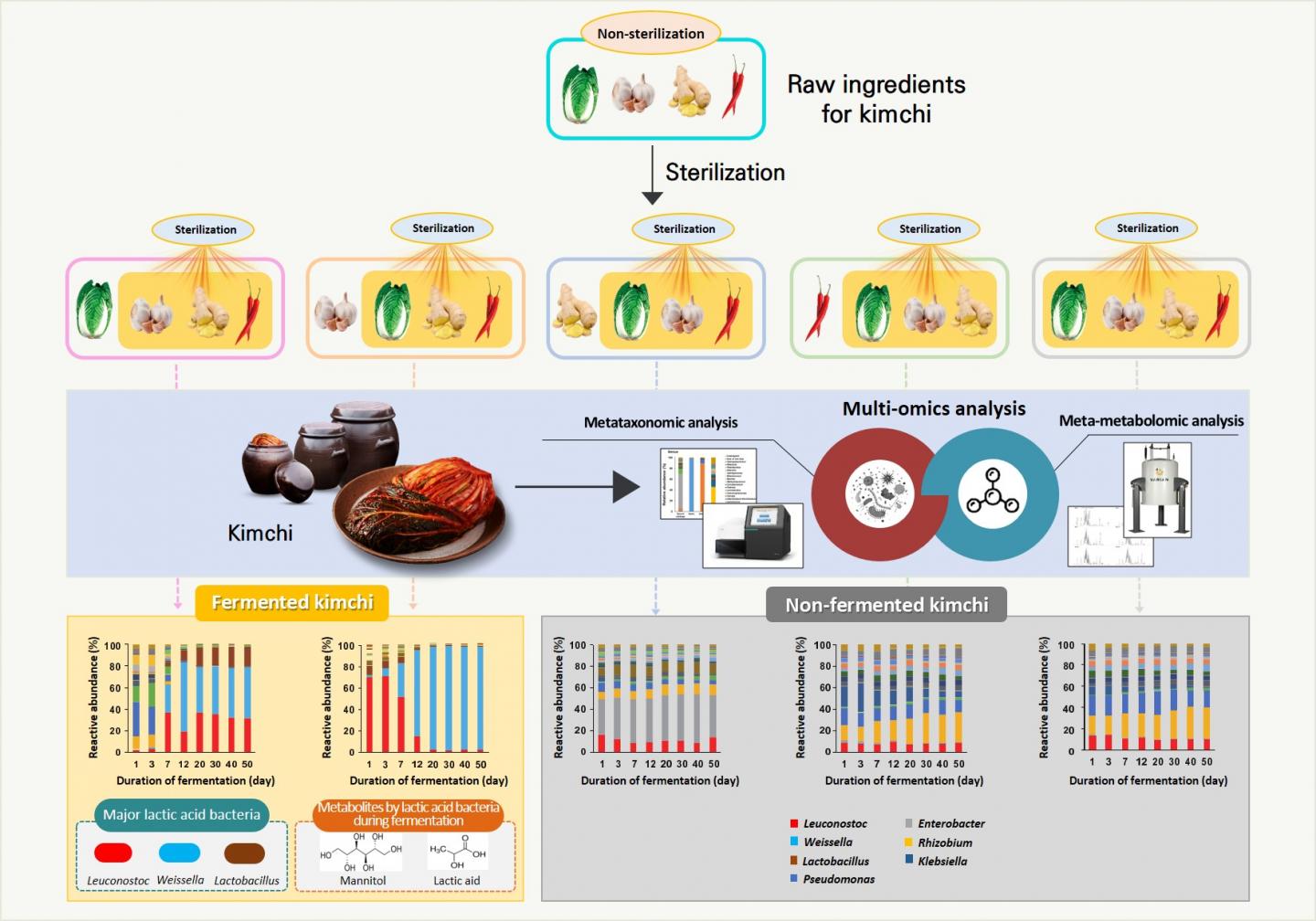
WiKim’s Microbiology and Functionality Research Group led by Dr. Roh, Seong Woon analyzed the origin source of lactic acid bacteria that directly affect the fermentation of kimchi through multi-omics analysis after selectively sterilizing four ingredients for kimchi, namely kimchi cabbage, garlic, ginger, and red pepper.
* Multi-omics is a holistic and integrated analysis of various data sets created at different molecular levels, such as genomes, transcriptomes, proteomes, metabolites, ipidomes, etc. This study accompanied metataxonomic and meta-metabolomic analysis.
According to the analysis, the fermentation was carried out by lactic acid bacteria indigenous to kimchi cabbage and garlic, not by microorganisms derived from ginger and red pepper, among the raw materials for kimchi.
Kimchi fermented by kimchi cabbage-derived microorganisms showed that the strains of in the genus Leuconostoc, Weissella, and Lactobacillus formed dominant communities. On the other hand, in case of kimchi fermented by microorganisms from garlic, the strains of in the Leuconostoc and Weissella, were dominant. These lactic acid bacteria were also confirmed to produce metabolites, such as mannitol and lactic acid.
Furthermore, the research group succeeded in isolating three major fermentative microbes involved in kimchi fermentation, which are specific to the ingredients: Leuconostoc gelidum, Weissella koreensis, and Lactobacillus sakei. It confirmed that kimchi was fermented differently depending on the species of lactic acid bacteria aforementioned by introducing them into sterilized kimchi.
In conclusion, this study identified the origin source of lactic acid bacteria, the determinants of the fermentation of kimchi, and the fermentation characteristics by bacteria derived from each ingredient. Therefore, these results will be utilized as scientific data for the production of standardized kimchi.
WiKim’s Acting Director Dr. Choi, Hak-Jong remarked, “We’ve successfully figured out scientific grounds for the fermentation of kimchi by tracing the origin source of lactic acid bacteria involved in the fermentation. This will surely give us an opportunity to strengthen the status of South Korea as the origin of kimchi.”
###
The results of this study were published in the online edition of Food Chemistry, an international food journal recognized as the upper 5.18% of the food science and technology category.
Media Contact
Na, Minah
[email protected]
Related Journal Article
http://dx.