• HOME
  • NEWS
  • EXPLORE
    • CAREER
      • Companies
      • Jobs
    • EVENTS
    • iGEM
      • News
      • Team
    • PHOTOS
    • VIDEO
    • WIKI
  • BLOG
  • COMMUNITY
    • FACEBOOK
    • INSTAGRAM
    • TWITTER
Monday, August 24, 2026
BIOENGINEER.ORG
No Result
View All Result
  • Login
  • HOME
  • NEWS
  • EXPLORE
    • CAREER
      • Companies
      • Jobs
        • Lecturer
        • PhD Studentship
        • Postdoc
        • Research Assistant
    • EVENTS
    • iGEM
      • News
      • Team
    • PHOTOS
    • VIDEO
    • WIKI
  • BLOG
  • COMMUNITY
    • FACEBOOK
    • INSTAGRAM
    • TWITTER
  • HOME
  • NEWS
  • EXPLORE
    • CAREER
      • Companies
      • Jobs
        • Lecturer
        • PhD Studentship
        • Postdoc
        • Research Assistant
    • EVENTS
    • iGEM
      • News
      • Team
    • PHOTOS
    • VIDEO
    • WIKI
  • BLOG
  • COMMUNITY
    • FACEBOOK
    • INSTAGRAM
    • TWITTER
No Result
View All Result
Bioengineer.org
No Result
View All Result
Home NEWS Science News Chemistry

Flatter graphene, faster electrons

Bioengineer by Bioengineer
April 16, 2020
in Chemistry
Reading Time: 2 mins read
0
IMAGE
Share on FacebookShare on TwitterShare on LinkedinShare on RedditShare on Telegram

IMAGE

Credit: Swiss Nanoscience Institute

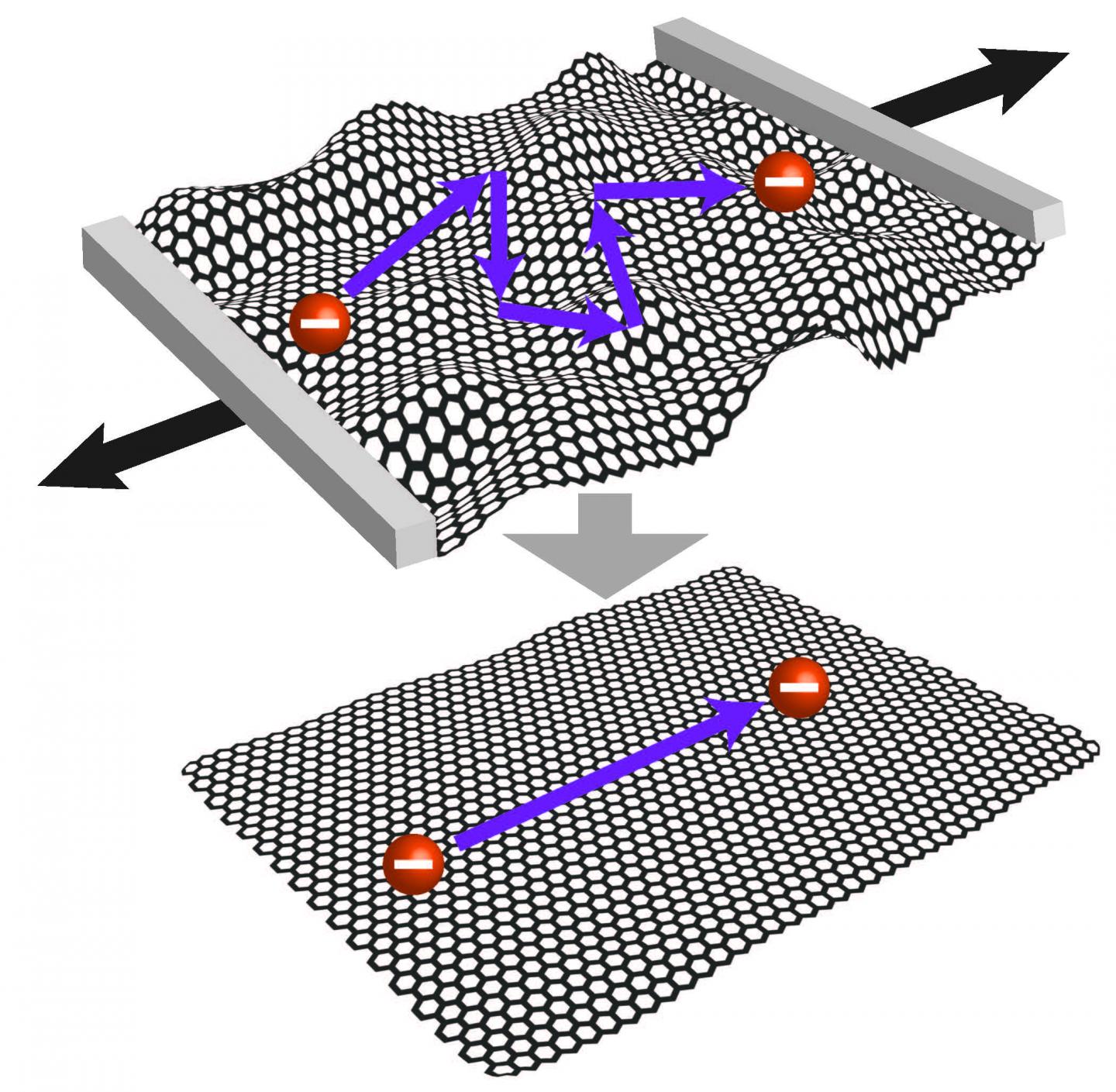
Bumps on a road slow down our pace, so do corrugations in graphene to travelling electrons. By flattening the corrugations out, we help electrons move effectively faster through a graphene sheet.

Limits because of microscopic distortions

The sample quality of graphene has been improved significantly since its discovery. One factor that limited further improvements has not been investigated directly so far, namely corrugations in the graphene sheet, i.e. microscopic distortions that form even when placed on atomically flat surfaces. Such corrugations can scatter the electrons when moving through an electronic device.

The team of professor Christian Schönenberger of the Swiss Nanoscience Institute and Department of Physics at the University of Basel has developed a technique to pull the graphene sheet on two opposite sides and thereby flattening and smoothing it. “It is similar to pulling on a piece of crumpled paper which irons out wrinkles and folds», says Dr. Lujun Wang, first author of the study. “After this process, the electrons travel effectively faster through the graphene sheet, their “mobility” increases, demonstrating an improved sample quality”, his supervisor Dr. Andreas Baumgartner adds.

These findings not only help us to further understand the electron transport in graphene but also provide instructions for studying other two-dimensional materials.

###

Original article

Mobility Enhancement in Graphene by in situ Reduction of Random Strain Fluctuations
Lujun Wang, Péter Makk, Simon Zihlmann, Andreas Baumgartner, David I. Indolese, Kenji Watanabe, Takashi Taniguchi, and Christian Schönenberger
DOI: 10.1103/PhysRevLett.124.157701, https://journals.aps.org/prl/abstract/10.1103/PhysRevLett.124.157701

Media Contact
Dr. Andreas Baumgartner
[email protected]

Related Journal Article

http://dx.doi.org/10.1103/PhysRevLett.124.157701

Tags: Chemistry/Physics/Materials SciencesMaterialsNanotechnology/Micromachines
Share12Tweet8Share2ShareShareShare2

Related Posts

Ultrathin Suspended Oxide Enables Programmable Mid-Infrared Vision

Ultrathin Suspended Oxide Enables Programmable Mid-Infrared Vision

August 24, 2026
Scientists Transform Plastic Bottles Into Cookies

Scientists Transform Plastic Bottles Into Cookies

August 24, 2026

KAIST discovers pathway to faster-charging, longer-lasting electric vehicle batteries

August 24, 2026

Scientists uncover design rules for high-performance thermoelectric materials

August 22, 2026
Please login to join discussion

POPULAR NEWS

  • No Sensorimotor Toxicity Observed with Clinical SMN Cassette in scAAV9

    29 shares
    Share 12 Tweet 7
  • Soil Microbes Commonly Depend on Metabolite Cross-Feeding

    29 shares
    Share 12 Tweet 7
  • Pilot study links prenatal workplace exposure to quaternary ammonium compounds with birthweight

    29 shares
    Share 12 Tweet 7
  • Seven-Day Korean Study Reveals How Biomonitoring Tracks Phthalate and Alternative Plasticizer Exposure

    29 shares
    Share 12 Tweet 7

About

We bring you the latest biotechnology news from best research centers and universities around the world. Check our website.

Follow us

Recent News

No Sensorimotor Toxicity Observed with Clinical SMN Cassette in scAAV9

Soil Microbes Commonly Depend on Metabolite Cross-Feeding

Pilot study links prenatal workplace exposure to quaternary ammonium compounds with birthweight

Subscribe to Blog via Email

Enter your email address to subscribe to this blog and receive notifications of new posts by email.

Join 85 other subscribers
  • Contact Us

Bioengineer.org © Copyright 2023 All Rights Reserved.

Welcome Back!

Login to your account below

Forgotten Password?

Retrieve your password

Please enter your username or email address to reset your password.

Log In
No Result
View All Result
  • Homepages
    • Home Page 1
    • Home Page 2
  • News
  • National
  • Business
  • Health
  • Lifestyle
  • Science

Bioengineer.org © Copyright 2023 All Rights Reserved.