Climate change snapshot in Fijian highlands
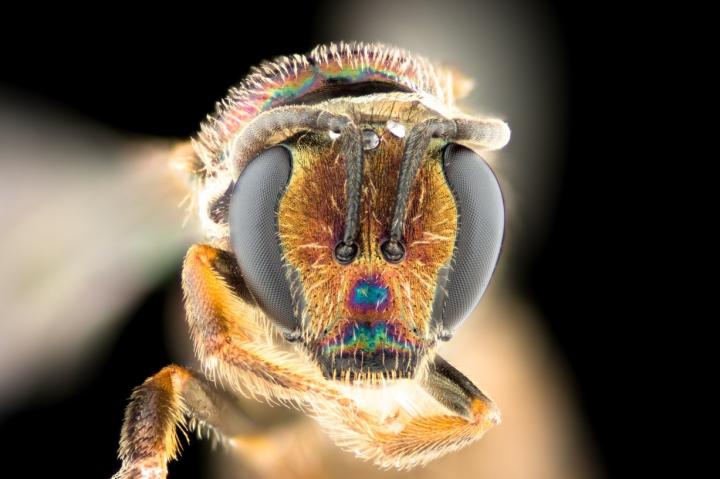
Credit: Courtesy James Dorey
Evolutionary biology aims to explain how new species arise and evolve to occupy myriad niches – but it is not a singular or simplistic story. Rare bees found in high mountain areas of Fiji provide evidence that they have evolved into many species, despite the fact they can’t readily adapt to different habitats.
These bees – discovered by a team of researchers from Flinders University, South Australian Museum, UniSA and University of Adelaide – serve as a major warning about the impact of ongoing human-induced climate change and loss of biodiversity for different species.
The Fijian bees are locked into very specific habitats, and when these have contracted and split due to past climate change, the bee populations also became fragmented, with some isolated populations eventually turning into new species.
“The adaptation to new habitats and niches is often assumed to drive the diversification of species, but we found that Fijian bee diversity arose from an inability to adapt,” says Flinders University’s James Dorey, lead author on a new paper that explains this research.
The paper – “Radiation of tropical island bees and the role of phylogenetic niche conservatism as an important driver of biodiversity,” by James Dorey, Scott Groom, Elisha Freedman, Cale Matthews, Olivia Davies, Ella Deans, Celina Rebola, Mark Stevens, Michael Lee and Michael Schwarz – has been published by Proceedings B journal.
“Our genetic data show how a single bee-colonisation in Fiji gave rise to over 20 endemic bee species largely constrained to cooler, high elevations,” says Mr Dorey. “At least for Fijian bees, a relative inability to adapt has created a species-making machine.”
New Fijian bee species evolved when a single ancestral species colonised and spread over lowland areas during cool periods, but were later restricted to different mountaintops as the climate warms and the lowlands become too hot for comfort. The isolated populations later become new species. Each subsequent climate cycle has the potential to generate new species.
“Perhaps, if Darwin had studied Fijian bees instead of Galapagos finches, he might have come to rather different conclusions about the origin of species”, adds Flinders Univeristy’s Associate Professor Mike Schwarz, who was part of the research group.
One of the major arguments at the core of evolutionary theory suggests that species arise from adaptive radiation into new niche spaces, with gene flow between the new and ancestral populations subsequently inhibited, eventually leading to speciation. As an alternative, phylogenetic niche conservatism points to the inability of a lineage to adapt to new or changing environments, in turn, promoting speciation when populations become isolated as their preferred habitats contract.
This is what the researchers found in the high mountain areas of Fiji. Of the 22 Fijian bee species they identified, most have very narrow elevational ranges (constrained by temperature) – and 14 species were only recovered from single mountain peaks.
“This demonstrates how slowly bees have adapted to new climates, since the colonisation of Fiji,” says Mr Dorey. ‘We further highlight that such phylogenetic signals could indicate climate-related extinction risks. Indeed, one Fijian bee species (Homalictus achrostus) appears to be at serious risk of extinction, with sightings becoming much rarer since its initial discovery in the 1970s. This raises concerns for the 13 other species that we have, so far, only found on single mountain tops. They have nowhere to go if climate continues to warm and represent 14 very good reasons to curb global greenhouse gas emissions.”
###
Project and personal funding for this research project was provided by the Australian and Pacific Science Foundation, New Colombo Plan program, Flinders University, The South Australian Museum and Playford Trust Scholarships to James Dorey and Olivia Davies.
Media Contact
James Dorey
[email protected]
Related Journal Article
http://dx.