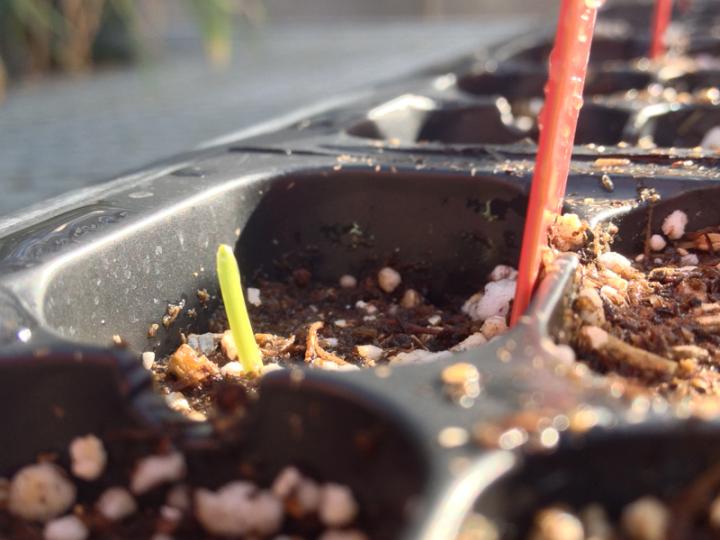
Credit: Lynn Veenstra
Some new crop varieties are bred to be more nutritious. Others are more resilient, bred to tolerate harsher environmental conditions.
In a new study, researchers report a variety of wheat that combines enhanced nutrition with increased resilience. The researchers also tested a breeding method that could reduce costs and save time compared to traditional methods.
The newly developed wheat variety contains higher levels of a naturally occurring carbohydrate, called fructans.
“Wheat with increased fructan levels can be more climate-resilient in certain situations,” says Lynn Veenstra, a researcher at Cornell University. “These situations include high salinity or cold temperatures”.
Fructans are long chains of the sugar fructose. Unlike the fructose present in foods, such as high-fructose corn syrup, fructans cannot be digested by humans. This makes fructans a good source of soluble fiber.
Previous research has shown that consuming foods with higher fructan levels could also promote healthy gut bacteria.
In the US, a large portion of daily fructan intake comes from wheat products, such as bread. That makes developing high-fructan wheat important.
There’s yet another advantage to using high-fructan wheat. “We wouldn’t have to supplement wheat products with fructans or fiber from other sources,” says Veenstra. “This wheat would already contain higher levels of fructans.”
But breeding high-fructan wheat can be time-consuming and expensive. “The development of nutritionally improved wheat varieties often requires extensive resources,” says Veenstra.
Typically, a process called phenotyping takes the most time. Phenotyping is the measurement of crop characteristics – like fructan levels or yield.
Phenotyping allows plant breeders to compare new and existing varieties of crops. For example, they can test if newer varieties have higher or lower fructan levels than existing crops. At the same time, they need to make sure other crop features – like yield or disease resistance – haven’t been reduced.
A relatively new breeding method can expedite the development of new crop varieties. Veenstra and colleagues tested variations of this method, called genomic selection.
Genomic selection uses a relatively small ‘training’ set of individual plants. Researchers combine phenotyping and genetic data from this training set of plants. Then they use these data to train a statistical model.
Once trained, the statistical model can predict plant characteristics – like fructan levels – based solely on genetics.
“This allows crop breeding without needing to collect data on observed characteristics,” says Veenstra.
Genomic selection saves time and resources in two ways. First, the training set of plants is relatively small. That allows phenotyping to be concluded quickly. Second, genetic testing can often be much quicker than measuring crop characteristics.
Ultimately, genomic selection can allow breeders to save both cost and time during the breeding process.
There are some caveats to using genomic selection, though. Inbreeding can happen, for instance, which can reduce crop diversity. Reduced diversity can make crops susceptible to diseases.
So Veenstra and her colleagues tested two different modes of genomic selection. They found that one method led to wheat with higher fructans while maintaining genomic diversity.
“I think this is the most important finding of this study,” says Veenstra. “Genomic selection can be used for nutritional breeding.”
Researchers still need to know more about the fructans in the new wheat variety. “We also want to determine how stable these fructans are during food processing,” says Veenstra.
For example, yeast degrades different fructans at different rates. That would impact how much fructan ends up in a loaf of bread.
“I believe both wheat growers and consumers stand to benefit from high-fructan wheat,” says Veenstra. “For wheat growers, high-fructan varieties have the potential to withstand climatic stress. For consumers, high-fructan wheat products may have positive impacts on gut-health.”
###
This research was recently published in Crop Science. The work was funded by USDA-NIFA-AFRI grants, award numbers 2009-65300-05661, 2011-68002-30029, and 2005-05130, and by Hatch project 149-447.
Media Contact
Rachel Leege
[email protected]
Related Journal Article
http://dx.