• HOME
  • NEWS
  • EXPLORE
    • CAREER
      • Companies
      • Jobs
    • EVENTS
    • iGEM
      • News
      • Team
    • PHOTOS
    • VIDEO
    • WIKI
  • BLOG
  • COMMUNITY
    • FACEBOOK
    • INSTAGRAM
    • TWITTER
Saturday, May 16, 2026
BIOENGINEER.ORG
No Result
View All Result
  • Login
  • HOME
  • NEWS
  • EXPLORE
    • CAREER
      • Companies
      • Jobs
        • Lecturer
        • PhD Studentship
        • Postdoc
        • Research Assistant
    • EVENTS
    • iGEM
      • News
      • Team
    • PHOTOS
    • VIDEO
    • WIKI
  • BLOG
  • COMMUNITY
    • FACEBOOK
    • INSTAGRAM
    • TWITTER
  • HOME
  • NEWS
  • EXPLORE
    • CAREER
      • Companies
      • Jobs
        • Lecturer
        • PhD Studentship
        • Postdoc
        • Research Assistant
    • EVENTS
    • iGEM
      • News
      • Team
    • PHOTOS
    • VIDEO
    • WIKI
  • BLOG
  • COMMUNITY
    • FACEBOOK
    • INSTAGRAM
    • TWITTER
No Result
View All Result
Bioengineer.org
No Result
View All Result
Home NEWS Science News Chemistry

Reducing sulfur dioxide emissions alone cannot substantially decrease air pollution

Bioengineer by Bioengineer
April 13, 2020
in Chemistry
Reading Time: 2 mins read
0
IMAGE
Share on FacebookShare on TwitterShare on LinkedinShare on RedditShare on Telegram

IMAGE

Credit: Qianqian Zhang

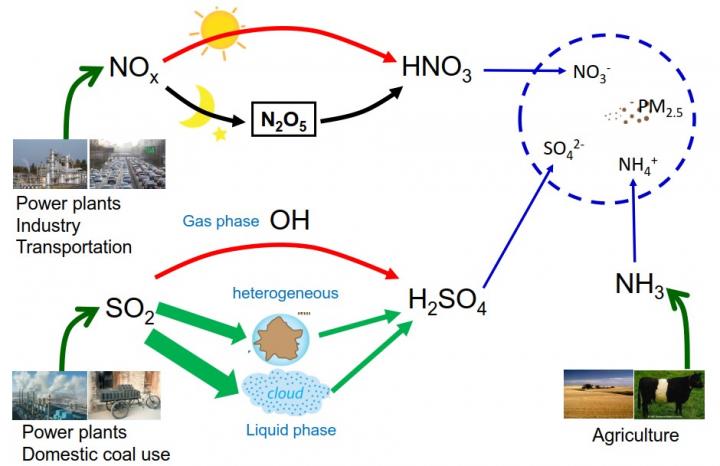
High loadings of fine particulate matter (PM2.5) during haze are mostly produced from the chemical reactions of the reactive gas precursors, including sulfur dioxide (SO2), nitrogen oxides (NOx), ammonia (NH3), and volatile organic compounds. In an ideal world, air pollution would be cured by wiping clean any one of these four PM2.5 precursors. However, in the real world, we have to go step by step, considering the technological conditions and the economic costs in the emission control strategies. Besides, these gases are subject to a certain thermodynamic equilibrium in the atmosphere. Theoretically, NH3 prefers to combine with SO2 (sulfuric acid) to form ammonium sulfate, which is stable in the atmosphere. Excessive NH3 will react with nitrogen dioxide (nitric acid) to form ammonium nitrate, which is unstable, and the formation of which is influenced by the relative abundance of NH3 and nitrogen dioxide. Consequently, a decrease in SO2 emissions leaves more NH3 to form ammonium nitrate, and it may also perturb the balance between NH3 and nitrogen dioxide.

Due to the delivery of the Air Pollution Control Action Plan, SO2 emissions have declined dramatically since 2013. It also offers us an opportunity to examine whether a reduction in SO2 will perturb the balance between NH3 and nitrogen dioxide in forming ammonium nitrate, and to decide how to make emission control strategies in the future.

Professor Xingying ZHANG from the National Satellite Meteorological Center and his coauthors have addressed this issue. They evaluated and compared the behavior of PM2.5 with respect to NOx and NH3 emission changes in high (2013) and low (2018) SO2 emission cases.

Prof. Zhang’s group has found that, from 2013 to 2018, due to the changes in precursor emissions, the simulated annual mean PM2.5 concentration decreased by nearly 20%, more than half of which was driven by reduced SO2 emissions. “To evaluate the influence of a reduction in SO2 emissions on the sensitivity of PM2.5 to NOx and NH3 emissions, we conducted model sensitivity studies by separately perturbing NOx and NH3 emissions by ?25%. Then, we calculated the relative reduction of PM2.5 concentration caused by a 1% decrease in NOx and NH3 emissions,” explains Professor Zhang.

According to the study of Prof. Zhang, it can be concluded that, due to the reduced emissions of SO2, and considering the high level of NH3 emissions in China, nitrogen dioxide emissions control is more effective in reducing the surface PM2.5 concentration in China. This paper has been published in Atmospheric and Oceanic Science Letters.

###

Media Contact
Ms. Zheng Lin
[email protected]

Original Source

http://159.226.119.58/aosl/EN/news/news38.shtml

Related Journal Article

http://dx.doi.org/10.1080/16742834.2020.1738009

Tags: Atmospheric ScienceChemistry/Physics/Materials SciencesEarth SciencePollution/Remediation
Share12Tweet8Share2ShareShareShare2

Related Posts

New Drexel Study Reveals Key to Keeping Students on Track in Physics Learning — Chemistry

New Drexel Study Reveals Key to Keeping Students on Track in Physics Learning

May 15, 2026
Reversible Glue Technology Powers Up with Electric Activation — Chemistry

Reversible Glue Technology Powers Up with Electric Activation

May 15, 2026

Sweet as Honey: Unveiling a New Heat Transport Regime in Ultrathin Semiconductors

May 15, 2026

High-Precision Boltzmann Luminescent Nanothermometry Achieved Through Predictive Rules

May 15, 2026
Please login to join discussion

POPULAR NEWS

  • Research Indicates Potential Connection Between Prenatal Medication Exposure and Elevated Autism Risk

    843 shares
    Share 337 Tweet 211
  • New Study Reveals Plants Can Detect the Sound of Rain

    730 shares
    Share 291 Tweet 182
  • Salmonella Haem Blocks Macrophages, Boosts Infection

    62 shares
    Share 25 Tweet 16
  • Breastmilk Balances E. coli and Beneficial Bacteria in Infant Gut Microbiomes

    58 shares
    Share 23 Tweet 15

About

We bring you the latest biotechnology news from best research centers and universities around the world. Check our website.

Follow us

Recent News

New Actinomycin Derivatives Target Malaria More Selectively

Mobile App Enhances Exercise for Older Adults’ Cognition

Botulinum Toxin Reduces Urinary Retention Post-Hemorrhoidopexy

Subscribe to Blog via Email

Enter your email address to subscribe to this blog and receive notifications of new posts by email.

Join 82 other subscribers
  • Contact Us

Bioengineer.org © Copyright 2023 All Rights Reserved.

Welcome Back!

Login to your account below

Forgotten Password?

Retrieve your password

Please enter your username or email address to reset your password.

Log In
No Result
View All Result
  • Homepages
    • Home Page 1
    • Home Page 2
  • News
  • National
  • Business
  • Health
  • Lifestyle
  • Science

Bioengineer.org © Copyright 2023 All Rights Reserved.