• HOME
  • NEWS
  • EXPLORE
    • CAREER
      • Companies
      • Jobs
    • EVENTS
    • iGEM
      • News
      • Team
    • PHOTOS
    • VIDEO
    • WIKI
  • BLOG
  • COMMUNITY
    • FACEBOOK
    • INSTAGRAM
    • TWITTER
Monday, October 5, 2026
BIOENGINEER.ORG
No Result
View All Result
  • Login
  • HOME
  • NEWS
  • EXPLORE
    • CAREER
      • Companies
      • Jobs
        • Lecturer
        • PhD Studentship
        • Postdoc
        • Research Assistant
    • EVENTS
    • iGEM
      • News
      • Team
    • PHOTOS
    • VIDEO
    • WIKI
  • BLOG
  • COMMUNITY
    • FACEBOOK
    • INSTAGRAM
    • TWITTER
  • HOME
  • NEWS
  • EXPLORE
    • CAREER
      • Companies
      • Jobs
        • Lecturer
        • PhD Studentship
        • Postdoc
        • Research Assistant
    • EVENTS
    • iGEM
      • News
      • Team
    • PHOTOS
    • VIDEO
    • WIKI
  • BLOG
  • COMMUNITY
    • FACEBOOK
    • INSTAGRAM
    • TWITTER
No Result
View All Result
Bioengineer.org
No Result
View All Result
Home NEWS Science News

With TxDOT grant, UTA team to test feasibility of recycled plastics in road construction

Bioengineer by Bioengineer
April 10, 2020
in Science News
Reading Time: 3 mins read
0
IMAGE
Share on FacebookShare on TwitterShare on LinkedinShare on RedditShare on Telegram

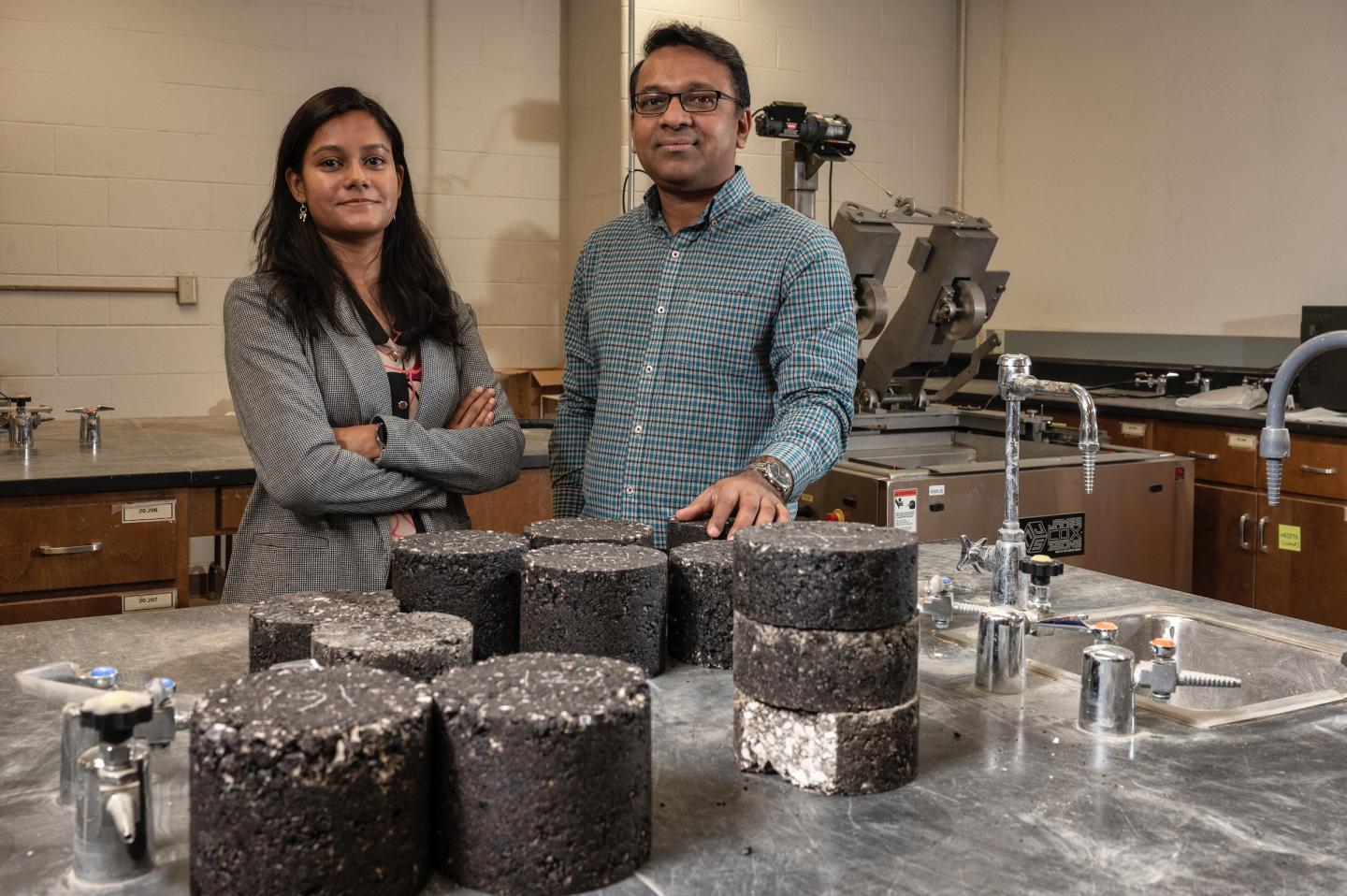
Building roads from plastic recyclables
IMAGE

Credit: UT Arlington

When China recently stopped importing much of the United States’ recycling materials, it created a glut of recyclables, including plastics, with no place to go.

Enter Sahadat Hossain and Warda Ashraf.

The University of Texas at Arlington researchers are combining their two areas of expertise–recycling and asphalt/concrete, respectively–to lead a two-year, $342,588 feasibility study on building plastic roads, funded by the Texas Department of Transportation (TxDOT).

The roads wouldn’t be made entirely of recycled plastic, but instead mixed with asphalt for an ideal consistency to keep the road safe for motorists and help it last longer, cost less and avoid cracking.
“When China was taking all of the recyclables, it was an $11 billion per year industry for the United States,” said Hossain, a professor in the Department of Civil Engineering and director of UTA’s Solid Waste Institute for Sustainability. “Materials that were recycled before are now going to landfills, where they are going to occupy a large volume of landfill space for a long time.

“Now that the international market for U.S. recycling materials no longer exists, we need to find and create local uses and markets for recycled plastics. TxDOT is focusing on increasing use of sustainable construction material, and this feasibility study of plastic roads is the agency’s latest effort.”

Some countries already have tried building plastic roads, with inconsistent results. Hossain said the right mix of plastic is needed in asphalt to create friction between a vehicle’s tires and the road, ensuring safe driving.

Ashraf, an assistant professor of civil engineering, has expertise in construction materials.

“We want to make the road more sustainable with these recycled plastics mixed in,” Ashraf said. “The project could lead to more durable, sustainable and cheaper roads while also maintaining safety for vehicles. We also need to evaluate the effects of using recycled plastics on the performance of roads.”

The research team certainly will have a lot of recycled plastics available for its testing. The United States is creating more waste than ever. In 2015, the most recent year for which national data was available, the U.S. generated more than 262 million tons of waste, up 4.5% from 2010 and 60% from 1985, according to the U.S. Environmental Protection Agency. That amounts to nearly five pounds per person per day.

A Bloomberg survey showed that each person in the United States generates the equivalent of 3,700 bottles in plastic waste annually.

“The plastic road project demonstrates TxDOT’s commitment to incorporate recycling and sustainability in pavement repair, construction and management,” said Boon Thian, TxDOT Dallas District pavement engineer.

Ali Abolmaali, chair and professor of the Department of Civil Engineering, said the project could have long-term implications for roads across the United States.

“Finding the proper mix of plastics used in roadways could be life-changing for the infrastructure most of America takes for granted,” Abolmaali said. “UTA already has a great working relationship with TxDOT. This project will only serve to strengthen that relationship.”

###

Media Contact
Herb Booth
[email protected]

Original Source

https://www.uta.edu/news/news-releases/2020/04/10/plastic-roads

Tags: Civil EngineeringTechnology/Engineering/Computer Science
Share13Tweet8Share2ShareShareShare2

Related Posts

Early Fever May Not Seal Fate in Status Epilepticus, Landmark French Registry Finds

Early Fever May Not Seal Fate in Status Epilepticus, Landmark French Registry Finds

October 5, 2026
Cheap Gel Test Reveals Hidden Coral Species Without Sequencing

Cheap Gel Test Reveals Hidden Coral Species Without Sequencing

October 5, 2026

Faster MRI Scans Could Slash Anesthetic Doses in Children, Study Finds

October 5, 2026

Blood Tests of Ageing Face Off: Brain Scans and Epigenetic Clocks Beat Organ Clocks at Predicting Death

October 5, 2026
Please login to join discussion

POPULAR NEWS

  • Alloys That Shrink Their Own Grains: New PIX Mechanism Refines Metals With Heat Alone

    Alloys That Shrink Their Own Grains: New PIX Mechanism Refines Metals With Heat Alone

    29 shares
    Share 12 Tweet 7
  • Endurance Exercise Reshapes the Liver in Males and Females Through Distinct Molecular Routes

    29 shares
    Share 12 Tweet 7
  • Single Transcription Factor PU.1 Rapidly Converts Fibroblasts into Macrophage-Lineage Cells

    29 shares
    Share 12 Tweet 7
  • New Scale Measures How Ready Nurse Educators Really Are for the AI Era

    29 shares
    Share 12 Tweet 7

About

We bring you the latest biotechnology news from best research centers and universities around the world. Check our website.

Follow us

Recent News

Alloys That Shrink Their Own Grains: New PIX Mechanism Refines Metals With Heat Alone

Endurance Exercise Reshapes the Liver in Males and Females Through Distinct Molecular Routes

Single Transcription Factor PU.1 Rapidly Converts Fibroblasts into Macrophage-Lineage Cells

Subscribe to Blog via Email

Success! An email was just sent to confirm your subscription. Please find the email now and click 'Confirm' to start subscribing.

Join 85 other subscribers
  • Contact Us

Bioengineer.org © Copyright 2023 All Rights Reserved.

Welcome Back!

Login to your account below

Forgotten Password?

Retrieve your password

Please enter your username or email address to reset your password.

Log In
No Result
View All Result
  • Homepages
    • Home Page 1
    • Home Page 2
  • News
  • National
  • Business
  • Health
  • Lifestyle
  • Science

Bioengineer.org © Copyright 2023 All Rights Reserved.