Strengthening steel using bond-free carbon fiber reinforced plastic laminates
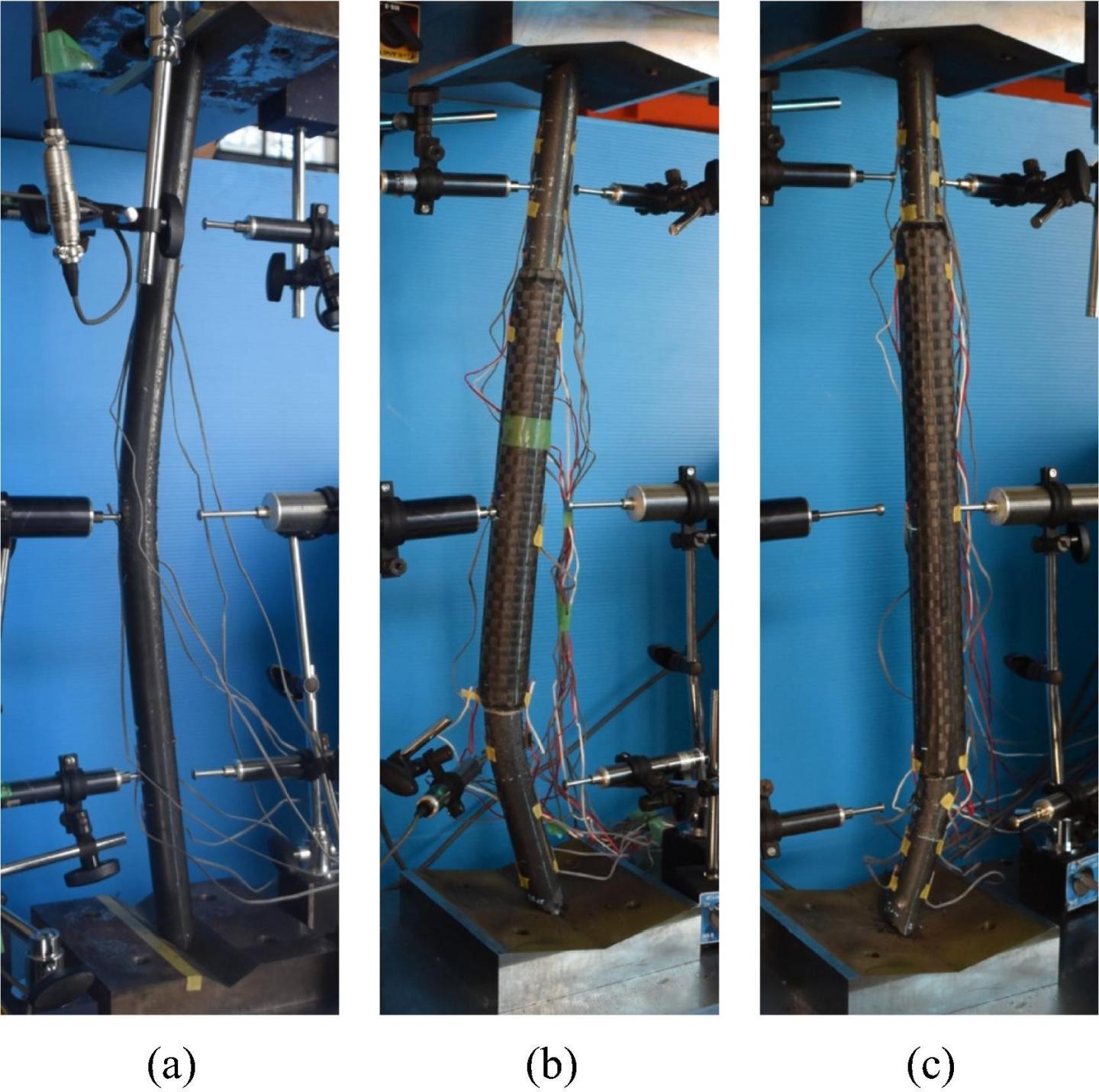
Credit: COPYRIGHT (C) TOYOHASHI UNIVERSITY OF TECHNOLOGY. ALL RIGHTS RESERVED.
Researchers of the Structural Engineering Laboratory, Department of Architecture and Civil Engineering, Toyohashi University of Technology have developed a new concept for strengthening steel in critical building structures using bond-free carbon fiber reinforced plastic (CFRP) laminates to enhance the buckling performance of structural steel elements. This method does not require steel surface treatment prior to CFRP application because the CFRP is not bonded onto the surface, which contributes to structural strength through its flexural rigidity. The research findings were published in Construction and Building Materials in early 2020.
Following its success regarding reinforcement of concrete in the civil engineering field, CFRP has now been developed as a means for strengthening steel members instead of conventional steel plates being used. CFRP is preferred because it offers several advantages such as light weight, high strength-to-weight ratio, and excellent fatigue and corrosion resistances. To date, however, research and development on strengthening steel using CFRP has focused primarily on bonding techniques involving CFRP being attached to steel surfaces using an adhesive. Bonded strengthening presents disadvantages as complex and time-consuming surface treatments are required prior to CFRP installation. Moreover, the bonding strength performance between steel and CFRP, which is the key aspect of this strengthening technique, can also decrease significantly owing to environmental exposure throughout the service life. Replacing this approach with another new bonded-CFRP technique is not particularly an appropriate solution because it is unlikely to be cost-effective.
The research team developed its method for strengthening steel using CFRP, for which they did not bond it to the steel surface. This method has been shown to delay buckling and increase the compression capacity of steel bars, where the capacity gain is affected by the number of carbon fiber layers used.
“As an alternative to the steel strengthening method using CFRP which is bonded to the steel surface, we developed this unbonded-CFRP method,” explained the primary author, Fengky Satria Yoresta. “The major advantages of this method are that it is easier and less time-consuming to implement, especially when it is applied to the existing elements of building structures. No more troublesome steel surface treatments are needed, such as sand blasting, grit blasting, or hand grinding, and this leads to significant cost savings,” he said.
Associate Professor Yukihiro Matsumoto, the leader of the research team, added, “Nearly all previous studies used adhesively-bonded joints to strengthen steel members with CFRP. This method is quite complex because appropriate steel surface treatments are required before the application of the CFRP to obtain an acceptable bond between the CFRP and the steel surface. The surface treatment conditions also affect bonding strengths.”
“Moreover, we cannot perfectly estimate the effects of environmental exposure during the service life on the bonding performance between the CFRP and the steel. As such, we sought to improve on conventional methods by developing our own bond-free strengthening method.”
“The unbonded strengthening method is useful, easy to apply, and manageable,” he said. “However, our method does not transfer stress smoothly, so an appropriate mechanical model needed to be established. Consequently, we performed mechanical simulations and experiments to demonstrate this,” he added.
The findings of their work make the research team members believe that the bond-free CFRP method can be applied not only in civil engineering, but also to other fields such as those in the aerospace, automotive, and marine industries. This promising new method is expected to be adopted to rapidly produce innovative, high-quality products.
###
Reference:
Fengky Satria Yoresta, Ryotaro Maruta, Genki Mieda, Yukihiro Matsumoto (2020). Unbonded CFRP strengthening method for buckling control of steel members. Construction and Building Materials, April 2020, 10.1016/j.conbuildmat.2020.118050.
Acknowledgement:
We would like to thank Editage (http://www.
Media Contact
Yuko Ito
[email protected]
Related Journal Article
http://dx.