Credit: University of Exeter
A pioneering study has shed new light on how a group of novel organelle-based disorders affect cells.
The study led by Professor Michael Schrader from the University of Exeter, and featuring an international, multi-disciplinary team of scientists, has explored on peroxisome alterations and their contribution to the disease.
Organelles are the functional units of a cell. They perform specialised functions, and defects in their enzymes performing those functions can result in metabolic disorders.
However, organelles are not just cellular factories in a production line, but are also highly dynamic. They are able to move around in the cell to interact and cooperate with other organelles and multiply by increasing in size and then dividing to adapt their number and functions to cellular needs.
Recently, scientists have identified a new group of disorders, characterised by defects in the membrane dynamics and division of organelles rather than by loss of metabolic functions.
Those disorders are caused by mutations in genes encoding for the organelle division machinery, such as Mitochondrial fission factor (MFF) – a key component of the division machinery of two organelles, mitochondria and peroxisomes.
MFF functions as an adaptor protein to recruit a mechanochemical enzyme, Dynamin-related protein 1 (DRP1), to mitochondria and peroxisomes. This enzyme can constrict and divide membranes and is essential for membrane fission and organelle multiplication.
Defects in either MFF or DRP1 block the division of mitochondria and peroxisomes and result in highly elongated organelles unable to divide. Patients with MFF deficiency present with developmental and neurological abnormalities.
The majority of studies into MFF-deficiency have focused on mitochondrial dysfunction, but the contribution of peroxisomal alterations to the pathophysiology is largely unknown.
An international, multi-disciplinary team of scientists, led by Professor Michael Schrader from the University of Exeter, has now shed light on peroxisome alterations and their contribution to the disease.
Peroxisomes fulfil important protective functions in the cell and are vital for health; they contribute to cellular lipid metabolism and redox balance, which links them to the control of energy regulation, cellular ageing and age-related disorders. They also cooperate with mitochondria in the combat of viruses and anti-viral defence. Loss of peroxisome function leads to severe developmental and neurological defects such as those seen in MFF-deficiency.
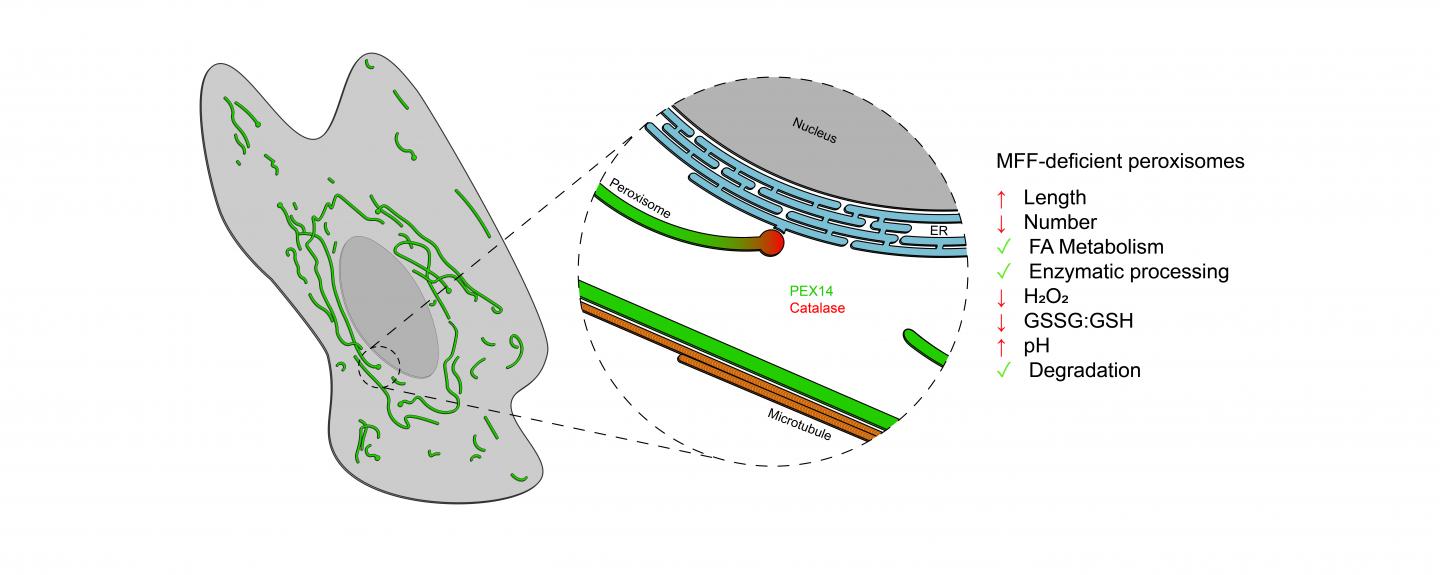
“In this study, we show that MFF-deficiency impacts on the maturation of peroxisomes. Loss of MFF function results in an altered distribution of peroxisomal proteins and causes the accumulation of extremely long pre-peroxisomal membrane structures inside the cell, which have reduced import-competency for peroxisomal enzymes,” said Professor Michael Schrader.
“We show that peroxisomes in MFF-deficient cells display alterations in peroxisomal redox state and intra-peroxisomal pH.
“Previous studies have shown that the peroxisomes in MFF-deficiency are largely functional, leading to the general assumption that defects in peroxisomal dynamics and division results only in elongated peroxisomes, which are otherwise unaltered. We have now revealed in MFF-deficient cells that this is not the case.
“Interestingly, we observed that the highly elongated peroxisomes in MFF-deficient cells are not fully static; their dynamics can be modulated, for example through the induction of organelle degradation.
“These experiments have provided us with new insights into the pathophysiology of MFF-deficiency and related disorders with impaired peroxisome plasticity.
“In peroxisomal disorders, we often see altered numbers, different shapes or even different distributions of peroxisomes in patient cells. We also developed a mathematical modelling approach to help understand this.
“Understanding why this happens and how to modulate peroxisome numbers or distribution can provide new possibilities to improve cell performance in those patients.”
“This might also be relevant to age-related conditions like dementia, deafness and blindness, as peroxisomal dynamics are known to have important protective functions within sensory cells.”
The international research team combined human cell biology (Professor Michael Schrader), clinical diagnostics (Dr Sacha Ferdinandusse, Amsterdam University Medical Centre, NL; Professor Peter Freisinger, Department of Pediatrics, Reutlingen, GER), redox biology (Professor Marc Fransen, University of Leuven, BE), neurobiology (Dr Markus Islinger, University of Heidelberg, GER) and mathematic modelling (Dr David Richards, Centre for Biomedical Modelling and Analysis, LSI, Exeter, UK) to shed further light into the physical processes disturbed in MFF-deficient cells.
People with severe peroxisomal disorders, also known as Zellweger Spectrum Disorders, often die as children or young adults, and the team cooperates with a charity called Zellweger UK to raise awareness and to support families and sufferers.
###
The research was supported by the Biotechnology and Biological Sciences Research Council, and the EU Marie Sklodowska-Curie Innovative Training Network PerICo.
The paper, published in the Journal Biochimica et Biophysica Acta – Molecular Cell Research, is entitled: “Mitochondrial fission factor (MFF) is a critical regulator of peroxisome maturation”, authored by J.B. Passmore, R.E. Carmichael, T.A. Schrader, L. F. Godinho, S. Ferdinandusse, C. Lismont, Y. Wang, C. Hacker, M. Islinger, M. Fransen, D.M. Richards, P. Freisinger, and M. Schrader. See also bio-archive.
Media Contact
Duncan Sandes
[email protected]
Related Journal Article
http://dx.