• HOME
  • NEWS
  • EXPLORE
    • CAREER
      • Companies
      • Jobs
    • EVENTS
    • iGEM
      • News
      • Team
    • PHOTOS
    • VIDEO
    • WIKI
  • BLOG
  • COMMUNITY
    • FACEBOOK
    • INSTAGRAM
    • TWITTER
Saturday, February 7, 2026
BIOENGINEER.ORG
No Result
View All Result
  • Login
  • HOME
  • NEWS
  • EXPLORE
    • CAREER
      • Companies
      • Jobs
        • Lecturer
        • PhD Studentship
        • Postdoc
        • Research Assistant
    • EVENTS
    • iGEM
      • News
      • Team
    • PHOTOS
    • VIDEO
    • WIKI
  • BLOG
  • COMMUNITY
    • FACEBOOK
    • INSTAGRAM
    • TWITTER
  • HOME
  • NEWS
  • EXPLORE
    • CAREER
      • Companies
      • Jobs
        • Lecturer
        • PhD Studentship
        • Postdoc
        • Research Assistant
    • EVENTS
    • iGEM
      • News
      • Team
    • PHOTOS
    • VIDEO
    • WIKI
  • BLOG
  • COMMUNITY
    • FACEBOOK
    • INSTAGRAM
    • TWITTER
No Result
View All Result
Bioengineer.org
No Result
View All Result
Home NEWS Science News Chemistry

Harnessing the power of electricity-producing bacteria for programmable ‘biohybrids’

Bioengineer by Bioengineer
April 8, 2020
in Chemistry
Reading Time: 2 mins read
0
IMAGE
Share on FacebookShare on TwitterShare on LinkedinShare on RedditShare on Telegram

IMAGE

Credit: ACS Applied Materials & Interfaces 2020, DOI: 10.1021/acsami.9b22116

Someday, microbial cyborgs — bacteria combined with electronic devices — could be useful in fuel cells, biosensors and bioreactors. But first, scientists need to develop materials that not only nurture the microbes, but also efficiently and controllably harvest the electricity or other resources they make. Now, researchers reporting in ACS Applied Materials & Interfaces have developed one such material that enabled them to create a programmable “biohybrid” system that conducts electrons from electricity-producing (exoelectrogenic) bacteria.

Unlike other bacteria, exoelectrogens can move electrons across their outer membrane to the outside of their cell. Scientists have tried to harness this electricity by using various materials to conduct the electrons to an electrode. So far, however, conductive materials that support bacterial growth have been either inefficient, or not easily programmable to control the electrical current. Christof Niemeyer and colleagues wanted to develop a nanocomposite material that supports exoelectrogen growth while conducting electricity in a controlled way.

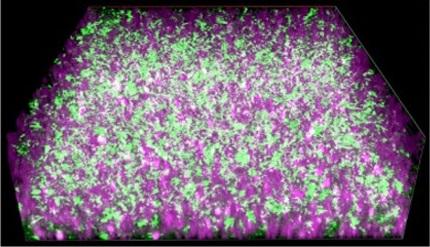
The researchers made a porous hydrogel composed of carbon nanotubes and silica nanoparticles, woven together by DNA strands. They added exoelectrogenic bacteria to this scaffold, along with liquid culture medium to supply the microbes with nutrients. The material efficiently conducted the electrons produced by the bacteria to an electrode. The bacteria grew well on the material, completely penetrating it. To cut off the electricity, the researchers added an enzyme that snipped DNA strands, causing the material to disassemble. The conductivity and other properties of the material could also be tailored by varying the size and sequence of the DNA fragments that hold the scaffold together, the researchers say.

###

The authors acknowledge funding from the Helmholtz programme “BioInterfaces in Technology and Medicine,” the Chinese Scholarship Council and the Swedish Research Council. 

The abstract that accompanies this paper can be viewed here.

The American Chemical Society (ACS) is a nonprofit organization chartered by the U.S. Congress. ACS’ mission is to advance the broader chemistry enterprise and its practitioners for the benefit of Earth and its people. The Society is a global leader in providing access to chemistry-related information and research through its multiple research solutions, peer-reviewed journals, scientific conferences, eBooks and weekly news periodical Chemical & Engineering News. ACS journals are among the most cited, most trusted and most read within the scientific literature; however, ACS itself does not conduct chemical research. As a specialist in scientific information solutions (including SciFinder® and STN®), its CAS division powers global research, discovery and innovation. ACS’ main offices are in Washington, D.C., and Columbus, Ohio.

To automatically receive news releases from the American Chemical Society, contact [email protected].

Follow us: Twitter | Facebook

Media Contact
Katie Cottingham
[email protected]

Tags: BacteriologyBiotechnologyChemistry/Physics/Materials SciencesElectrical Engineering/ElectronicsEnergy SourcesEnergy/Fuel (non-petroleum)GeneticsNanotechnology/Micromachines
Share12Tweet8Share2ShareShareShare2

Related Posts

blank

Breakthrough in Environmental Cleanup: Scientists Develop Solar-Activated Biochar for Faster Remediation

February 7, 2026
blank

Cutting Costs: Making Hydrogen Fuel Cells More Affordable

February 6, 2026

Scientists Develop Hand-Held “Levitating” Time Crystals

February 6, 2026

Observing a Key Green-Energy Catalyst Dissolve Atom by Atom

February 6, 2026
Please login to join discussion

POPULAR NEWS

  • Robotic Ureteral Reconstruction: A Novel Approach

    Robotic Ureteral Reconstruction: A Novel Approach

    82 shares
    Share 33 Tweet 21
  • Digital Privacy: Health Data Control in Incarceration

    63 shares
    Share 25 Tweet 16
  • Study Reveals Lipid Accumulation in ME/CFS Cells

    57 shares
    Share 23 Tweet 14
  • Breakthrough in RNA Research Accelerates Medical Innovations Timeline

    53 shares
    Share 21 Tweet 13

About

We bring you the latest biotechnology news from best research centers and universities around the world. Check our website.

Follow us

Recent News

Digital Health Perspectives from Baltic Sea Experts

Florida Cane Toad: Complex Spread and Selective Evolution

Exploring Decision-Making in Dementia Caregivers’ Mobility

Subscribe to Blog via Email

Enter your email address to subscribe to this blog and receive notifications of new posts by email.

Join 73 other subscribers
  • Contact Us

Bioengineer.org © Copyright 2023 All Rights Reserved.

Welcome Back!

Login to your account below

Forgotten Password?

Retrieve your password

Please enter your username or email address to reset your password.

Log In
No Result
View All Result
  • Homepages
    • Home Page 1
    • Home Page 2
  • News
  • National
  • Business
  • Health
  • Lifestyle
  • Science

Bioengineer.org © Copyright 2023 All Rights Reserved.