• HOME
  • NEWS
  • EXPLORE
    • CAREER
      • Companies
      • Jobs
    • EVENTS
    • iGEM
      • News
      • Team
    • PHOTOS
    • VIDEO
    • WIKI
  • BLOG
  • COMMUNITY
    • FACEBOOK
    • INSTAGRAM
    • TWITTER
Sunday, October 4, 2026
BIOENGINEER.ORG
No Result
View All Result
  • Login
  • HOME
  • NEWS
  • EXPLORE
    • CAREER
      • Companies
      • Jobs
        • Lecturer
        • PhD Studentship
        • Postdoc
        • Research Assistant
    • EVENTS
    • iGEM
      • News
      • Team
    • PHOTOS
    • VIDEO
    • WIKI
  • BLOG
  • COMMUNITY
    • FACEBOOK
    • INSTAGRAM
    • TWITTER
  • HOME
  • NEWS
  • EXPLORE
    • CAREER
      • Companies
      • Jobs
        • Lecturer
        • PhD Studentship
        • Postdoc
        • Research Assistant
    • EVENTS
    • iGEM
      • News
      • Team
    • PHOTOS
    • VIDEO
    • WIKI
  • BLOG
  • COMMUNITY
    • FACEBOOK
    • INSTAGRAM
    • TWITTER
No Result
View All Result
Bioengineer.org
No Result
View All Result
Home NEWS Science News

Bubble dynamics reveal how to empty bottles faster

Bioengineer by Bioengineer
April 7, 2020
in Science News
Reading Time: 3 mins read
0
IMAGE
Share on FacebookShare on TwitterShare on LinkedinShare on RedditShare on Telegram

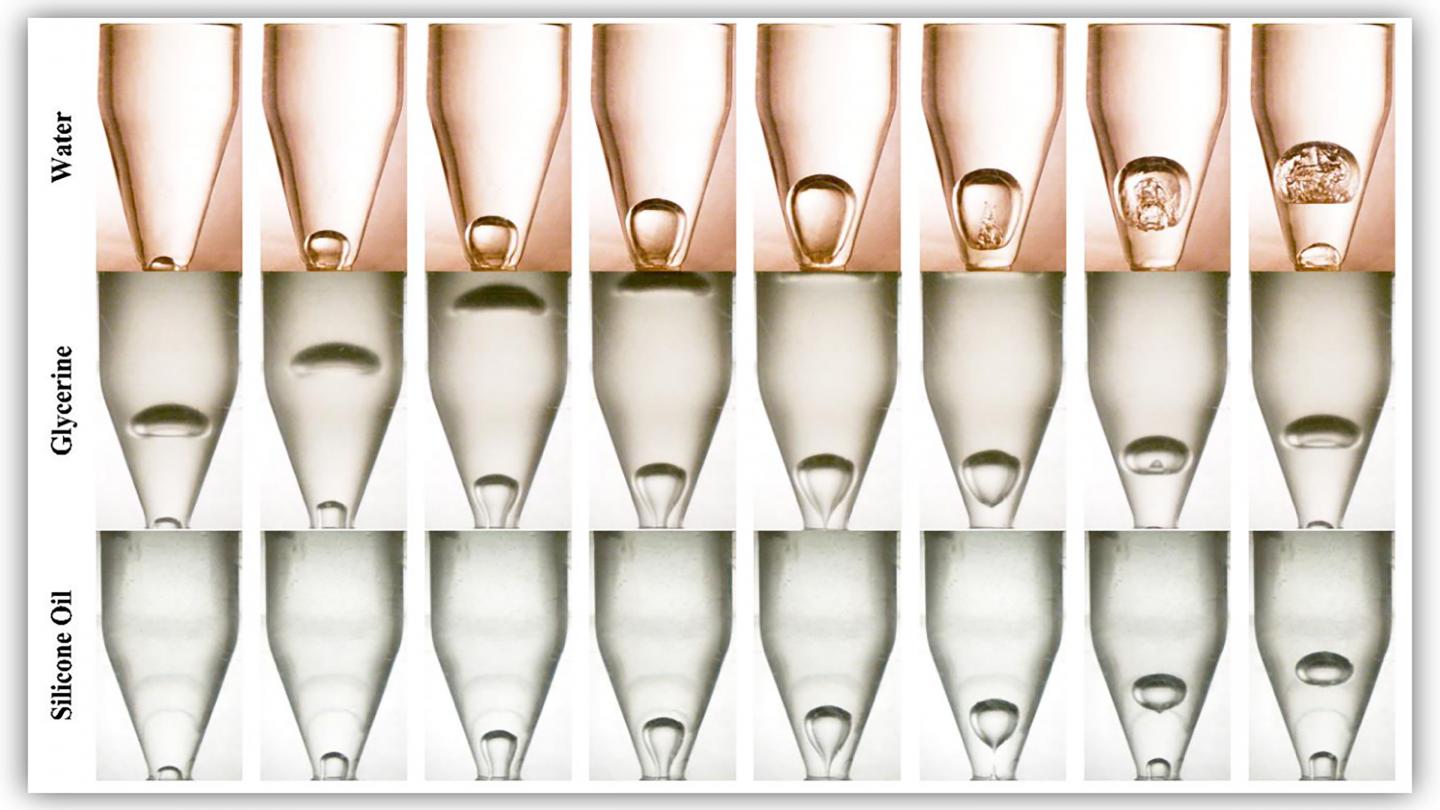
Glug, glug: Researchers zero in on the rhythmic sound bubble dynamics produce during bottle emptying to better understand the physics at play
IMAGE

Credit: Lokesh Rohilla

WASHINGTON, April 7, 2020 — Bottle emptying is a phenomenon most of us have observed while pouring a beverage. Researchers from the Indian Institute of Technology Roorkee discovered how to make bottles empty faster, which has wide-ranging implications for many areas beyond the beverage industry.

Bubbles have been studied extensively for centuries, including early efforts by Leonardo da Vinci who famously noted the sinusoidal rise of bubbles within a pool. The growth dynamics of bubbles at the mouth of a bottle depend on the thermophysical properties of the fluid, the bottle geometry and its angle of inclination. These inextricably intertwined parameters have made bottle-emptying dynamics the next frontier for bubble physicists.

In this week’s Physics of Fluids, from AIP Publishing, Lokesh Rohilla and Arup Kumar Das explore this bottle-emptying phenomenon from the perspective of bubble dynamics on a commercial bottle by using high-speed photography. Image analysis allowed them to conceptualize various parameters, such as liquid film thickness, bubble aspect ratio, rise velocity and bottle emptying modes.

“Bubble dynamics inside the bottle are too complex to study, so we divided the bubble interfacial growth into different stages to comprehend them,” said Rohilla.

It’s well known that a bottle’s emptying time is faster if you increase its angle of inclination. This increases what’s known as bubble pinch off frequency, and the relative increment depends upon the thermophysical properties of the fluid.

“Our experiments suggest there is a critical angle of inclination, after which any further increase in the inclination of the bottle won’t lead to further reduction in the bottle emptying time,” said Rohilla. “This occurs due to the saturation of the voidage, space occupied by air within liquid surrounding, at the bottle’s mouth with the angle of inclination.”

Two distinct bottle-emptying modes were identified. In one mode, the discharge rate is increased due to a high frequency pinch off of air bubbles inside the bottle. In the other mode, it is caused by an increase in volume of the pinched-off bubble at a comparatively lower frequency.

“We’ve also observed an encapsulated bubble while discharging fluid in a vertically upended bottle,” Rohilla said. “Encapsulated bubbles have pinch off sites outside the bottle mouth, contrary to intuition. The presence of a violent ejector jet within inviscid fluids, in which liquid becomes thin due to almost no internal friction, and its complete absence within viscous fluids control the periodicity of the bubbles.”

This work proves that bottle geometry and thermophysical properties play a role in reducing the time it takes for a bottle empty.

“We can manipulate the bottle discharge pattern by manipulating bottle geometry,” said Das. “An intuitive product-specific bottle design will enable better control of its discharge rate.”

The beverage industry and chemical plants are among the applications that will benefit from this better understanding of bottle geometry.

###

The article, “Fluidics in an emptying bottle during breaking and making of interacting interfaces,” is authored by Lokesh Rohilla and Arup Kumar Das. It will appear in Physics of Fluids on April 7, 2020 (DOI: 10.1063/5.0002249). After that date, it can be accessed at https://aip.scitation.org/doi/10.1063/5.0002249.

ABOUT THE JOURNAL

Physics of Fluids is devoted to the publication of original theoretical, computational, and experimental contributions to the dynamics of gases, liquids, and complex or multiphase fluids. See https://aip.scitation.org/journal/phf.

Media Contact
Larry Frum
[email protected]

Related Journal Article

http://dx.doi.org/10.1063/5.0002249

Tags: Chemistry/Physics/Materials SciencesTechnology/Engineering/Computer Science
Share12Tweet8Share2ShareShareShare2

Related Posts

Desert Soil Microbes Reveal Hidden Divide Between Rare and Abundant Bacteria Under Drought

Desert Soil Microbes Reveal Hidden Divide Between Rare and Abundant Bacteria Under Drought

October 4, 2026
Tigecycline Shows Promise Against Drug-Resistant Nontuberculous Mycobacteria, Review Finds

Tigecycline Shows Promise Against Drug-Resistant Nontuberculous Mycobacteria, Review Finds

October 4, 2026

Hormone Balance and a Flowering Gene Decide Whether Grapevines Grow Tendrils or Clusters

October 4, 2026

Blood NAD+ Levels Track With Frailty in Older Adults, Japanese Study Finds

October 4, 2026
Please login to join discussion

POPULAR NEWS

  • Alloys That Shrink Their Own Grains: New PIX Mechanism Refines Metals With Heat Alone

    Alloys That Shrink Their Own Grains: New PIX Mechanism Refines Metals With Heat Alone

    29 shares
    Share 12 Tweet 7
  • Endurance Exercise Reshapes the Liver in Males and Females Through Distinct Molecular Routes

    29 shares
    Share 12 Tweet 7
  • Single Transcription Factor PU.1 Rapidly Converts Fibroblasts into Macrophage-Lineage Cells

    29 shares
    Share 12 Tweet 7
  • New Scale Measures How Ready Nurse Educators Really Are for the AI Era

    29 shares
    Share 12 Tweet 7

About

We bring you the latest biotechnology news from best research centers and universities around the world. Check our website.

Follow us

Recent News

Alloys That Shrink Their Own Grains: New PIX Mechanism Refines Metals With Heat Alone

Endurance Exercise Reshapes the Liver in Males and Females Through Distinct Molecular Routes

Single Transcription Factor PU.1 Rapidly Converts Fibroblasts into Macrophage-Lineage Cells

Subscribe to Blog via Email

Success! An email was just sent to confirm your subscription. Please find the email now and click 'Confirm' to start subscribing.

Join 85 other subscribers
  • Contact Us

Bioengineer.org © Copyright 2023 All Rights Reserved.

Welcome Back!

Login to your account below

Forgotten Password?

Retrieve your password

Please enter your username or email address to reset your password.

Log In
No Result
View All Result
  • Homepages
    • Home Page 1
    • Home Page 2
  • News
  • National
  • Business
  • Health
  • Lifestyle
  • Science

Bioengineer.org © Copyright 2023 All Rights Reserved.