• HOME
  • NEWS
  • EXPLORE
    • CAREER
      • Companies
      • Jobs
    • EVENTS
    • iGEM
      • News
      • Team
    • PHOTOS
    • VIDEO
    • WIKI
  • BLOG
  • COMMUNITY
    • FACEBOOK
    • INSTAGRAM
    • TWITTER
Wednesday, July 15, 2026
BIOENGINEER.ORG
No Result
View All Result
  • Login
  • HOME
  • NEWS
  • EXPLORE
    • CAREER
      • Companies
      • Jobs
        • Lecturer
        • PhD Studentship
        • Postdoc
        • Research Assistant
    • EVENTS
    • iGEM
      • News
      • Team
    • PHOTOS
    • VIDEO
    • WIKI
  • BLOG
  • COMMUNITY
    • FACEBOOK
    • INSTAGRAM
    • TWITTER
  • HOME
  • NEWS
  • EXPLORE
    • CAREER
      • Companies
      • Jobs
        • Lecturer
        • PhD Studentship
        • Postdoc
        • Research Assistant
    • EVENTS
    • iGEM
      • News
      • Team
    • PHOTOS
    • VIDEO
    • WIKI
  • BLOG
  • COMMUNITY
    • FACEBOOK
    • INSTAGRAM
    • TWITTER
No Result
View All Result
Bioengineer.org
No Result
View All Result
Home NEWS Science News Chemistry

How do superconductors break time-reversal symmetry?

Bioengineer by Bioengineer
April 3, 2020
in Chemistry
Reading Time: 2 mins read
0
IMAGE
Share on FacebookShare on TwitterShare on LinkedinShare on RedditShare on Telegram

IMAGE

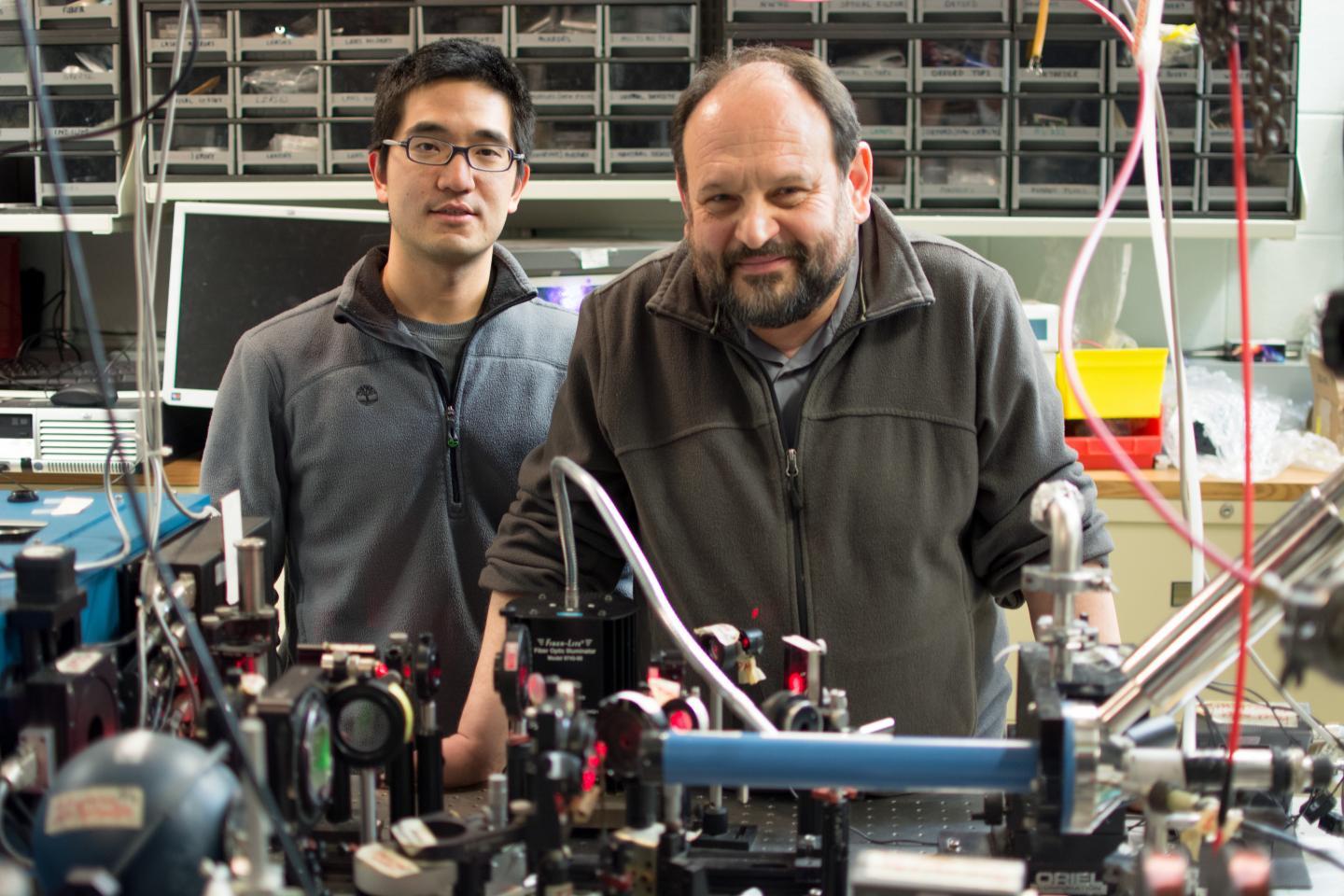
Credit: Carl Blesch / Rutgers University

Superconductors are one of the most exciting materials discovered in the last century. It is used to build medical tomographs, crucial details of particle accelerators and quantum computers. However, even a hundred years after the discovery of superconductivity we understand its microscopic mechanisms only in the simplest cases.

The European Research Council (ERC) has awarded a competitive 2.5 million euros advanced research grant to the principal investigator Girsh Blumberg and a team of researchers at the national institute KBFI, Tallinn, Estonia. The grant ‘How do superconductors break time-reversal symmetry?’ is to develop a unique instrument to study microscopic properties of superconductors. The work builds on Blumberg’s expertise in studying strongly correlated electron systems and the competence of the team in the field of terahertz spectroscopy and low temperature physics.

Our everyday experience shows that the past and future are not the same — they are not ‘symmetric’ say the physicists. The second law of thermodynamics explains the asymmetry between the past and future. In contrast, most laws of physics satisfy time-symmetry: such include Newton’s laws from school physics, but also the laws of gravity and quantum mechanics. For example, time-reversal symmetry implies that the equations of motion do not contain a direction of time. Thus, the physicists say that the time-reversal symmetry is equivalent with the motion-reversed symmetry. However, if one puts an electric wire to the magnetic field, one discovers that the reversed motion of an electron in the wire breaks Newton’s laws. One can conclude that the motion-reversed symmetry is broken and so the time-reversed symmetry. Therefore, the appearance of spontaneous magnetic fields is often taken as a signature of broken time-reversal symmetry.

“This research focuses on the microscopic symmetries of superconductors. We really hope to fill a gap in our knowledge that hinders us from building new devices including quantum computers,” said Girsh Blumberg. He explained that conventional superconductors are robust diamagnets: materials that expel magnetic fields. It would therefore be highly unexpected if a superconducting material would support spontaneous magnetic fields. Nevertheless, such spontaneously broken time-reversal symmetry states have been suggested for unconventional superconductors, but their identification remains experimentally controversial. Particularly interesting are unconventional superconductors for which the superconducting state is protected topologically and vortices of the supercurrent can host unconventional particles (Majorana fermions) with potential use in quantum computing applications.

“The ‘smoking gun’ experiments (could confirm time-reversal symmetry breaking) are experiments which are extremely sensitive to a very tiny magnetization,” said a team member of the grant, Urmas Nagel. “I am really excited we can start to build very novel probes here, at our institute KBFI.”

###

Media Contact
Girsh Blumberg
[email protected]

Tags: Chemistry/Physics/Materials Sciences
Share12Tweet8Share2ShareShareShare2

Related Posts

Chemistry from Alien World Detected in Meteorite That Hit New Jersey Home

Chemistry from Alien World Detected in Meteorite That Hit New Jersey Home

July 15, 2026
Low Carbon Dioxide Boosts Microbes to Produce More Biodegradable Plastic

Low Carbon Dioxide Boosts Microbes to Produce More Biodegradable Plastic

July 15, 2026

ROS Dynamics Controlled by Polyoxometalate-Functionalized Fe3O4 Nanozyme for Infected Wound Healing

July 15, 2026

Study Finds Smokers Rarely Increase Smoking After Switching to Low-Nicotine Cigarettes

July 15, 2026
Please login to join discussion

POPULAR NEWS

  • New Drug Candidate Developed at McMaster Shows Potential for Treating Brain Cancer

    58 shares
    Share 23 Tweet 15
  • A varied menu

    51 shares
    Share 22 Tweet 12
  • 研究人员开发认知工具包,实现阿尔茨海默症早期检测

    50 shares
    Share 20 Tweet 13
  • Porcine Heart Transplant

    50 shares
    Share 20 Tweet 13

About

We bring you the latest biotechnology news from best research centers and universities around the world. Check our website.

Follow us

Recent News

Virtual Reality Meditation Reduces Stress in Neonatal Intensive Care Parents and Staff

Prebiotics and Probiotics Help Honeybees Survive Temperature Stress Better

IL7-Receptor–Targeted CAR T Therapy Targets T-Cell Acute Lymphoblastic Leukemia

Subscribe to Blog via Email

Success! An email was just sent to confirm your subscription. Please find the email now and click 'Confirm' to start subscribing.

Join 85 other subscribers
  • Contact Us

Bioengineer.org © Copyright 2023 All Rights Reserved.

Welcome Back!

Login to your account below

Forgotten Password?

Retrieve your password

Please enter your username or email address to reset your password.

Log In
No Result
View All Result
  • Homepages
    • Home Page 1
    • Home Page 2
  • News
  • National
  • Business
  • Health
  • Lifestyle
  • Science

Bioengineer.org © Copyright 2023 All Rights Reserved.