• HOME
  • NEWS
  • EXPLORE
    • CAREER
      • Companies
      • Jobs
    • EVENTS
    • iGEM
      • News
      • Team
    • PHOTOS
    • VIDEO
    • WIKI
  • BLOG
  • COMMUNITY
    • FACEBOOK
    • INSTAGRAM
    • TWITTER
Wednesday, January 14, 2026
BIOENGINEER.ORG
No Result
View All Result
  • Login
  • HOME
  • NEWS
  • EXPLORE
    • CAREER
      • Companies
      • Jobs
        • Lecturer
        • PhD Studentship
        • Postdoc
        • Research Assistant
    • EVENTS
    • iGEM
      • News
      • Team
    • PHOTOS
    • VIDEO
    • WIKI
  • BLOG
  • COMMUNITY
    • FACEBOOK
    • INSTAGRAM
    • TWITTER
  • HOME
  • NEWS
  • EXPLORE
    • CAREER
      • Companies
      • Jobs
        • Lecturer
        • PhD Studentship
        • Postdoc
        • Research Assistant
    • EVENTS
    • iGEM
      • News
      • Team
    • PHOTOS
    • VIDEO
    • WIKI
  • BLOG
  • COMMUNITY
    • FACEBOOK
    • INSTAGRAM
    • TWITTER
No Result
View All Result
Bioengineer.org
No Result
View All Result
Home NEWS Science News Health

Non-invasive method to predict brain pressure

Bioengineer by Bioengineer
April 1, 2020
in Health
Reading Time: 2 mins read
0
IMAGE
Share on FacebookShare on TwitterShare on LinkedinShare on RedditShare on Telegram

IMAGE

Credit: Copyright 2020, Springer Nature Limited

The only way to accurately measure pressure inside the skull is to insert a catheter or sensor inside. However, this is invasive and techniques with less risk are desired. Intracranial pressure (ICP) needs to be correctly accounted for in a variety of medical situations including neurosurgery, neurology and emergency medicine.

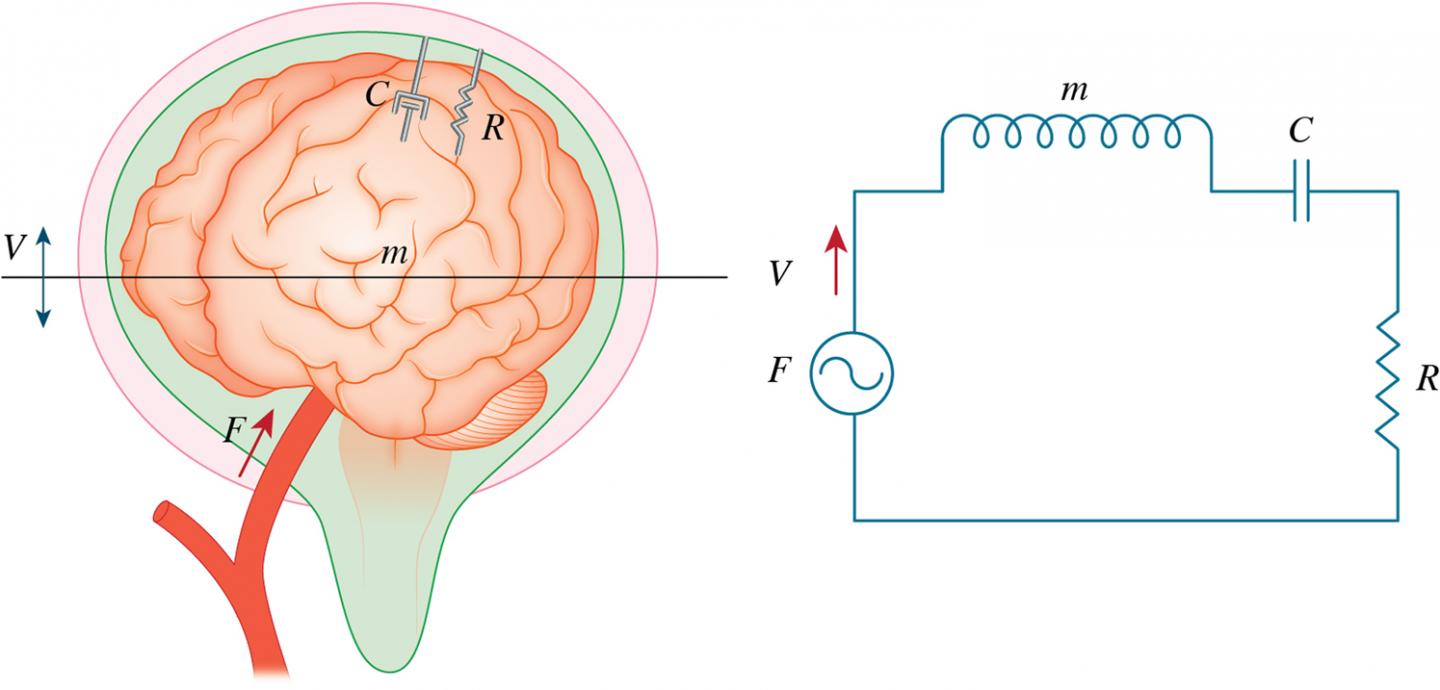
Doctors at Shinshu University School of Medicine discovered a non-invasive way to predict ICP by the brain’s natural resonance frequency (NRF). This is because the NRF of the brain was found to be only dependent on the ICP value. The NRF is what frequencies an object will vibrate at when a force is applied.

The NRF of the brain can be measured from the movement of the eardrum and external ear pressure waveform. The NRF of an object is based on its mass, elasticity and other factors. The NRF of the brain is dependent on brain weight, which on average is 1.4kg and the cerebral volumetric compliance, or how much give the skull has.

There are many factors that modulate the ICP value, such as the respiratory rhythm, which changes as much as 55% with inhalation and exhalation. The pressure inside the chest effects the pressure inside the vessels taking blood up to the brain which then effects the ICP.

There was a strong correlation (R =0.99999) between the ICP value and NRF of the brain, which means that ICP can be predicted from the NRF.

More data needs to be collected for high ICP values and small brain weights.

All experiments were conducted in accordance with relevant guidelines, regulations and informed consent.

###

For more information: https://doi.org/10.1038/s41598-020-59376-7

Acknowledgements

Special thanks to Mr. Norio Koike and Mr. Satoshi Yasumoto for manufacturing original measurement and recording apparatus in Ichikawa Electric Corporation Ltd. Tokyo, Japan. This research was funded by Japan Science and Technology Agency (JST). A-STEP feasibility study in 2012, and by Japan’s New Energy and Industrial Technology Development Organization (NEDO) in 2013, and by Grants-in-Aid for scientific research in Ministry of Education, Culture, Sports, Science and Technology-Japan from 2015 to 2017 and 2018 to 2020. Receiver: Kenji Furihata.

Author contributions

K.H. and T.G. conceived the project, managed patients and investigated clinical data. K.F. and T.G. designed the study. K.F. designed measurement apparatus, constructed the mathematical model and analysed the data. T.G. and K.F. wrote the paper and K.H. supervised the paper. The manuscript reflects the contributions of all authors.

Media Contact
Hitomi Thompson
[email protected]

Related Journal Article

http://dx.doi.org/10.1038/s41598-020-59376-7

Tags: Critical Care/Emergency MedicineMedicine/HealthRobotry/Artificial IntelligenceSurgery
Share12Tweet8Share2ShareShareShare2

Related Posts

Impact of Trauma on Neurodevelopment in Asylum-Seeking Children

January 14, 2026

Gut Dysbiosis: Key Driver of Immunoresistance in Cancer

January 14, 2026

Validating Blenkin Taylor vs London Atlas for Aussie Dental Aging

January 14, 2026

Understanding Nurses’ Views on Dual-Diagnosis Care in Ghana

January 14, 2026
Please login to join discussion

POPULAR NEWS

  • Enhancing Spiritual Care Education in Nursing Programs

    155 shares
    Share 62 Tweet 39
  • PTSD, Depression, Anxiety in Childhood Cancer Survivors, Parents

    147 shares
    Share 59 Tweet 37
  • Robotic Ureteral Reconstruction: A Novel Approach

    73 shares
    Share 29 Tweet 18
  • Study Reveals Lipid Accumulation in ME/CFS Cells

    52 shares
    Share 21 Tweet 13

About

We bring you the latest biotechnology news from best research centers and universities around the world. Check our website.

Follow us

Recent News

Impact of Trauma on Neurodevelopment in Asylum-Seeking Children

Adult Health After Neonatal Oesophageal Atresia: New Concerns

Accelerated Donkey Breed Classification via SNP Insights

Subscribe to Blog via Email

Enter your email address to subscribe to this blog and receive notifications of new posts by email.

Join 71 other subscribers
  • Contact Us

Bioengineer.org © Copyright 2023 All Rights Reserved.

Welcome Back!

Login to your account below

Forgotten Password?

Retrieve your password

Please enter your username or email address to reset your password.

Log In
No Result
View All Result
  • Homepages
    • Home Page 1
    • Home Page 2
  • News
  • National
  • Business
  • Health
  • Lifestyle
  • Science

Bioengineer.org © Copyright 2023 All Rights Reserved.