• HOME
  • NEWS
  • EXPLORE
    • CAREER
      • Companies
      • Jobs
    • EVENTS
    • iGEM
      • News
      • Team
    • PHOTOS
    • VIDEO
    • WIKI
  • BLOG
  • COMMUNITY
    • FACEBOOK
    • INSTAGRAM
    • TWITTER
Monday, March 30, 2026
BIOENGINEER.ORG
No Result
View All Result
  • Login
  • HOME
  • NEWS
  • EXPLORE
    • CAREER
      • Companies
      • Jobs
        • Lecturer
        • PhD Studentship
        • Postdoc
        • Research Assistant
    • EVENTS
    • iGEM
      • News
      • Team
    • PHOTOS
    • VIDEO
    • WIKI
  • BLOG
  • COMMUNITY
    • FACEBOOK
    • INSTAGRAM
    • TWITTER
  • HOME
  • NEWS
  • EXPLORE
    • CAREER
      • Companies
      • Jobs
        • Lecturer
        • PhD Studentship
        • Postdoc
        • Research Assistant
    • EVENTS
    • iGEM
      • News
      • Team
    • PHOTOS
    • VIDEO
    • WIKI
  • BLOG
  • COMMUNITY
    • FACEBOOK
    • INSTAGRAM
    • TWITTER
No Result
View All Result
Bioengineer.org
No Result
View All Result
Home NEWS Science News Biology

‘Thermometer’ protein regulates blooming

Bioengineer by Bioengineer
March 23, 2020
in Biology
Reading Time: 2 mins read
0
IMAGE
Share on FacebookShare on TwitterShare on LinkedinShare on RedditShare on Telegram

IMAGE

Credit: © Silva et al. / PNAS


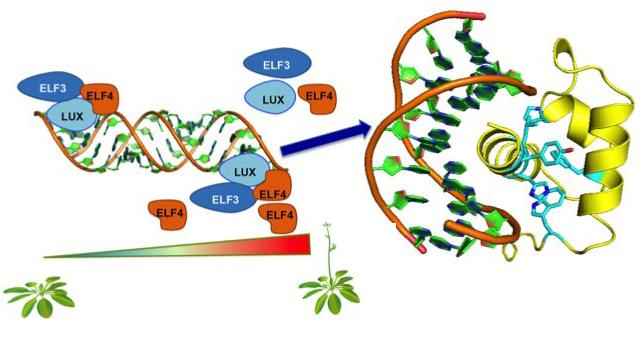
As average temperatures rise every year, it is no longer rare to see plants flower as early as February. Behind this phenomenon is a complex of proteins whose activity is controlled by temperature changes, as has just been demonstrated by researchers from the Cell and Plant Physiology Laboratory (CNRS / CEA / INRAE / Université Grenoble Alpes) and their partners.* Composed of three proteins (LUX, ELF3, and ELF4), the Evening Complex regulates the expression of genes involved in plant growth and flowering, as a function of exterior temperatures. The research team has shown, in vitro, that while all three proteins are needed for the complex to function correctly, ELF3 is the only one whose activity directly depends on temperature. When the temperature increases, ELF3 prevents the complex from binding to DNA and repressing plant growth genes. Consequently, growth proceeds. A study of the structure of LUX nonetheless demonstrated that certain mutations could alter plant sensitivity to temperature. These findings are published in PNAS (12 March 2020).

###

*- Scientists from the following institutions participated in this study: the European Synchrotron Radiation Facility (Grenoble); Sungkyunkwan University (South Korea); the Centro Nacional de Biotecnología, Consejo Superior de Investigaciones Científicas (Spain); the National Institute of Science Education and Research (India); and the Institut für Gemüse- und Zierpflanzenbau (Germany).

Media Contact
Francois Maginiot
[email protected]

Original Source

http://www.cnrs.fr/en/thermometer-protein-regulates-blooming

Related Journal Article

http://dx.doi.org/10.1073/pnas.1920972117

Tags: BiologyCell BiologyGeneticsMolecular BiologyPlant Sciences
Share12Tweet8Share2ShareShareShare2

Related Posts

Scientists Create Novel Tool to Analyze Plant Actin Cytoskeleton and Unlock Cell Structure Insights

Scientists Create Novel Tool to Analyze Plant Actin Cytoskeleton and Unlock Cell Structure Insights

March 30, 2026
University of Tennessee Faculty Pioneer Groundbreaking Evolutionary Research

University of Tennessee Faculty Pioneer Groundbreaking Evolutionary Research

March 30, 2026

One Brain, Two Organs: How Fish Navigate Their Underwater World

March 30, 2026

Study Finds Human Touch Boosts Chick Happiness, Leaving Them Feeling Egg-stra Joyful

March 30, 2026
Please login to join discussion

POPULAR NEWS

  • blank

    Revolutionary AI Model Enhances Precision in Detecting Food Contamination

    96 shares
    Share 38 Tweet 24
  • Imagine a Social Media Feed That Challenges Your Views Instead of Reinforcing Them

    1005 shares
    Share 397 Tweet 248
  • Promising Outcomes from First Clinical Trials of Gene Regulation in Epilepsy

    51 shares
    Share 20 Tweet 13
  • Advancements in EV Battery Technology to Surpass Climate Change-Induced Degradation

    45 shares
    Share 18 Tweet 11

About

We bring you the latest biotechnology news from best research centers and universities around the world. Check our website.

Follow us

Recent News

How Abortion Bans Affect Neonatal ICU Use

AI-Enhanced Eye Imaging Reveals New Insights into Cardiovascular Risk

Avatar Created to Advance Pediatric Brain Cancer Research

Subscribe to Blog via Email

Enter your email address to subscribe to this blog and receive notifications of new posts by email.

Join 78 other subscribers
  • Contact Us

Bioengineer.org © Copyright 2023 All Rights Reserved.

Welcome Back!

Login to your account below

Forgotten Password?

Retrieve your password

Please enter your username or email address to reset your password.

Log In
No Result
View All Result
  • Homepages
    • Home Page 1
    • Home Page 2
  • News
  • National
  • Business
  • Health
  • Lifestyle
  • Science

Bioengineer.org © Copyright 2023 All Rights Reserved.