• HOME
  • NEWS
  • EXPLORE
    • CAREER
      • Companies
      • Jobs
    • EVENTS
    • iGEM
      • News
      • Team
    • PHOTOS
    • VIDEO
    • WIKI
  • BLOG
  • COMMUNITY
    • FACEBOOK
    • INSTAGRAM
    • TWITTER
Sunday, October 4, 2026
BIOENGINEER.ORG
No Result
View All Result
  • Login
  • HOME
  • NEWS
  • EXPLORE
    • CAREER
      • Companies
      • Jobs
        • Lecturer
        • PhD Studentship
        • Postdoc
        • Research Assistant
    • EVENTS
    • iGEM
      • News
      • Team
    • PHOTOS
    • VIDEO
    • WIKI
  • BLOG
  • COMMUNITY
    • FACEBOOK
    • INSTAGRAM
    • TWITTER
  • HOME
  • NEWS
  • EXPLORE
    • CAREER
      • Companies
      • Jobs
        • Lecturer
        • PhD Studentship
        • Postdoc
        • Research Assistant
    • EVENTS
    • iGEM
      • News
      • Team
    • PHOTOS
    • VIDEO
    • WIKI
  • BLOG
  • COMMUNITY
    • FACEBOOK
    • INSTAGRAM
    • TWITTER
No Result
View All Result
Bioengineer.org
No Result
View All Result
Home NEWS Science News Chemistry

Researchers observe ultrafast processes of single molecules for the first time

Bioengineer by Bioengineer
March 23, 2020
in Chemistry
Reading Time: 3 mins read
0
IMAGE
Share on FacebookShare on TwitterShare on LinkedinShare on RedditShare on Telegram

IMAGE

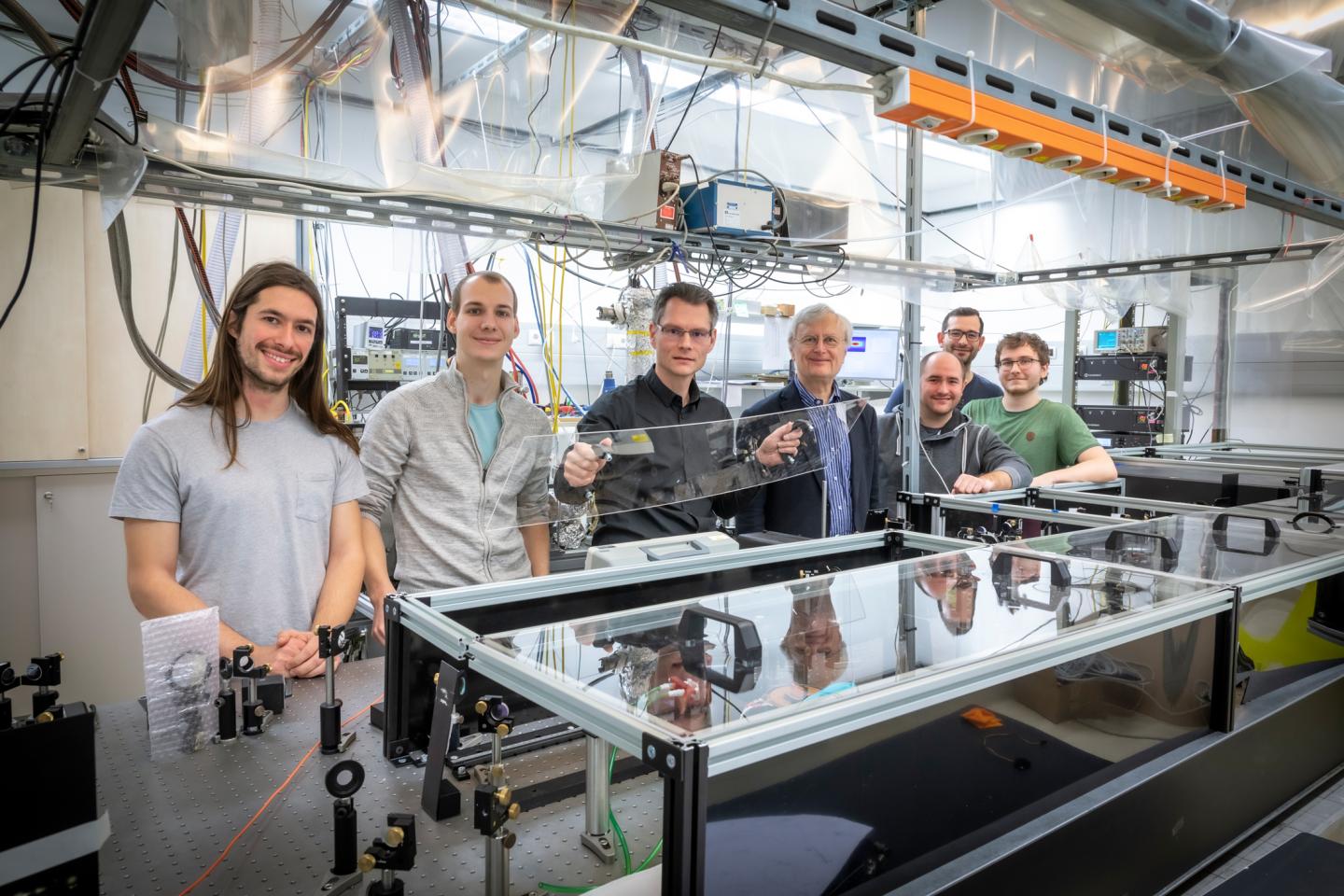
Credit: © Lunghammer – TU Graz

Markus Koch, head of the research group Femtosecond Dynamics at the Institute of Experimental Physics at TU Graz, and his team develop new methods for time-resolved femtosecond laser spectroscopy to investigate ultrafast processes in molecular systems. In 2018 the group demonstrated for the first time that photo-induced processes can be observed inside a helium nanodroplet, a nanometer-sized droplet of superfluid helium that serves as a quantum solvent. For their investigations, the researchers placed a single indium atom inside the droplet and analysed the reaction of the system with the pump-probe principle. The atom was excited with an ultrashort laser pulse, triggering the rearrangement of the helium environment within femtoseconds (10-15 seconds). A time-delayed second laser pulse probed this development and provided information on the behavior of the system.

Successful next step

Using the same technique, Koch and his colleagues Miriam Meyer, Bernhard Thaler and Pascal Heim, visualized the movement of single, isolated molecules inside a helium droplet for the first time. The researchers formed an indium dimer molecule inside a helium droplet by loading it successively with two indium atoms. They then triggered a vibration in the molecule by photoexcitation and observed the movement of the nuclei in real time with the same pump-probe technique.

The researchers consider two aspects of the experiment as particularly important: First, it demonstrates that such experiments are able to observe ultrafast intramolecular processes – i.e. processes that occur within an excited molecule.

Helium has little influence on embedded molecules

Second, the group discovered that the influence of superfluid helium on molecular vibrations is significantly weaker than with conventional solvents, such as water or methanol. Intramolecular processes are usually influenced by interactions with the environment and in conventional solvents this interaction is so strong that intramolecular processes cannot be observed, as Bernhard Thaler explains: “The quantum fluid helium, which has a temperature of only 0.4 K (note: minus 272.75 degrees Celsius), is truly special, as the perturbation on the embedded molecule is very low. Additionally, fragile molecules, which often break apart in other techniques, are stabilized due to the cooling mechanism and can now be investigated.”

Markus Koch wants to extend the method to complex molecules

“We see great potential in helium nanodroplets because they offer wonderful opportunities for creating molecular systems,” said Koch, explaining why he and his team develop this method for femtosecond studies. In the next step, the Femtosecond Dynamics group aims for more complex systems. “The structure of indium molecules, which we used as a model system, is very simple but in the future we want to look at technologically relevant molecules, which are more complex. I consider this as promising approach to molecular engineering, where future materials are developed by manipulating the quantum behavior of their molecular constituents.”

###

This research area is anchored in the Field of Expertise “Advanced Materials Science”, one of five strategic foci of TU Graz. Participating researchers are members of NAWI Graz Physics.

Original publication:

Long-lived nuclear coherences inside helium nanodroplets

Bernhard Thaler, Miriam Meyer, Pascal Heim, Markus Koch*

Physical Review Letters 124, 115301 DOI: https://doi.org/10.1103/PhysRevLett.124.115301

Further information can be found in the online magazine Physics of the American Physical Society, which dedicates a focus story to the paper: https://physics.aps.org/articles/v13/41

Contact:

Markus Koch

Assoc.Prof. Dipl.-Ing. Dr.techn.

TU Graz | Institute of Experimental Physics

Rechbauerstrasse 16, 8010 Graz

Phone: +43 316 873 8161

[email protected]

Media Contact
Markus Koch
[email protected]
43-316-873-8161

Original Source

https://www.tugraz.at/en/tu-graz/services/news-stories/media-service/singleview/article/forschende-beobachten-erstmals-ultraschnelle-prozesse-einzelner-molekuele-in-fluessigem-helium0/

Related Journal Article

http://dx.doi.org/10.1103/PhysRevLett.124.115301

Tags: Atomic PhysicsAtomic/Molecular/Particle PhysicsChemistry/Physics/Materials SciencesMaterialsMolecular PhysicsNanotechnology/MicromachinesNuclear PhysicsOpticsResearch/Development
Share12Tweet8Share2ShareShareShare2

Related Posts

Porous Carbon Electrode Enables Iodide Sensing in Salty Waters

Porous Carbon Electrode Enables Iodide Sensing in Salty Waters

October 4, 2026
Pyrazole Chemistry Surges as New Wave of Bioactive Derivatives Emerges in 2025 and 2026

Pyrazole Chemistry Surges as New Wave of Bioactive Derivatives Emerges in 2025 and 2026

October 4, 2026

Earth-Abundant Metal Catalysts Close In on the Oxygen Evolution Bottleneck

October 4, 2026

Plant-Powered Nanoparticles Push Corrosion Protection Toward 99 Percent

October 4, 2026
Please login to join discussion

POPULAR NEWS

  • Alloys That Shrink Their Own Grains: New PIX Mechanism Refines Metals With Heat Alone

    Alloys That Shrink Their Own Grains: New PIX Mechanism Refines Metals With Heat Alone

    29 shares
    Share 12 Tweet 7
  • Endurance Exercise Reshapes the Liver in Males and Females Through Distinct Molecular Routes

    29 shares
    Share 12 Tweet 7
  • Single Transcription Factor PU.1 Rapidly Converts Fibroblasts into Macrophage-Lineage Cells

    29 shares
    Share 12 Tweet 7
  • New Scale Measures How Ready Nurse Educators Really Are for the AI Era

    29 shares
    Share 12 Tweet 7

About

We bring you the latest biotechnology news from best research centers and universities around the world. Check our website.

Follow us

Recent News

Alloys That Shrink Their Own Grains: New PIX Mechanism Refines Metals With Heat Alone

Endurance Exercise Reshapes the Liver in Males and Females Through Distinct Molecular Routes

Single Transcription Factor PU.1 Rapidly Converts Fibroblasts into Macrophage-Lineage Cells

Subscribe to Blog via Email

Enter your email address to subscribe to this blog and receive notifications of new posts by email.

Join 85 other subscribers
  • Contact Us

Bioengineer.org © Copyright 2023 All Rights Reserved.

Welcome Back!

Login to your account below

Forgotten Password?

Retrieve your password

Please enter your username or email address to reset your password.

Log In
No Result
View All Result
  • Homepages
    • Home Page 1
    • Home Page 2
  • News
  • National
  • Business
  • Health
  • Lifestyle
  • Science

Bioengineer.org © Copyright 2023 All Rights Reserved.