

• HOME
  • NEWS
  • EXPLORE
    • CAREER
      • Companies
      • Jobs
    • EVENTS
    • iGEM
      • News
      • Team
    • PHOTOS
    • VIDEO
    • WIKI
  • BLOG
  • COMMUNITY
    • FACEBOOK
    • INSTAGRAM
    • TWITTER
Saturday, February 7, 2026
BIOENGINEER.ORG
No Result
View All Result
  • Login
  • HOME
  • NEWS
  • EXPLORE
    • CAREER
      • Companies
      • Jobs
        • Lecturer
        • PhD Studentship
        • Postdoc
        • Research Assistant
    • EVENTS
    • iGEM
      • News
      • Team
    • PHOTOS
    • VIDEO
    • WIKI
  • BLOG
  • COMMUNITY
    • FACEBOOK
    • INSTAGRAM
    • TWITTER
  • HOME
  • NEWS
  • EXPLORE
    • CAREER
      • Companies
      • Jobs
        • Lecturer
        • PhD Studentship
        • Postdoc
        • Research Assistant
    • EVENTS
    • iGEM
      • News
      • Team
    • PHOTOS
    • VIDEO
    • WIKI
  • BLOG
  • COMMUNITY
    • FACEBOOK
    • INSTAGRAM
    • TWITTER
No Result
View All Result
Bioengineer.org
No Result
View All Result
Home NEWS Science News Health

To sleep deeply: The brainstem neurons that regulate non-REM sleep

Bioengineer by Bioengineer
March 23, 2020
in Health
Reading Time: 2 mins read
0
IMAGE
Share on FacebookShare on TwitterShare on LinkedinShare on RedditShare on Telegram

Researchers from the University of Tsukuba identify the key role of brainstem neurotensinergic neurons in non-REM sleep regulation
IMAGE

Credit: University of Tsukuba


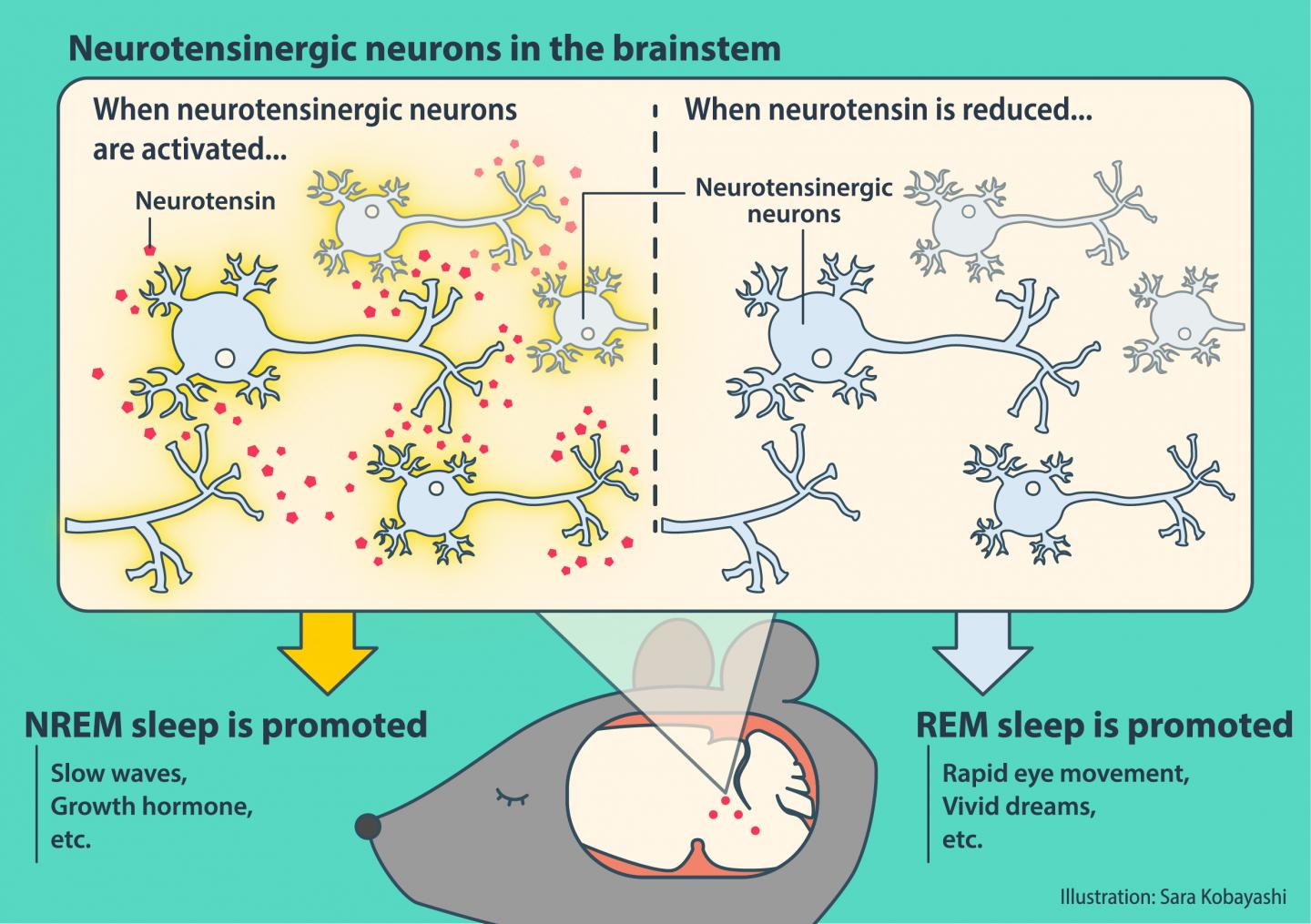
Tsukuba, Japan – Mammals experience rapid eye movement (REM) and non-REM (NREM) sleep. While the hypothalamus and brainstem are known to be a critical regulators of sleep, the precise mechanism is not fully understood. New work in mice has found that a widely distributed network of neurotensinergic neurons regulates NREM sleep, which also implicates a critical role of the neuropeptide neurotensin.

A normal sleep architecture is crucial for physical and cognitive health, and disruption of REM/NREM sleep can therefore have serious consequences. While several brain areas including the hypothalamus are known to be essential for NREM sleep, comparatively little is known about how the brainstem controls NREM sleep. Previous work has found that a subregion of the brainstem, the sublaterodorsal tegmental nucleus (SubLDT), regulates both REM and NREM sleep. Researchers at the University of Tsukuba therefore targeted this area to identify NREM sleep-promoting neurons, and found that a wide network of neurotensin-producing neurons is involved in NREM sleep regulation. The article was published in Current Biology last month.

“Using microarray analyses, we measured the expression levels of several genes in the mouse SubLDT,” says Associate Professor Yu Hayashi, corresponding and last author of the study. “A subset of these SubLDT neurons had a high, selective expression of the gene Nts, which encodes the neuropeptide neurotensin. Artificial activation of these SubLDT neurons promoted NREM sleep, which confirmed the role of Nts-expressing neurons in NREM sleep.”

NREM sleep-promoting neurons were also found in three other brainstem structures that have not previously been proven to be involved in sleep regulation (the dorsal deep mesencephalic nucleus, periaqueductal gray, and medial vestibular nucleus). Neurons in these regions also expressed Nts. Furthermore, direct administration of neurotensin itself induced NREM sleep-like brain activity.

“Our findings not only provide insights about brainstem involvement in NREM sleep promotion, but also highlight the key role of neurotensin,” says Mitsuaki Kashiwagi, first author. “It will be interesting to see whether Nts-expressing neurons contribute to the co-ordination between sleep and other known functions of neurotensin signaling, such as pain and metabolism. The response of Nts-expressing neurons also differed according to the time of day, so the influence of the circadian rhythm on these neurons should be studied.”

More broadly, these results could tell us something about the evolution of the complex sleep architecture of mammals. Future work could examine whether similar Nts¬-expressing neurons are also present in vertebrates, which do not experience REM and NREM sleep.

###

Media Contact
Naoko Yamashina
[email protected]
81-298-532-066

Related Journal Article

http://dx.doi.org/10.1016/j.cub.2020.01.047

Tags: BiologyCell BiologyGenesGeneticsMolecular BiologyPhysiologySleep/Sleep Disorders
Share12Tweet8Share2ShareShareShare2

Related Posts

Personalized Guide to Understanding and Reducing Chemicals

February 7, 2026

Inflammasome Protein ASC Drives Pancreatic Cancer Metabolism

February 7, 2026

Phage-Antibiotic Combo Beats Resistant Peritoneal Infection

February 7, 2026

Boosting Remote Healthcare: Stepped-Wedge Trial Insights

February 7, 2026
Please login to join discussion

POPULAR NEWS

  • Robotic Ureteral Reconstruction: A Novel Approach

    Robotic Ureteral Reconstruction: A Novel Approach

    82 shares
    Share 33 Tweet 21
  • Digital Privacy: Health Data Control in Incarceration

    63 shares
    Share 25 Tweet 16
  • Study Reveals Lipid Accumulation in ME/CFS Cells

    57 shares
    Share 23 Tweet 14
  • Breakthrough in RNA Research Accelerates Medical Innovations Timeline

    53 shares
    Share 21 Tweet 13

About

We bring you the latest biotechnology news from best research centers and universities around the world. Check our website.

Follow us

Recent News

Personalized Guide to Understanding and Reducing Chemicals

Inflammasome Protein ASC Drives Pancreatic Cancer Metabolism

Phage-Antibiotic Combo Beats Resistant Peritoneal Infection

Subscribe to Blog via Email

Enter your email address to subscribe to this blog and receive notifications of new posts by email.

Join 73 other subscribers
  • Contact Us

Bioengineer.org Ā© Copyright 2023 All Rights Reserved.

Welcome Back!

Login to your account below

Forgotten Password?

Retrieve your password

Please enter your username or email address to reset your password.

Log In
No Result
View All Result
  • Homepages
    • Home Page 1
    • Home Page 2
  • News
  • National
  • Business
  • Health
  • Lifestyle
  • Science

Bioengineer.org Ā© Copyright 2023 All Rights Reserved.

