Disordered proteins preserve molecular order and reduce neurodegeneration in animal models
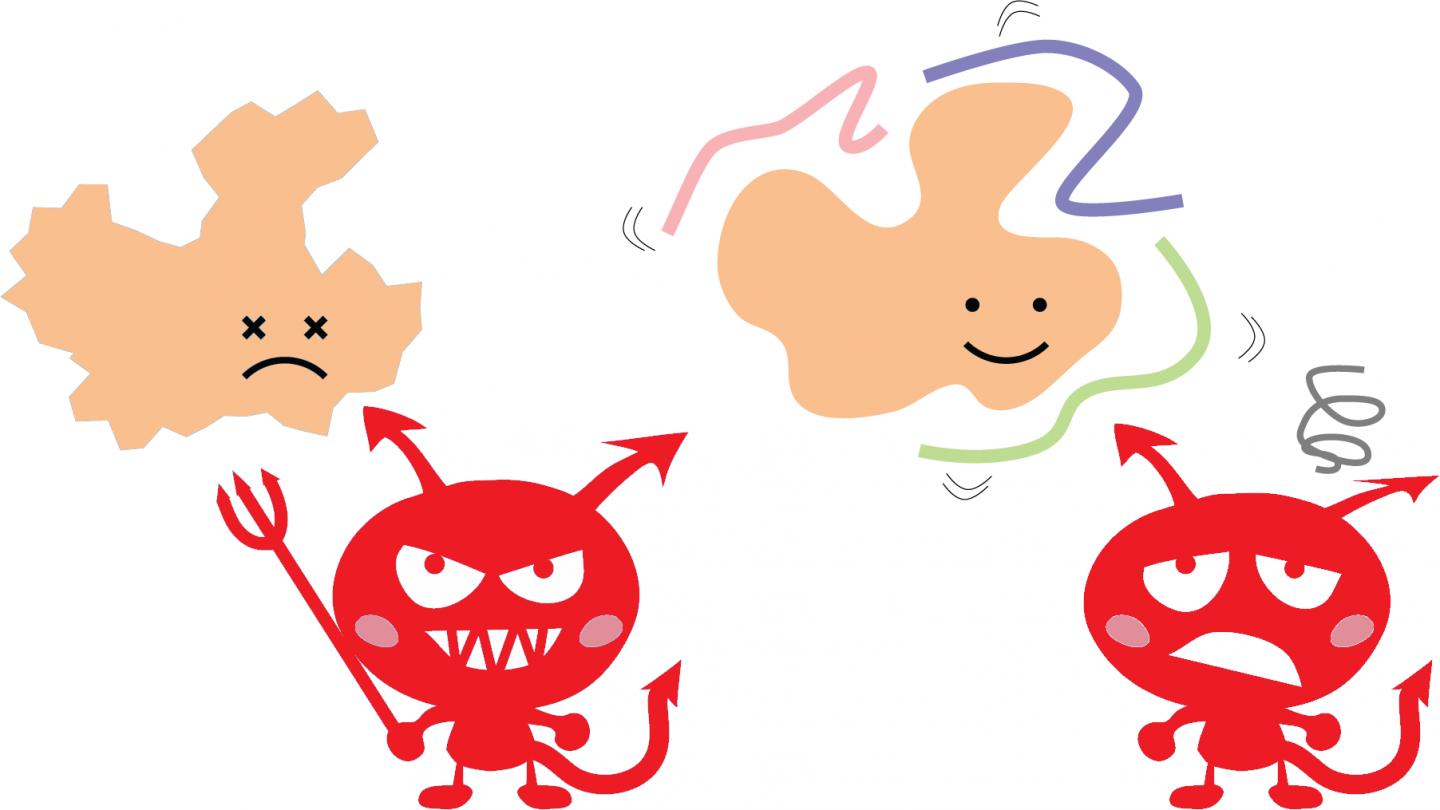
Credit: Illustration by Kotaro Tsuboyama, CC BY 4.0
Protein aggregation and misfolding underpins several neurodegenerative diseases such as Huntingdon’s and Alzheimer’s. Proteins can also become aggregated or denatured under conditions of stress, such as extreme heat. A new study published March 12 in the open-access journal PLOS Biology by Kotaro Tsuboyama and Yukihide Tomari of The University of Tokyo, Japan, and colleagues reveals a newly discovered class of proteins in both humans and flies which protect vulnerable proteins from becoming aggregated or denatured in extreme heat and other stresses – a function previously only known in “extremophile” organisms such as heat-loving bacteria. The proteins, discovered through a serendipitous observation, may find applications in biotechnology and protection from neurodegenerative disease.
Proteins are molecular tools held in their active folded shape by weak attractions between amino acids. Heat can disrupt these attractions, changing protein shape and causing them to clump together. This also stops them from functioning. An entire class of proteins–the “molecular chaperones”–use cellular energy in the form of ATP to either refold or dispose of misfolded proteins. But for proteins in most organisms, temperatures close to the boiling point of water irreversibly destroy their structure.
In the course of their research on an entirely different question, while trying to purify a structurally unstable fly protein called Ago2, the authors found that liquid extracted by breaking open fly cells contained some factor that stabilized the protein. Unexpectedly, this stabilizing activity remained even after boiling this liquid and removing aggregated proteins; similar protein stabilization was caused by the boiled liquid from human cells. Further biochemical testing confirmed that proteins were responsible for the stabilizing effect.
Heat inactivates and aggregates proteins by exposing hydrophobic (oily) amino acids, which then clump back together. So the authors reasoned that any protein remaining soluble after boiling would be enriched in hydrophilic (water-loving) amino acids. They confirmed that hypothesis by analyzing the mix of proteins remaining in the boiled liquid. They then used bioinformatic approaches to identify hundreds of proteins in the human proteome with high proportions of hydrophilic amino acids and high levels of “intrinsically disordered regions,” sequences known not to fold into specific shapes. That disorder, they reasoned, would likely allow the protein to drape around other proteins like a shield, protecting against misfolding. They dubbed these putative protectors “Hero” (HEat Resistant Obscure) proteins, with a nod to the Japanese word hero-hero, which means flimsy, loose, or flexible.
They studied six Hero proteins in more detail, and showed that each could protect a set of delicate proteins from physical stresses, including heat and organic solvents. In cultured human cells, Hero proteins reduced the misfolding and aggregation of both TDP-43 and huntingtin, which are thought to drive pathogenesis in ALS (Amyotrophic lateral sclerosis, also known as motor neurone disease) and Huntington’s disease, respectively. In a fly model of ALS, Hero proteins reduced neuronal dysfunction caused by TDP-43, and in normal flies, Hero overexpression increased longevity.
“Unlike chaperones, Hero proteins don’t appear to use any ATP, and probably act on the functional form of their client proteins and prevent them from lapsing into misfolded states,” Tomari said. “Their ability to protect proteins from multiple kinds of denaturing stresses may be useful in biotechnology applications in the purification of proteins, and the fact that they can block pathogenic aggregates in neurodegenerative disease models may make them attractive candidates for therapeutic development.”
###
In your coverage please use this URL to provide access to the freely available article in PLOS Biology: https:/
Citation: Tsuboyama K, Osaki T, Matsuura-Suzuki E, Kozuka-Hata H, Okada Y, Oyama M, et al. (2020) A widespread family of heat-resistant obscure (Hero) proteins protect against protein instability and aggregation. PLoS Biol 18(3): e3000632. https:/
Funding: This work was supported in part by JSPS KAKENHI Grant Number JP16J02134 and 19J30003 to KT (https:/
Competing Interests: I have read the journal’s policy and the authors of this manuscript have the following competing interests: YT, KT, SI, EM-S, HK-H, and MO have a patent application related to this work. The other authors declare no competing interests.
Media Contact
Yukihide Tomari
[email protected]
Original Source
https:/
Related Journal Article
http://dx.