Accidents involving drivers testing below legal blood alcohol concentration limits are more likely to cause harm to others than drivers with levels at or above the limit, according to a new study in the American Journal of Preventive Medicine
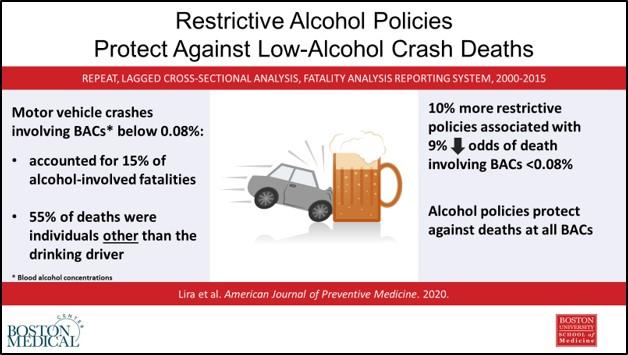
Credit: Lira MC, et al. American Journal of Preventive Medicine, 2020.
Ann Arbor, March 16, 2020 – A new study in the American Journal of Preventive Medicine, published by Elsevier, found that motor vehicle crashes involving drivers with blood alcohol concentrations (BACs) below the legal limit of 0.08 percent accounted for 15 percent of alcohol-involved crash deaths in the United States. Of these deaths, 55 percent of fatalities were individuals other than the drinking driver, and these crashes were more likely to result in youth fatalities compared with crashes above the legal BAC limit.
Alcohol-involved motor vehicle accidents remain a leading cause of injury-related death in the US. Most research on crashes and alcohol focuses on alcohol above the legal limit of 0.08 percent, but cognitive impairment can begin at BACs as low as 0.03 percent. The National Transportation Safety Board and the National Academies of Sciences, Engineering, and Medicine have recommended reducing the legal blood alcohol concentration limit from 0.08 percent to 0.05 percent. In 2018, Utah became the first state to do so. Other countries have adopted this limit already and have seen decreases in motor vehicle crashes.
“Our study challenges the popular misconception that alcohol-involved crashes primarily affect drinking drivers, or that BACs below the legal limit don’t matter,” explained lead investigator Timothy S. Naimi, MD, MPH, Section of General Internal Medicine, Boston Medical Center, and Department of Community Health Sciences, Boston University School of Public Health, Boston, MA, USA.
The study analyzed sixteen years of US motor vehicle crash data from the Fatality Analysis Reporting System with the Alcohol Policy Scale, a measure of state alcohol policies. From 2000 to 2015, 37 percent of more than 600,00 motor vehicle deaths occurred in crashes involving at least one driver with a positive BAC. Of these, 15 percent were from crashes involving drivers testing below the legal alcohol limit.
The results of this study also showed that more restrictive alcohol policies were associated with a 9 percent decrease in the odds that a crash involved alcohol at levels below the legal limit. This relationship was consistent for multiple subgroups (e.g., men only, women only) and at a blood alcohol cutoff of 0.05 percent.
“Lower alcohol crashes have been underestimated as a public health problem. Our research suggests that stringent alcohol policies reduce the likelihood of fatal accidents involving drivers with all levels of alcohol blood concentration,” noted Dr. Naimi. The study identified a number of policy approaches that could lead to a decrease in crash deaths involving alcohol at all levels, including increased alcohol taxes, required keg registration, and limited alcohol availability in grocery stores.
“Policies restricting impaired driving increase freedom from worry of injury or death for the majority of people on public roadways who are not drinking,” observed lead author Marlene Lira, Section of General Internal Medicine, Boston Medical Center, Boston, MA, USA.
###
Media Contact
Jillian B. Morgan
[email protected]
734-936-1590
Related Journal Article
http://dx.