• HOME
  • NEWS
  • EXPLORE
    • CAREER
      • Companies
      • Jobs
    • EVENTS
    • iGEM
      • News
      • Team
    • PHOTOS
    • VIDEO
    • WIKI
  • BLOG
  • COMMUNITY
    • FACEBOOK
    • INSTAGRAM
    • TWITTER
Monday, May 25, 2026
BIOENGINEER.ORG
No Result
View All Result
  • Login
  • HOME
  • NEWS
  • EXPLORE
    • CAREER
      • Companies
      • Jobs
        • Lecturer
        • PhD Studentship
        • Postdoc
        • Research Assistant
    • EVENTS
    • iGEM
      • News
      • Team
    • PHOTOS
    • VIDEO
    • WIKI
  • BLOG
  • COMMUNITY
    • FACEBOOK
    • INSTAGRAM
    • TWITTER
  • HOME
  • NEWS
  • EXPLORE
    • CAREER
      • Companies
      • Jobs
        • Lecturer
        • PhD Studentship
        • Postdoc
        • Research Assistant
    • EVENTS
    • iGEM
      • News
      • Team
    • PHOTOS
    • VIDEO
    • WIKI
  • BLOG
  • COMMUNITY
    • FACEBOOK
    • INSTAGRAM
    • TWITTER
No Result
View All Result
Bioengineer.org
No Result
View All Result
Home NEWS Science News Chemistry

Invisible plastics in water

Bioengineer by Bioengineer
March 13, 2020
in Chemistry
Reading Time: 3 mins read
0
IMAGE
Share on FacebookShare on TwitterShare on LinkedinShare on RedditShare on Telegram

IMAGE

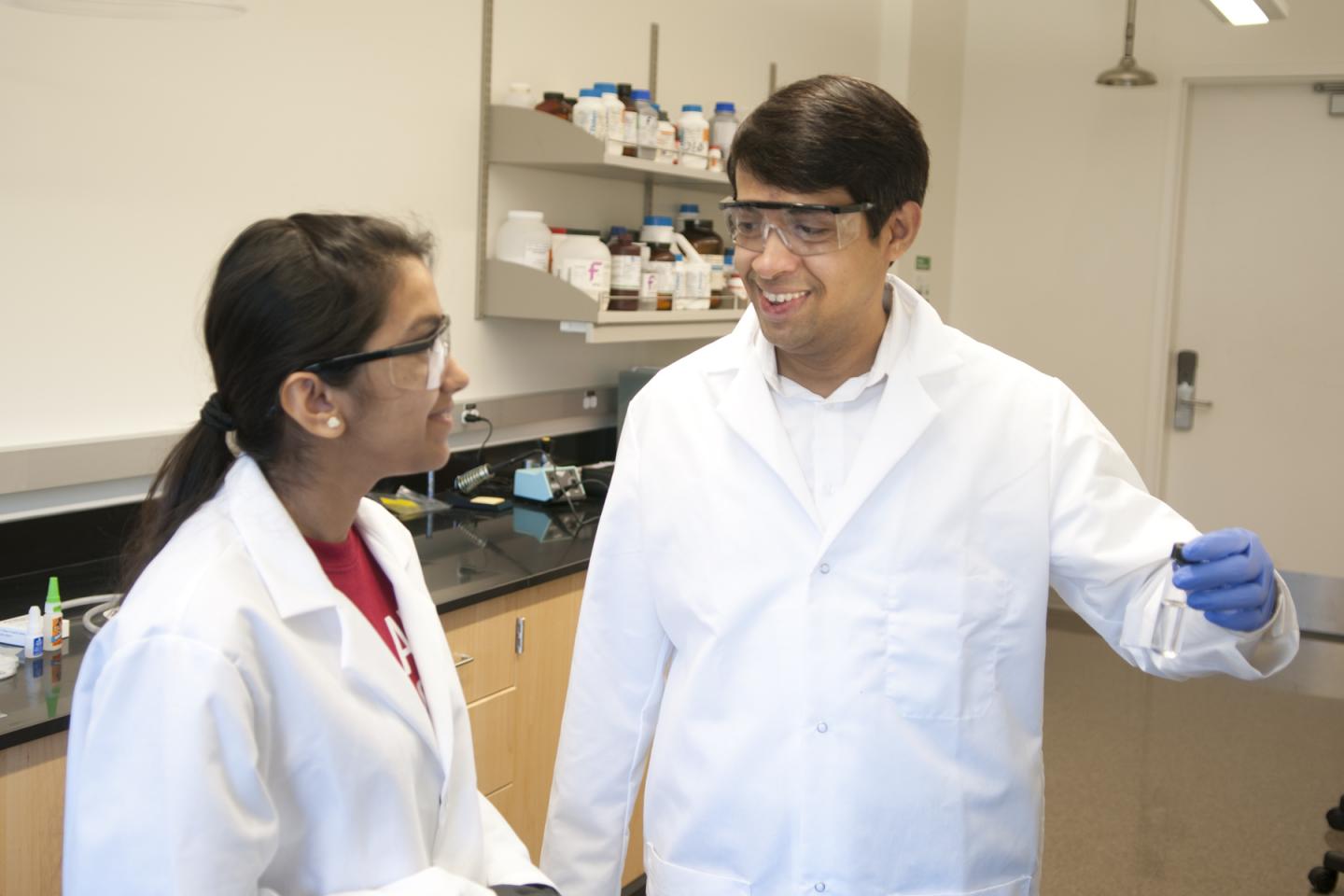
Credit: WSU


A Washington State University research team has found that nanoscale particles of the most commonly used plastics tend to move through the water supply, especially in fresh water, or settle out in wastewater treatment plants, where they end up as sludge, in landfills, and often as fertilizer.

Neither scenario is good.

“We are drinking lots of plastics,” said Indranil Chowdhury, an assistant professor in WSU’s Department of Civil and Environmental Engineering, who led the research. “We are drinking almost a few grams of plastics every month or so. That is concerning because you don’t know what will happen after 20 years.” 

The researchers, including graduate students, Mehanz Shams and Iftaykhairul Alam, examined what happens to tiny, nanoscale plastics that are making their way into the aquatic environment. They have published their work in the high-impact journal, Water Research.  
 

It’s estimated that every day about eight trillion pieces of microplastics go through wastewater treatment plants and end up in the aquatic environment.

These little bits of plastic can come from the degradation of larger plastics or from microbeads that are used in personal care products.

A recent study showed that more than 90 percent of tap water in the U.S. contains nanoscale plastics that are invisible to the human eye, Chowdury said.

In their study, the researchers studied the fate of nanoparticles of polyethylene and polystyrene, which are used in a huge number of products, including plastic bags, personal care products, kitchen appliances, disposable drinking cups and packaging material. They examined how the tiny plastic particles behaved under various chemistries, ranging from salty seawater to water containing organic material. 

“We’re looking at this more in a fundamental way,” Chowdury said.  “Why are they becoming stable and remaining in the water? Once they’re in different types of water, what makes these plastics remain suspended in the environment?”

The researchers found that while acidity of water has little impact on what happens to nanoscale plastics, salt and natural organic matter are important in determining how the plastics move or settle. What is clear is that tiny plastics are staying in the environment with unknown health and environmental consequences, he said.

“Our drinking water plants are not sufficient at removing these micro and nanoscale plastics,” he said. “We’re finding these plastics in the drinking water but we don’t know why.” 

Chowdury and his team are now studying techniques for removing the plastics from water and have recently received a grant from the State of Washington Water Research Center for that work.

In the meantime, he encourages people to lessen the impact of nanoscale plastics by reducing their use of single-use plastics. 

“Reuse plastics as much as possible,” he said.  

###

Media Contact
Indranil Chowdhury
[email protected]
509-335-3721

Original Source

https://news.wsu.edu/2020/03/13/invisible-plastics-water/

Related Journal Article

http://dx.doi.org/10.1016/j.watres.2019.115401

Tags: Chemistry/Physics/Materials SciencesEarth ScienceHydrology/Water ResourcesMedicine/HealthPollution/Remediation
Share12Tweet8Share2ShareShareShare2

Related Posts

Study Reveals How Valproate Affects Early Brain Development: Insights into the Antiepileptic Drug’s Impact — Chemistry

Study Reveals How Valproate Affects Early Brain Development: Insights into the Antiepileptic Drug’s Impact

May 22, 2026
Sustainable Chemistry: Iron Replaces Noble Metals in Catalytic Reactions — Chemistry

Sustainable Chemistry: Iron Replaces Noble Metals in Catalytic Reactions

May 22, 2026

Advancing Thin-Film Device Manufacturing with Imaging Ellipsometry for Enhanced Process Control

May 22, 2026

Simple Adjustment in 3D Printing Enhances Fit of Dental Crowns

May 22, 2026
Please login to join discussion

POPULAR NEWS

  • ESMO 2025: mRNA COVID Vaccines Enhance Efficacy of Cancer Immunotherapy

    315 shares
    Share 126 Tweet 79
  • New Study Reveals Plants Can Detect the Sound of Rain

    734 shares
    Share 293 Tweet 183
  • Research Indicates Potential Connection Between Prenatal Medication Exposure and Elevated Autism Risk

    847 shares
    Share 339 Tweet 212
  • Common Food Preservatives Associated with Elevated Blood Pressure and Increased Heart Disease Risk

    56 shares
    Share 22 Tweet 14

About

We bring you the latest biotechnology news from best research centers and universities around the world. Check our website.

Follow us

Recent News

Bone-Brain Links Show Regional Genetic and Phenotypic Variation

Socioeconomic Gaps in Elderly Chronic Disease Impact

Thermal Tolerance Does Not Influence Blue Mussel Hybrid Zone Stability

Subscribe to Blog via Email

Enter your email address to subscribe to this blog and receive notifications of new posts by email.

Join 83 other subscribers
  • Contact Us

Bioengineer.org © Copyright 2023 All Rights Reserved.

Welcome Back!

Login to your account below

Forgotten Password?

Retrieve your password

Please enter your username or email address to reset your password.

Log In
No Result
View All Result
  • Homepages
    • Home Page 1
    • Home Page 2
  • News
  • National
  • Business
  • Health
  • Lifestyle
  • Science

Bioengineer.org © Copyright 2023 All Rights Reserved.