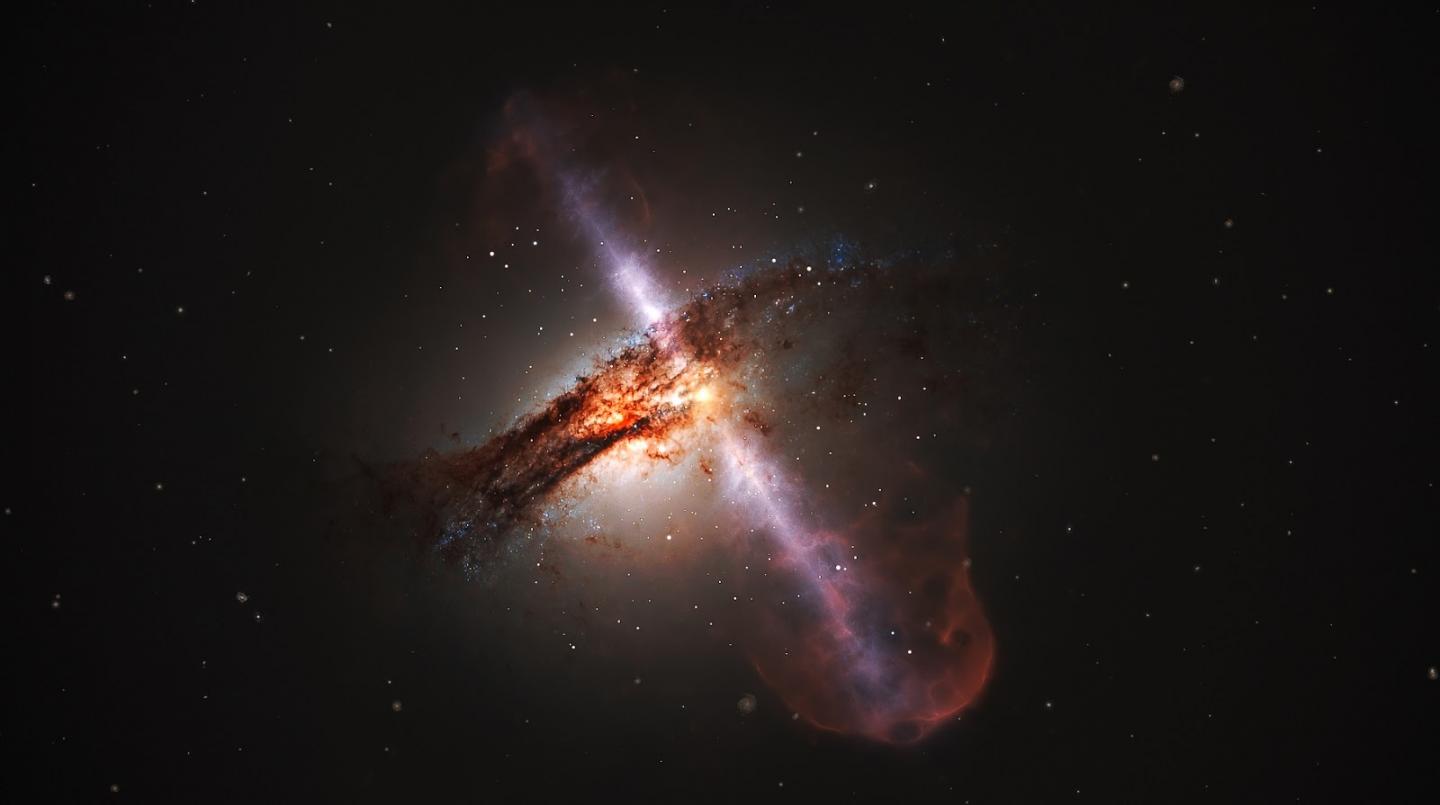
Credit: Credit: ESA/Hubble, L. Calçada (ESO)
A team of researchers from Russia and Greece has shown a way to determine the origins and nature of quasar light by its polarization. The new approach is analogous to the way cinema glasses produce a 3D image by feeding each eye with the light of a particular polarization: either horizontal or vertical. The authors of the recent study in the Monthly Notices of the Royal Astronomical Society managed to distinguish between the light coming from different parts of quasars — their disks and jets — by discerning its distinct polarizations.
Active galactic nuclei, also known as quasars, are massive black holes with matter orbiting around them. They emit two oppositely directed jets of plasma traveling out into space at close to the speed of light.
Any massive black hole has matter orbiting around it, slowly falling toward it and emitting light. This matter forms what is known as an accretion disk. Due to a mechanism that is not yet fully understood, part of the matter approaching the black hole makes an escape. It is accelerated to tremendous velocities and expelled along the black hole’s axis of rotation in the form of two symmetric jets of hot plasma. When a quasar is observed, the radiation picked up by a telescope comes from the jets, the accretion disk, and also from the stars, dust, and gas in the host galaxy.
To study galactic nuclei, researchers use a range of telescopes. Prior research had shown that the parts of a quasar emit two different kinds of light, technically referred to as distinctly polarized light.
Most of the telescopes operate in the optical range and see a galactic nucleus as a tiny faraway dot. They cannot tell which part of the quasar the light comes from and where the jet points if it happens to be the light source. All an optical telescope can do is measure the polarization of light, which has been shown to contain clues about the origins of that radiation.
Radio telescopes offer a much better resolution and produce an image that reveals the direction of the jet. However, these telescopes pick up no radiation from the most interesting central region, which includes the accretion disk.
The astrophysicists therefore had to combine the strengths of both types of telescopes for a detailed view of quasars.
Yuri Kovalev, who heads the MIPT Laboratory of Fundamental and Applied Research of Relativistic Objects of the Universe, commented: “The fact that jet radiation was polarized was known. We combined the data obtained by radio and optical telescopes, and showed that the polarization is directed along the jet. The conclusion from this is that hot plasma must be moving in a magnetic field that is coiled like a spring.”
But there’s more to it.
“It turned out that by measuring the polarization of the light picked up by the telescope, we can tell which part of radiation came from the jet and determine its direction,” another co-author of the study, MIPT’s Alexander Plavin said. “This is analogous to how 3D glasses enable each eye to see a different picture. There is no other way to obtain such information about the disk and jet with an optical telescope.”
The findings are important for modeling black hole behavior, studying accretion disks, and understanding the mechanism that accelerate particles to nearly the speed of light in active galactic nuclei.
###
The research reported in this story was supported by the Russian Science Foundation.
Media Contact
Varvara Bogomolova
[email protected]
7-916-147-4496
Original Source
https:/
Related Journal Article
http://dx.