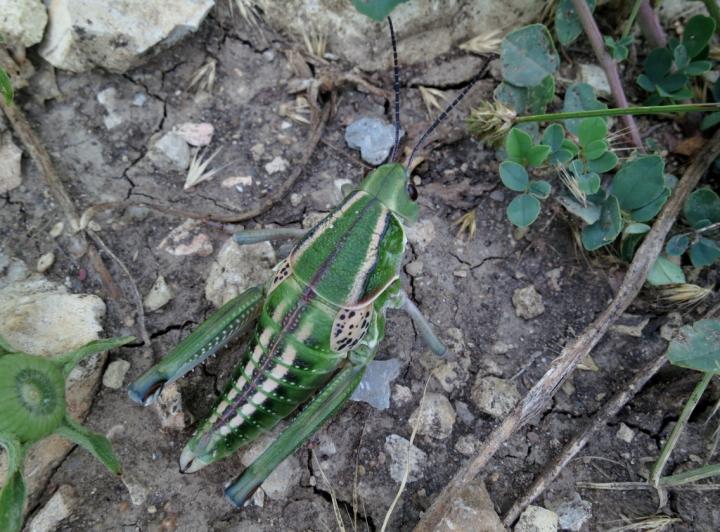
Credit: Ellen Welti
A University of Oklahoma-led study shows that grasshopper numbers have declined over 30% in a Kansas grassland preserve over the past two decades. Published in the Proceedings of the National Academy of Sciences (USA), the paper, “Nutrient dilution and climate cycles underlie declines in a dominant herbivore,” reveals a new potent and potentially widespread threat to Earth’s plant feeders: the dilution of nutrients like nitrogen, phosphorus, and sodium in the plants themselves due to increasing levels of atmospheric CO2.
Ellen Welti, of the Geographical Ecology Group in the Department of Biology at OU, led the collaboration of ecologists from OU, the University of Illinois and Kansas State University in this National Science Foundation-funded study.
Grasshoppers are abundant consumers in grasslands – a habitat that covers more than 30% of Earth’s land mass and is the source of the majority of human crops. The same decline in plant quality revealed by Welti and her colleagues has recently raised alarms about the global human food supply.
“This decline in plant nutrient concentration poses a challenge for all animals that consume plants, including humans,” Welti said.
The OU-based study adds to the growing evidence that some insect groups are declining in abundance. Such long-term data are rare but are a primary function of the National Science Foundation’s LTER (Long Term Ecological Research) sites, including Konza Prairie – a large protected tallgrass prairie reserve in northeast Kansas that provided the study’s key data.
“One surprise was that grasshopper abundances in this large native tallgrass prairie reserve are declining,” Welti said. “This grassland appears to be a stable and prime habitat for grasshoppers and yet even here, we are seeing 2% annual declines.”
The grasshoppers have been surveyed at Konza for approaching 30 years, providing a rare and detailed breakdown of this important group of insects.
The study is unique, not only in the length of the record, but in the sophisticated set of mathematical tools Welti and her colleagues implemented to account for two drivers of grasshopper populations.
“I used tools developed by geologists to look at orbital cycles, to identify cyclic patterns and understand how climate oscillations such as El Niño that may shape grasshopper abundances,” Welti said.
Michael Kaspari, George Lynn Cross Research Professor in the OU College of Arts and Sciences, was the study’s senior author.
“Where some folks look at these data – with their wide yearly swings in grasshopper numbers – and see only noise, Dr. Welti had the tools and the insight to reveal the music in the data,” Kaspari said. “That music consisted of five-year cycles in precipitation and temperature that drove changes in grasshopper numbers, as well as the plants they feed on.”
Welti and her colleagues’ second discovery – that plant quality is declining even as plant growth has nearly doubled – highlights the paradoxical nature of nutrient dilution.
“The greenhouse gas CO2 is heating the Earth and acidifying its oceans, but it is also the main ingredient in the sugars, starches, and cellulose of plants,” Kaspari said. “When we pump the atmosphere full of CO2, we build more plants. But, with no additional nutrients to fertilize them, the nutritional value of each bite is diluted. Mouthful by mouthful, the prairie provides less and less food to the grasshoppers. Hence, their decline.”
This new cause of insect declines is particularly problematic.
“The mechanism of grasshopper declines that we propose in this study – declining plant quality with increasing atmospheric CO2 – is expected to be global in scope and pose the largest challenge to herbivores. It is notable that a large number of previous studies documenting insect declines were on another herbivorous group (butterflies and moths), but few of these papers identified a mechanism causing declines,” Welti said.
The worldwide increase in CO2 highlights a potential worldwide threat to the largest group of animals: its plant feeders.
“Of late, much has been made of ‘greening the Earth’ as a tool to fight climate change,” Kaspari said. “We show that while growing plants may indeed help scrub CO2 from the atmosphere, those same plants are likely becoming and less nutritious. It is as if, by burning fossil fuels, humans are transforming all of our kale into iceberg lettuce: still edible, but less and less sustaining.”
###
Media Contact
Ellen Welti
[email protected]