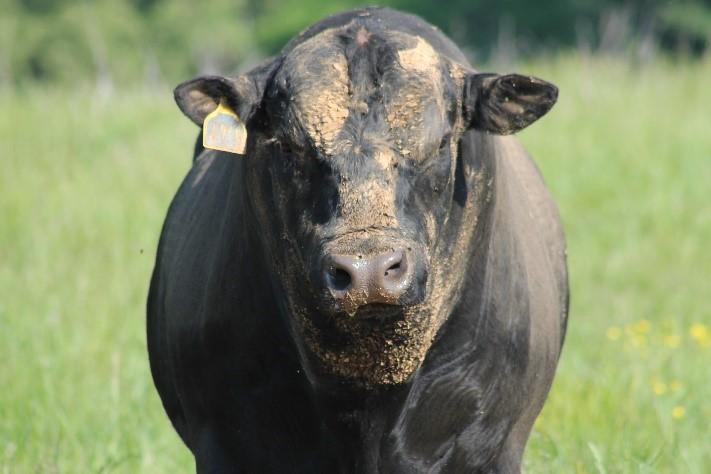
Credit: Dan Shike, University of Illinois
URBANA, Ill. – Cattle feeders choose distillers grains in feedlot diets as an inexpensive alternative to corn and soybean meal. But until now, no one had studied the effects of the common feed ingredient on bull development and fertility. With bull fertility to blame for a significant portion of reproductive failures in cow-calf operations, University of Illinois researchers decided it was worth a look.
“We get questions occasionally about the effects of distillers grains on bulls, and a recent study showed some negative effects in rams. Even though there have been hundreds of experiments done on distillers grains with growing and finishing cattle, there’s very limited bull development research from a breeding standpoint,” says Daniel Shike, associate professor in the Department of Animal Sciences at U of I and co-author on a new study in Translational Animal Science.
In the study, eight-month-old Simmental × Angus bulls consumed either a 40% distillers-grain diet or a standard corn-based diet for 140 days, then they all switched to a common low-energy diet for 70 days.
“We chose the 40% inclusion rate, which is kind of on the high end, thinking there’s really no reason to have distillers inclusion greater than that in most practical situations,” Shike says. “Then we collected data on just about everything under the sun.”
Throughout the study, the researchers measured growth performance, body condition, and hoof development, as well as a wide array of reproductive metrics. Shike and his team wanted to make the most of the opportunity to take a detailed look at bull development, citing a lack of basic information in the scientific literature.
At the end of the initial 140-day experimental treatment, only one reproductive metric differed between the groups of bulls. Those that ate distillers grains had a higher percentage of sperm with “proximal droplets,” tiny fluid-filled sacs near the head of the sperm. Normally, these droplets shake down the flagella with movement, and eventually are flung away. But when they’re retained close to the head, it’s considered a major defect that could affect reproductive capacity. However, after 70 days on the low-energy diet, the problem resolved.
Similarly, bulls that consumed distillers grains had greater body weight and fat at a couple of time points during the experiment, but, by the end of the study, the researchers could only detect a slight difference in body fat between the two groups of animals.
“We wanted the study to be typical of what bulls experience around here. The distillers grain is a little higher in fat and energy, so they’re really being developed on a higher plane of nutrition to get ready for sale time. When people go to bull sales, they like to see well-developed heavyweight bulls. But then we’ve got to cool them back down again, back into their working condition. So that’s why we evaluated them at the end of that low-energy common diet period as well,” Shike says.
The fact that the two groups of bulls were essentially indistinguishable at the end of the study is good news for feeders utilizing distillers grains. However, Shike notes that the source of distillers grains used in the study was relatively low in sulfur; the experimental diet contained 0.23% sulfur as formulated, coming in below the 0.3% threshold for potential toxicity.
“That’s a little bit of a disclaimer. If your distillers had elevated sulfur content, I would recommend a lower inclusion than 40%,” he says. “Sources vary, and that’s a potential problem. It’s getting better, though. They’re getting more predictable and they’re getting lower across the board.
“The bottom line is, assuming sulfur content is not at a toxic level, we can utilize distillers in bull development rations, with very similar results as if they were developed on a corn-based diet.”
###
The article, “Influence of distillers grains with solubles on bull growth and reproductive traits,” is published in Translational Animal Science [DOI: 10.1093/tas/txz189]. Co-authors include Parker Henley, Giorgia Podico, Edgar Garrett, Claire Kaplan, William Meteer, Joshua McCann, Igor Canisso, and Daniel Shike. The work was funded by the Illinois Beef Association’s checkoff program.
The Department of Animal Sciences is in the College of Agricultural, Consumer and Environmental Sciences at the University of Illinois.
Media Contact
Lauren Quinn
[email protected]
217-300-2435
Original Source
https:/
Related Journal Article
http://dx.