By combining modern data analysis techniques with stellar structure modelling for main-sequence and giant stars, researchers shed new light on stellar dynamos.
Credit: MPS / Aalto University / hormesdesign.de
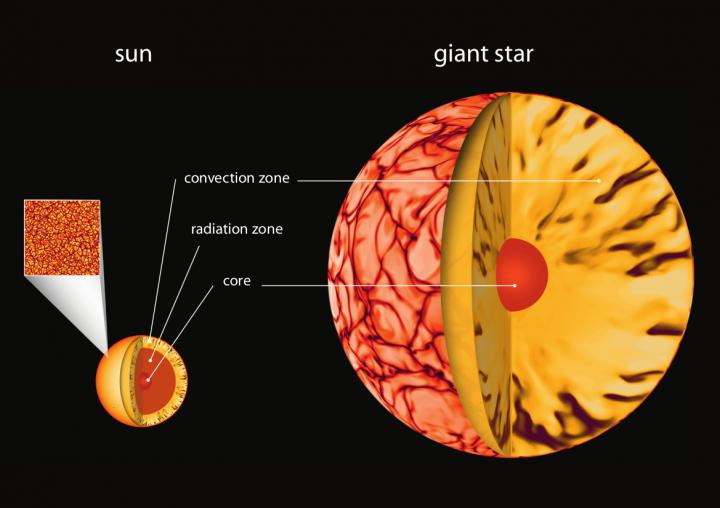
In their interiors, stars are structured in a layered, onion-like fashion. In those with solar-like temperatures, the core is followed by the radiation zone. There, the heat from within is led outwards by means of radiation. As the stellar plasma becomes cooler farther outside, heat transport is dominated by plasma flows: hot plasma from within rises to the surface, cools, and sinks down again. This process is called convection. At the same time, the star’s rotation, which depends on stellar latitude, introduces shear movements. Together, both processes twist and twirl magnetic field lines and create a star’s complex magnetic fields in a dynamo process that is not yet fully understood.
“Unfortunately, we cannot look directly into the Sun and other stars to see these processes in action, but have to resort to more indirect methods”, says Dr. Jyri Lehtinen from the Max Planck Institute for Solar System Research (MPS) in Germany, first author of the new paper published today in Nature Astronomy. In their current study, the researchers compared different stars’ activity levels on the one hand, and their rotational and convective properties on the other. The goal was to determine, which properties have a strong influence on activity. This can help to understand the specifics of the dynamo process within.
Several models of the stellar dynamo have been proposed in the past, but two main paradigms prevail. While one of them puts a greater emphasis on the rotation and assumes only subtle effects of convectional flows, the other depends crucially on turbulent convection. In this type of convection, the hot stellar plasma does not rise to the surface in large-scale, sedate motions. Rather, small-scale vigorous flows dominate.
In order to find evidence for one or the other of the two paradigms, Lehtinen and his colleagues for the first time took a look at 224 very different stars. Their sample contained both main sequence stars, which are so to say in the prime of their life, and older, more evolved giant stars. Typically, both convection and rotational properties of stars change as they age. Compared to main sequence stars, evolved stars exhibit a thicker convection zone often expanding over much of the star’s diameter and sometimes superseding the radiation zone completely. This leads to longer turnover times for convective heat transport. At the same time, rotation usually slows down.
For their study, the researchers analyzed a data set obtained at Mount Wilson Observatory in California (USA), which over several years recorded the stars’ emissions in wavelengths typical of calcium ions found in the stellar plasma. These emissions are not only correlated with the stars’ activity level. Complex data processing also made it possible to infer the stars’ rotation periods.
Like the Sun, stars are sometimes dappled with regions of extremely high magnetic field strength, so-called active regions, which are often associated with dark spots on the stars’ visible surface. “As a star rotates, these regions come into view and pass out of it leading to a periodic rise and fall in emission brightness”, Prof. Dr. Maarit Käpylä from Aalto University in Finland, who also heads the research group “Solar and Stellar Dynamos” at MPS, explains. However, since stellar emissions can also fluctuate due to other effects, identifying periodic variations – especially over long periods – is tricky.
“Some of the stars we studied show rotation periods of several hundreds of days, and surprisingly still a magnetic activity level similar to the other stars, and remarkably even magnetic cycles like the Sun”, says Dr. Nigul Olspert from MPS, who analyzed the data. The Sun, in comparison, rotates rather briskly with a rotation period of only approximately 25 days at the solar equator. The convective turnover times were calculated by means of stellar structure modelling taking into account each star’s mass, chemical composition, and evolutionary stage.
The scientists’ analysis shows that a star’s activity level does not – as had been suggested by other studies based on smaller and more uniform samples including only main sequence stars – depend only on its rotation. Instead, only if convection is accounted for, can the behavior of main-sequence and evolved stars be understood in a unified manner. “The coaction of rotation and convection determine how active a star is”, Prof. Käpylä summarizes. “Our results tip the scales in favor of the dynamo mechanism including turbulent convection”, she adds.
###
Media Contact
Birgit Krummheuer
[email protected]
49-551-384-979-462
Related Journal Article
http://dx.