First step to accomplishment of next-generation batteries superior to conventional lithium-ion batteries
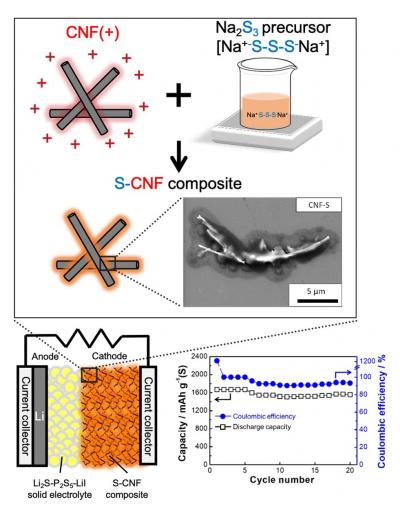
Credit: COPYRIGHT (C) TOYOHASHI UNIVERSITY OF TECHNOLOGY. ALL RIGHTS RESERVED.
Overview:
Prof. Atsunori Matsuda, Prof. Hiroyuki Muto, Assistant Prof. Kazuhiro Hikima, Assistant Prof. Nguyen Huu Huy Phuc, Researcher Reiko Matsuda, and Mr. Takaki Maeda (Master Program) at the Department of Electrical and Electronic Information Engineering, Toyohashi University of Technology have made an active sulfur material and carbon nanofiber (CNF) composite using a low-cost and straightforward liquid phase process. All-solid-state lithium-sulfur batteries using a sulfur-CNF composite material obtained by liquid phase process show a higher discharge capacity and better cycle stability than those of lithium-ion secondary batteries. Thus, this all-solid-state lithium-sulfur batteries enable leading to applications in large scale batteries such as electric vehicles in the future.
Details:
Lithium-ion secondary batteries, which was awarded the Nobel Prize in chemistry last year, have been widely used as power sources for smartphones, electric vehicles, etc. All-solid-state batteries have also attracted attention as next-generation batteries in recent years because of the increase with hybrid and electric vehicles. In particular, all-solid-state lithium-sulfur batteries have attracted attention because of five times higher energy density than conventional lithium-ion secondary batteries. However, sulfur is an insulator, which thus limits their application in battery devices. In order to solve this issue, sulfur must be provided with an ionic and electron-conductive path.
Our research group suggested that cathode composites by combining a sulfur active material and carbon nanofiber (CNF) by an electrostatic assembly method, which can uniformly combine materials in a solution. All-solid-state lithium sulfur batteries using sulfur-CNF composites and electrochemically stable Li2S-P2S5-LiI solid electrolytes synthesized by liquid phase process showed high discharge capacity equivalent to the theoretical capacity of sulfur and maintained high capacity after repeated charge-discharge cycles.
The first author, Assistant Prof. Nguyen Huu Huy Phuc of Toyohashi University of Technology explained its features “It is required that a sulfur active material and a carbon material are appropriately combined for making high-performance all-solid-state lithium sulfur batteries. Conventionally, sulfur-carbon composites were synthesized by mechanical mixing, liquid mixing using a special organic solvent and complicated methods, in which sulfur is combined with a porous carbon material with a high specific surface area. However, there were few reports that all-solid-state lithium sulfur batteries showed high capacity almost equivalent to the theoretical capacity of sulfur and high cycle stability. Therefore, we focused on making a sulfur-carbon composite using a low-cost and simple electrostatic adsorption method which can uniformly combine nanomaterials. It was confirmed that sulfur at the sulfur-carbon composite synthesized by electrostatic adsorption method was accumulated on carbon nanofiber in the form of sheets. Besides, we constructed all-solid-state lithium sulfur batteries and found that sulfur was fully utilized as an active material. The other merit is that this sulfur-carbon composite can be produced by lower cost than conventional processes.”
Development background:
The electrostatic adsorption method is that larger mother particles and smaller particles are electrostatically adsorbed by adjusting surface charges of the particles using polyelectrolytes in order to induce an electrostatic interaction. Although design of a variety of ceramic composites by the electrostatic adsorption were already reported, the adjustment of the surface charges of sulfur is difficult. However, our research group succeeded in the charge adjustment by using chemical reactions, in which Na2S and S reacted in ion-exchanged water to form aqueous soluble Na2S3. Therefore, this study achieved a new chemical process by applying the basic principle of electrostatic adsorption.
Future outlook:
This method is a low-cost and relatively simple method for preparing sulfur-carbon composites, so it is suitable for mass production. All-solid-state lithium-sulfur batteries using a sulfur active material will be put to practical use by this method. Besides, it is expected the exponential improvement in the energy density of electric vehicles, large-sized power source batteries for household and business use.
###
Acknowledgments:
This study was supported by the Advanced Low Carbon Technology Specially Promoted Research for Innovative Next Generation Batteries (ALCA-SPRING, JPMJAL1301) program of the Japan Science and Technology Agency (JST).
Reference:
Nguyen Huu Huy Phuc, Maeda Takaki, Hiroyuki Muto, Matsuda Reiko, Hikima Kazuhiro, and Atsunori Matsuda (2020). Sulfur-Carbon Nano Fiber Composite Solid Electrolyte for all-solid-state Li-S Batteries, ACS Applied Energy Materials, DOI: 10.1021/acsaem.9b02062
Media Contact
Yuko Ito
[email protected]
Related Journal Article
http://dx.