• HOME
  • NEWS
  • EXPLORE
    • CAREER
      • Companies
      • Jobs
    • EVENTS
    • iGEM
      • News
      • Team
    • PHOTOS
    • VIDEO
    • WIKI
  • BLOG
  • COMMUNITY
    • FACEBOOK
    • INSTAGRAM
    • TWITTER
Sunday, October 4, 2026
BIOENGINEER.ORG
No Result
View All Result
  • Login
  • HOME
  • NEWS
  • EXPLORE
    • CAREER
      • Companies
      • Jobs
        • Lecturer
        • PhD Studentship
        • Postdoc
        • Research Assistant
    • EVENTS
    • iGEM
      • News
      • Team
    • PHOTOS
    • VIDEO
    • WIKI
  • BLOG
  • COMMUNITY
    • FACEBOOK
    • INSTAGRAM
    • TWITTER
  • HOME
  • NEWS
  • EXPLORE
    • CAREER
      • Companies
      • Jobs
        • Lecturer
        • PhD Studentship
        • Postdoc
        • Research Assistant
    • EVENTS
    • iGEM
      • News
      • Team
    • PHOTOS
    • VIDEO
    • WIKI
  • BLOG
  • COMMUNITY
    • FACEBOOK
    • INSTAGRAM
    • TWITTER
No Result
View All Result
Bioengineer.org
No Result
View All Result
Home NEWS Science News Chemistry

Cooling magnets with sound

Bioengineer by Bioengineer
March 5, 2020
in Chemistry
Reading Time: 2 mins read
0
IMAGE
Share on FacebookShare on TwitterShare on LinkedinShare on RedditShare on Telegram

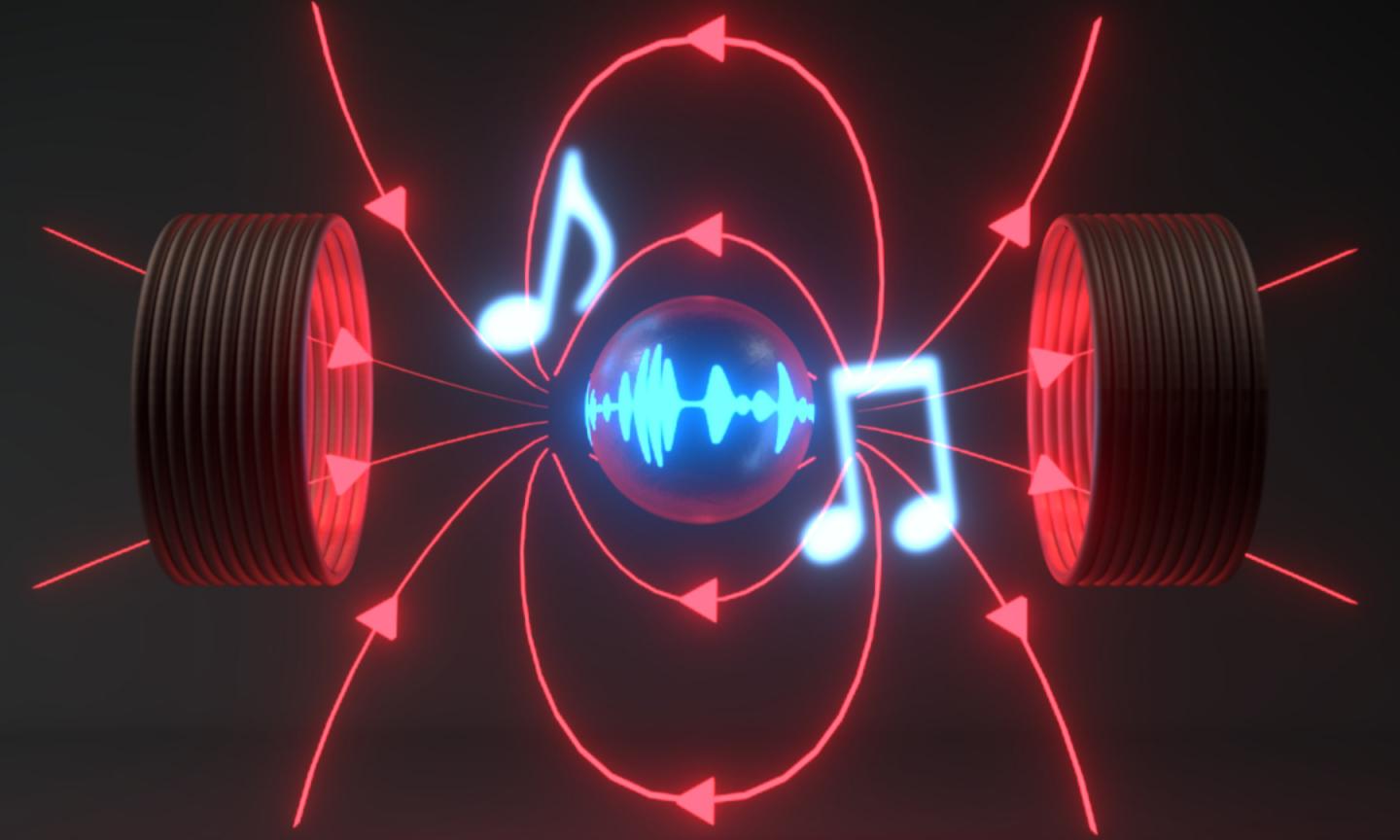
Quantum physicists are proposing to cool microparticles with sound waves
IMAGE

Credit: Carlos Sánchez Muñoz


While quantum physics is usually concerned with the basic building blocks of light and matter, for some time scientists have now been trying to investigate the quantum properties of larger objects, thereby probing the boundary between the quantum world and everyday life. For this purpose, particles are slowed down with the help of electromagnetic waves and the motional energy is drastically reduced. Therefore, one also speaks of “motional cooling”. Quantum properties occur when particles are cooled to their fundamental quantum ground state, that is to the lowest possible energy level. While so far the only way to cool particles to the ground state has been to make them interact with photons trapped in an electromagnetic resonator, theoretical physicists led by Carlos Gonzalez-Ballestero and Oriol Romero-Isart from the Department of Theoretical Physics at the University of Innsbruck and the Institute of Quantum Optics and Quantum Information (IQOQI) of the Austrian Academy of Sciences in collaboration with experimentalist Jan Gieseler from Harvard University and ICFO in Barcelona now propose to make the motion of magnetic particles interact with the internal acoustic waves that are confined inside every particle.

Sound waves in micro-magnets

In analogy to photons – the quanta of light – vibrations in a solid body can be described as so-called phonons. These small sound wave packets propagate through the crystal lattice of the solid. “The phonons are very isolated and interact with the movement of the particle motion only through magnetic waves,” explains Carlos Gonzalez-Ballestero. “In our work we now show that this interaction can be controlled by a magnetic field.” This allows to realize quantum experiments without photons, and therefore even with light-absorbing particles. “Conversely, we also show that the strong interaction between motion and phonons provides a path to probe and manipulate the elusive and exotic dynamics of acoustic and magnetic waves in very small particles,” adds Oriol Romero-Isart. The new method also opens up new possibilities for quantum information processing, for example, by using phonons as a quantum memory.

###

Two papers of the Innsbruck physicists present their new approach in the journals Physical Review Letters and Physical Review B. Financial support was provided by the European Union.

Publications:

Quantum Acoustomechanics with a Micromagnet. Carlos Gonzalez-Ballestero, Jan Gieseler, and Oriol Romero-Isart. Phys. Rev. Lett. 124, 093602 DOI: 10.1103/PhysRevLett.124.093602 [arXiv:1907.04039]

Theory of Quantum Acoustomagnonics and Acoustomechanics with a Micromagnet. Carlos Gonzalez-Ballestero, Daniel Hümmer, Jan Gieseler, and Oriol Romero-Isart. Phys. Rev. B 101, 125404 DOI: 10.1103/PhysRevB.101.125404 [arXiv:1912.08745]

Links:

Quantum Nanophysics, Optics and Information
https://iqoqi.at/en/group-page-romero-isart

Media Contact
Carlos Gonzalez-Ballestero
[email protected]
43-512-507-4770

Related Journal Article

http://dx.doi.org/10.1103/PhysRevLett.124.093602

Tags: Atomic PhysicsChemistry/Physics/Materials Sciences
Share12Tweet8Share2ShareShareShare2

Related Posts

Banana Peels Turn Into Catalysts That Boost Bio-Oil From Sewage Sludge

Banana Peels Turn Into Catalysts That Boost Bio-Oil From Sewage Sludge

October 4, 2026
Squeezing Polypropylene Flips Its Insulation From Rubbery to Glassy Conduction

Squeezing Polypropylene Flips Its Insulation From Rubbery to Glassy Conduction

October 4, 2026

Sulfated Seaweed Polymer Helps Gels Protect Anthocyanins Until the Gut

October 4, 2026

Nickel and Lithium Doping Face Off in Zinc Oxide Films for Supercapacitors

October 4, 2026
Please login to join discussion

POPULAR NEWS

  • Alloys That Shrink Their Own Grains: New PIX Mechanism Refines Metals With Heat Alone

    Alloys That Shrink Their Own Grains: New PIX Mechanism Refines Metals With Heat Alone

    29 shares
    Share 12 Tweet 7
  • Endurance Exercise Reshapes the Liver in Males and Females Through Distinct Molecular Routes

    29 shares
    Share 12 Tweet 7
  • Single Transcription Factor PU.1 Rapidly Converts Fibroblasts into Macrophage-Lineage Cells

    29 shares
    Share 12 Tweet 7
  • New Scale Measures How Ready Nurse Educators Really Are for the AI Era

    29 shares
    Share 12 Tweet 7

About

We bring you the latest biotechnology news from best research centers and universities around the world. Check our website.

Follow us

Recent News

Alloys That Shrink Their Own Grains: New PIX Mechanism Refines Metals With Heat Alone

Endurance Exercise Reshapes the Liver in Males and Females Through Distinct Molecular Routes

Single Transcription Factor PU.1 Rapidly Converts Fibroblasts into Macrophage-Lineage Cells

Subscribe to Blog via Email

Success! An email was just sent to confirm your subscription. Please find the email now and click 'Confirm' to start subscribing.

Join 85 other subscribers
  • Contact Us

Bioengineer.org © Copyright 2023 All Rights Reserved.

Welcome Back!

Login to your account below

Forgotten Password?

Retrieve your password

Please enter your username or email address to reset your password.

Log In
No Result
View All Result
  • Homepages
    • Home Page 1
    • Home Page 2
  • News
  • National
  • Business
  • Health
  • Lifestyle
  • Science

Bioengineer.org © Copyright 2023 All Rights Reserved.