The model developed by Lobachevsky University scientists can provide a tool for quantitative prediction of photodamage and development of adaptive changes of the plant photosynthetic apparatus under variations in lighting intensity
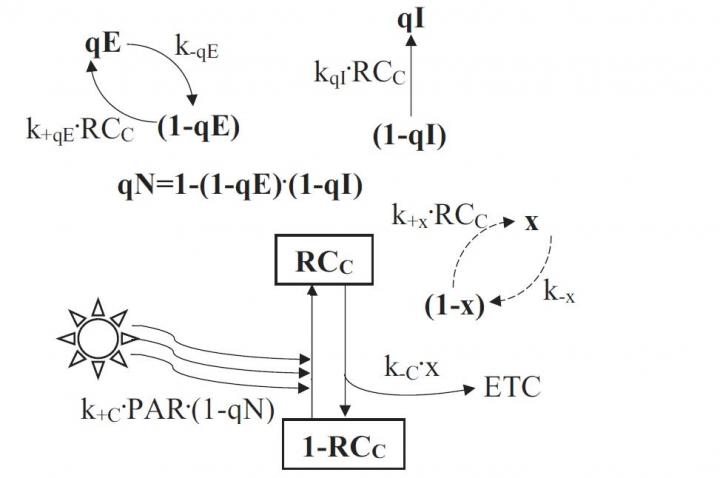
Credit: Lobachevsky University
Light is the main source of energy for photosynthesis, it underlies the production process in plants. At the same time, excessive lighting can lead to photodamage of the photosynthetic apparatus and, indirectly, of other structures of the plant cell. In order to avoid such damage, plants have developed a number of protective mechanisms, including the so-called non-photochemical fluorescence quenching.
Non-photochemical fluorescence quenching develops under the action of high intensity lighting and other stressors, which leads to a decrease in the light flux absorbed by the photosynthetic apparatus.
According to Vladimir Sukhov, Head of the Laboratory of Plant Electrophysiology at the Institute of Biology and Biomedicine of Lobachevsky University, non-photochemical quenching plays a key role in protecting plants from adverse lighting conditions, and the research in this field is very important in plant physiology and agricultural sciences.
“The development of mathematical models of non-photochemical quenching is of special importance, as such models allow us to predict photodamage and adaptive changes in plant resistance under certain lighting modes without additional experimental research”, Vladimir Sukhov notes.
The forecasts obtained by Lobachevsky University researchers can be used both for solving fundamental scientific problems and for applied purposes (for example, when developing new modes of artificial illumination of plants in greenhouses or for forecasting plant damage under certain weather conditions).
The article of Ekaterina Sukhova, post-graduate student of the Lobachevsky University Department of Biophysics, published with co-authors in Biochimica et Biophysica Acta – Bioenergetics, one of the leading journals in the field of photosynthesis research, focuses on the development of a mathematical model of non-photochemical quenching of chlorophyll fluorescence in plants and describes the peculiarities of such quenching under fluctuations of lighting intensity.
The proposed model describes the transitions between “open” (those that have not received a quantum of light) and “closed” (those that have received a quantum of light) reaction centers of photosystem II and the subsequent activation of the nonphotochemical quenching component by closed reaction centers.
“The peculiarity of the model is the description of photosystem II activation in the light and its inactivation in the dark, which was implemented in one of the versions of our model. This description significantly expands the applicability of the proposed model. In particular, it became possible to use the model to predict the effect of rapid light intensity changes on plants”, explains Ekaterina Sukhova.
The model was verified on the basis of experimental data obtained using the modern method of photosynthesis research – PAM-fluorometry (pulse amplitude modulated fluorometry).
The verification showed that the model allows an accurate prediction of the development of non-photochemical quenching and photodamage in plants under fluctuating light intensity, including alternating periods of darkness and periods of plant illumination.
“From the practical point of view, the proposed model should become a tool enabling quantitative prediction of photodamage and the development of adaptive changes in plant photosynthetic apparatus under fluctuations in light intensity”, concludes Ekaterina Sukhova.
Lobachevsky University researchers have identified only some areas for potential application of this new and important tool:
- prediction of light damage to plants under specific weather conditions in the field (i.e., at certain intensity and fluctuations of natural lighting).
- accelerated search for the most effective additional lighting modes in mixed plant lighting greenhouses (natural light plus additional artificial lighting).
- theoretical search for lighting modes that provide additional resistance of the photosynthetic apparatus to stressors of different nature.
###
The research was carried out with the financial support of the Russian Foundation for Basic Research, Project 18-34-00644 mol_a (headed by E.M. Sukhova) and Project 18-44-520009 (headed by V.S. Sukhov).
Media Contact
Alexey Pomazov
[email protected]
Related Journal Article
http://dx.