• HOME
  • NEWS
  • EXPLORE
    • CAREER
      • Companies
      • Jobs
    • EVENTS
    • iGEM
      • News
      • Team
    • PHOTOS
    • VIDEO
    • WIKI
  • BLOG
  • COMMUNITY
    • FACEBOOK
    • INSTAGRAM
    • TWITTER
Friday, March 27, 2026
BIOENGINEER.ORG
No Result
View All Result
  • Login
  • HOME
  • NEWS
  • EXPLORE
    • CAREER
      • Companies
      • Jobs
        • Lecturer
        • PhD Studentship
        • Postdoc
        • Research Assistant
    • EVENTS
    • iGEM
      • News
      • Team
    • PHOTOS
    • VIDEO
    • WIKI
  • BLOG
  • COMMUNITY
    • FACEBOOK
    • INSTAGRAM
    • TWITTER
  • HOME
  • NEWS
  • EXPLORE
    • CAREER
      • Companies
      • Jobs
        • Lecturer
        • PhD Studentship
        • Postdoc
        • Research Assistant
    • EVENTS
    • iGEM
      • News
      • Team
    • PHOTOS
    • VIDEO
    • WIKI
  • BLOG
  • COMMUNITY
    • FACEBOOK
    • INSTAGRAM
    • TWITTER
No Result
View All Result
Bioengineer.org
No Result
View All Result
Home NEWS Science News Chemistry

The IKBFU scientists created the first diamond x-ray micro lens

Bioengineer by Bioengineer
March 3, 2020
in Chemistry
Reading Time: 2 mins read
0
IMAGE
Share on FacebookShare on TwitterShare on LinkedinShare on RedditShare on Telegram

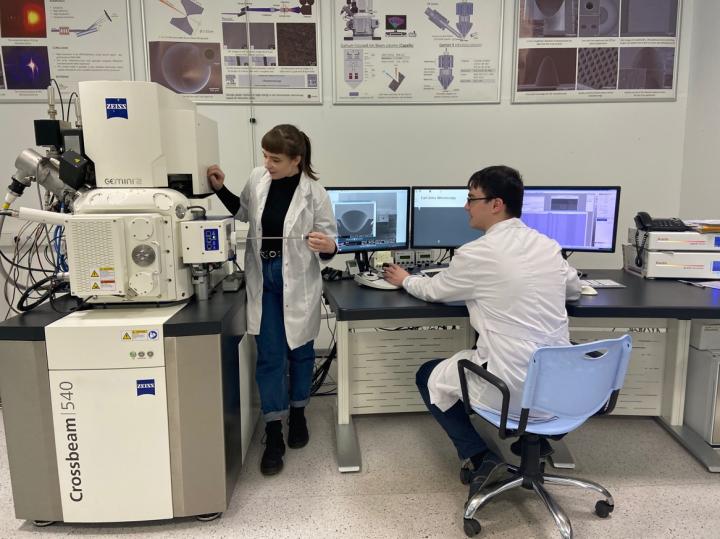
After the synchrotrons of the fourth generation were invented there was an urgent need for a fundamentally new optics that could withstand high temperatures and radiation loads
IMAGE

Credit: Immanuel Kant Baltic Federal University


After the synchrotrons of the fourth generation were invented (these are particle accelerators, which are, in fact, giant research facilities), there was an urgent need for a fundamentally new optics that could withstand high temperatures and radiation loads created by a powerful x-ray stream.

Scientists use metal and polymer lenses, but they are short-lived and the image they produce is distorted.

Several days ago the Optics Express scientific journal has published an article of the IKBFU scientists who offered a new innovative method of diamond x-ray microlens production.

Polina Medvedskaya, the scientist at the “Coherent Optics for Mega science-class plants” research center told us:

“A diamond is a unique and expensive material. But it is almost indestructible which makes the lens made of it more economically profitable than metallic or polymeric ones in the long run. The problem is that a diamond is the hardest material on the planet and it is extremely difficult to process. But we have found a way to do it. The IKBFU scientists used an electron-ion microscope (FIB) to process it”

Another scientist from the center Ivan Lyatun explained:

“It is concerning for a layman how is it possible to process something by using a microscope? But we have the microscope set on certain configuration that allows it not only to be used as a tool for analysis, but also to shape objects in the necessary form. Using microscopes like the one we make ultra-thin, nano-level cuts. And so we decided to make a microlens”

The result exceeded scientists’ expectations. A series of thinner-than-human-hair lenses were produced and it may be used for in the most powerful synchrotrons and x-ray lasers. According to the scientists, the use of lenses made by them will make it possible to obtain more detailed information about any material – to study the structure of nanostructures, to obtain maximum information about protein crystals, which will make it possible to synthesize new drugs.

In a word, new diamond lenses will allow us to penetrate deeper into the secrets of matter, to find out what was previously hidden from the eyes of man.

###

Media Contact
Sergey Bulanov
[email protected]
7-921-268-5362

Original Source

http://eng.kantiana.ru/news/261308/

Related Journal Article

http://dx.doi.org/10.1364/OE.384647

Tags: Atomic/Molecular/Particle PhysicsChemistry/Physics/Materials SciencesMaterialsMolecular PhysicsNanotechnology/MicromachinesOpticsParticle Physics
Share12Tweet8Share2ShareShareShare2

Related Posts

Isolated H2-Reduced Clusters Boost CO2-to-Methanol Catalysis

Isolated H2-Reduced Clusters Boost CO2-to-Methanol Catalysis

March 25, 2026
blank

Physicists Identify Electronic Drivers Behind Flat Band Quantum Materials

March 21, 2026

Würzburg Chemistry Professor Claudia Höbartner Receives Prestigious Honor

March 20, 2026

Scientists Reveal How Magnets Control Metamaterial Behavior

March 20, 2026
Please login to join discussion

POPULAR NEWS

  • blank

    Revolutionary AI Model Enhances Precision in Detecting Food Contamination

    96 shares
    Share 38 Tweet 24
  • Imagine a Social Media Feed That Challenges Your Views Instead of Reinforcing Them

    1003 shares
    Share 397 Tweet 248
  • Uncovering Functions of Cavernous Malformation Proteins in Organoids

    54 shares
    Share 22 Tweet 14
  • Promising Outcomes from First Clinical Trials of Gene Regulation in Epilepsy

    51 shares
    Share 20 Tweet 13

About

We bring you the latest biotechnology news from best research centers and universities around the world. Check our website.

Follow us

Recent News

In-Sensor Cryptography Links Physical Process to Digital Identity

Can Psychosocial Factors Influence Cancer Risk?

Depression Factors in Elderly: Pre vs. Post-COVID Analysis

Subscribe to Blog via Email

Success! An email was just sent to confirm your subscription. Please find the email now and click 'Confirm' to start subscribing.

Join 78 other subscribers
  • Contact Us

Bioengineer.org © Copyright 2023 All Rights Reserved.

Welcome Back!

Login to your account below

Forgotten Password?

Retrieve your password

Please enter your username or email address to reset your password.

Log In
No Result
View All Result
  • Homepages
    • Home Page 1
    • Home Page 2
  • News
  • National
  • Business
  • Health
  • Lifestyle
  • Science

Bioengineer.org © Copyright 2023 All Rights Reserved.