• HOME
  • NEWS
  • EXPLORE
    • CAREER
      • Companies
      • Jobs
    • EVENTS
    • iGEM
      • News
      • Team
    • PHOTOS
    • VIDEO
    • WIKI
  • BLOG
  • COMMUNITY
    • FACEBOOK
    • INSTAGRAM
    • TWITTER
Thursday, April 9, 2026
BIOENGINEER.ORG
No Result
View All Result
  • Login
  • HOME
  • NEWS
  • EXPLORE
    • CAREER
      • Companies
      • Jobs
        • Lecturer
        • PhD Studentship
        • Postdoc
        • Research Assistant
    • EVENTS
    • iGEM
      • News
      • Team
    • PHOTOS
    • VIDEO
    • WIKI
  • BLOG
  • COMMUNITY
    • FACEBOOK
    • INSTAGRAM
    • TWITTER
  • HOME
  • NEWS
  • EXPLORE
    • CAREER
      • Companies
      • Jobs
        • Lecturer
        • PhD Studentship
        • Postdoc
        • Research Assistant
    • EVENTS
    • iGEM
      • News
      • Team
    • PHOTOS
    • VIDEO
    • WIKI
  • BLOG
  • COMMUNITY
    • FACEBOOK
    • INSTAGRAM
    • TWITTER
No Result
View All Result
Bioengineer.org
No Result
View All Result
Home NEWS Science News Chemistry

Study finds ‘silent’ genetic variations can alter protein folding

Bioengineer by Bioengineer
March 2, 2020
in Chemistry
Reading Time: 2 mins read
0
IMAGE
Share on FacebookShare on TwitterShare on LinkedinShare on RedditShare on Telegram

IMAGE

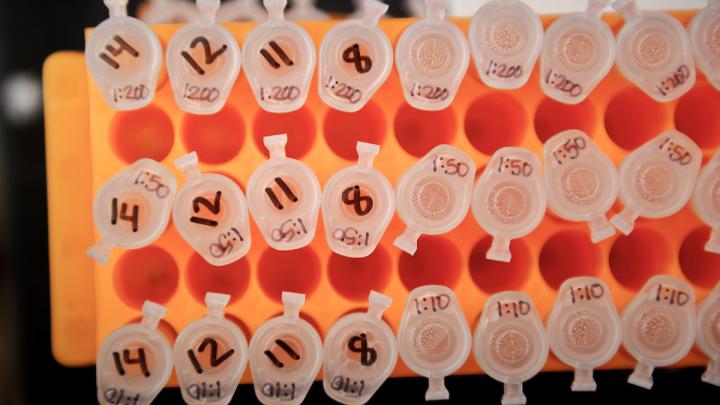
Credit: Photo by Matt Cashore/University of Notre Dame


Proteins, the workhorse of the human cell, help digest our food, carry oxygen though the body, fight off invading microbes, and so much more — but they only function when folded properly into specific, three dimensional structures.

Misfolded proteins contribute to a number of diseases — including cystic fibrosis, juvenile cataracts, Alzheimer’s disease and many forms of cancer.

Scientists have long ignored half of all mutations in the genetic sequences of our DNA, called synonymous or “silent” mutations, because these mutations were thought to not affect the process by which amino acid sequences lead proteins to fold properly. Now, new research from the University of Notre Dame shows these silent mutations are worth a closer look.

“Synonymous mutations were long considered to be genomic background noise, but we found they do indeed lead to altered protein folding, and in turn impair cell function,” said Patricia Clark, the Rev. John Cardinal O’Hara professor of biochemistry at the University of Notre Dame, and lead author of the study. “Our results show that synonymous variations in our DNA sequences — which account for most of our genetic variation — can have a significant impact on shaping the fitness level of cellular proteins.”

Clark and her team studied the genetic sequence of a naturally occurring antibiotic-resistant gene of the bacteria, E. coli. The bacterium presented researchers with a manageable field of study, consisting of just 4,000 genes — compared to more than the 20,000 genes in humans. The team focused on how synonymous mutations altered the rate of protein synthesis by the ribosome, the molecular machine present within all cells, including human cells, that carries out the process of protein synthesis.

This study provides an answer to a hypothesis that has been floating around the field for more than 50 years, Clark said.

“It’s been extremely challenging to test this hypothesis rigorously in live cells,” she added. “The fact that we decided to work with a bacterium rather than a human cell, really helped. It enabled us to make mutations in a specific gene and determine to what extent those mutations were affecting folding.”

Further study is needed to understand just how widespread protein misfolding is due to synonymous variations. “We’re ignoring half of the DNA mutations that are out there, because we’ve decided that they’re not going to cause a problem,” said Clark. “Our study just showed they can cause a problem.”

###

Co-authors of the study include Micayla A. Bowman, Anabel Rodriguez, Iker F. Soto Santarriaga and Ian M. Walsh, also at Notre Dame. Clark is the director of the Biophysics Instrumentation Core Facility at Notre Dame.

The National Institutes of Health and the W. M. Keck Foundation funded the study.

Media Contact
Jessica Sieff
[email protected]
574-631-3933

Original Source

https://news.nd.edu/news/study-finds-silent-genetic-variations-can-alter-protein-folding/

Tags: Chemistry/Physics/Materials Sciences
Share12Tweet8Share2ShareShareShare2

Related Posts

Native Bacteria Capable of Breaking Down Dioxins Naturally Without Genetic Modification

Native Bacteria Capable of Breaking Down Dioxins Naturally Without Genetic Modification

April 9, 2026
What If Dark Matter Exists in Two Distinct States?

What If Dark Matter Exists in Two Distinct States?

April 9, 2026

Linker Histone H1 Functions as a Liquid-Like “Glue” Binding Chromatin

April 8, 2026

UH Engineer Uncovers Structural Flaw Behind Lithium-Ion Battery Failures

April 8, 2026
Please login to join discussion

POPULAR NEWS

  • blank

    Revolutionary AI Model Enhances Precision in Detecting Food Contamination

    98 shares
    Share 39 Tweet 25
  • Imagine a Social Media Feed That Challenges Your Views Instead of Reinforcing Them

    1012 shares
    Share 400 Tweet 250
  • Popular Anti-Aging Compound Linked to Damage in Corpus Callosum, Study Finds

    44 shares
    Share 18 Tweet 11
  • Revolutionary Theory Transforms Quantum Perspective on the Big Bang

    40 shares
    Share 16 Tweet 10

About

We bring you the latest biotechnology news from best research centers and universities around the world. Check our website.

Follow us

Recent News

High-Resolution DNA Methylation Mapping of MDS Stem Cells Uncovers Novel Disease Mechanism

Tracing Piast Dynasty DNA in European Royals

Fc-Free Single-Chain Antibody mRNA Treats Resistant Pseudomonas

Subscribe to Blog via Email

Enter your email address to subscribe to this blog and receive notifications of new posts by email.

Join 78 other subscribers
  • Contact Us

Bioengineer.org © Copyright 2023 All Rights Reserved.

Welcome Back!

Login to your account below

Forgotten Password?

Retrieve your password

Please enter your username or email address to reset your password.

Log In
No Result
View All Result
  • Homepages
    • Home Page 1
    • Home Page 2
  • News
  • National
  • Business
  • Health
  • Lifestyle
  • Science

Bioengineer.org © Copyright 2023 All Rights Reserved.