Precision measurements can aid understanding of disease, infection and vaccines
Credit: Northwestern University
EVANSTON, Ill. — Biology can be murky, and medicine involves dealing with very complex mixtures of molecules. A new technology developed at Northwestern University now offers some clarity to scientists with precision measurements of proteins down to their atoms.
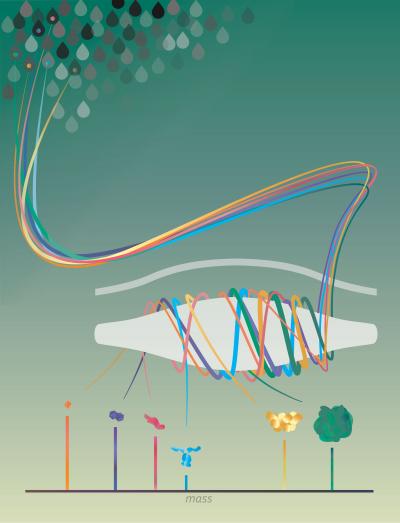
The powerful new approach, called individual ion mass spectrometry, or I2MS, can determine the exact mass of a huge range of intact proteins. It weighs each and every molecule on an individual basis. This ability promises to aid the understanding of disease and infection and accelerate the design of vaccines for deadly viruses, such as the coronavirus.
Details on this fundamentally new way to weigh single molecules of proteins or their assemblies, such as whole viruses, will be published March 2 by the journal Nature Methods.
The researchers show their method, which uses the commercially available Orbitrap mass analyzer system, can be used on super complex mixtures of intact proteins, and even whole virus particles carrying diverse cargo within them. This power and versatility will enable a new wave of molecular precision to be brought to diverse problems in vacinnology, virology, neurodegenerative plaques and disease biology in general.
“Quickly characterizing the masses of viruses and their infectious cargo over time may help scientists understand mutations that are occurring,” said Neil L. Kelleher, who led the research.
“Whether directly characterizing different strains of viruses or profiling different vaccine formulations, our new technology now can be deployed directly on these protein-containing samples to pursue the most urgent challenges of the day,” he said.
Kelleher is a pioneer in top-down proteomics with one of the leading groups in the world that studies intact proteins. He is the Walter and Mary Elizabeth Glass Chair in Life Sciences in the Weinberg College of Arts and Sciences’ departments of chemistry and molecular biosciences.
The technology will help scientists further understand the composition of the exterior of a virus (called the capsid) and the infectious cargo held within the capsid, Kelleher said. Because the researchers can analyze a handful of single virus particles at a time, they can extract information about precise variations in each particle.
“Many research groups are studying the use of viral capsids filled with cargo as a means to deliver life-saving drugs to patients,” said Jared O. Kafader, the study’s first author. “Our technology provides a practical way to determine if the cargo contains the correct drug or to find out what is actually within each virus particle.”
Kafader is a senior research associate in Northwestern’s Proteomics Center of Excellence. (Proteomics is the study and analysis of protein structure and function.)
A related study by the Kelleher group, published recently in the Journal of Proteome Research, extends analysis of I2MS to fragmentation of intact species. By fragmenting intact proteins, important information about where modifications or mutations on the protein can be identified, the researchers said. These modifications have implications for understanding how proteins change or mutate in cancer patients.
###
The research was supported by National Institute of General Medical Sciences, National Institutes of Health (grant P41 GM108569), Thermo Fisher Scientific and the Sherman Fairchild Foundation.
The paper is titled “Multiplexed mass spectrometry of individual ions improves measurement of proteoforms and their complexes.” Kelleher is a corresponding author, and Kafader is the first author.
Kelleher also is a professor in the Feinberg School of Medicine’s department of medicine. He is a member of the Robert H. Lurie Comprehensive Cancer Center of Northwestern University.
(Source contacts: Neil Kelleher at [email protected] and Jared Kafader at [email protected])
More news at Northwestern Now
Find experts on our Faculty Experts Hub
Follow @NUSources for expert perspectives
Media Contact
Amanda Morris
[email protected]
847-467-6790
Related Journal Article
http://dx.