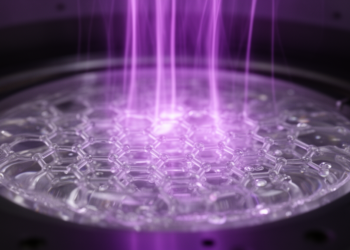
Credit: Andrey Kovalevsky/Oak Ridge National Laboratory, US Dept. of Energy
Biochemistry – Chasing the antidote
In the most comprehensive, structure-based approach to date, a team of scientists may have discovered a new family of antidotes for certain poisons that can mitigate their effects more efficiently compared with existing remedies.
Poisons such as organophosphorus nerve agents and pesticides wreak havoc by blocking an enzyme essential for proper brain and nerve function. Fast-acting drugs, called reactivators, are required to reach the central nervous system and counteract damage that could lead to death.
“To enhance the antidote’s effectiveness, we need to improve the reactivator’s ability to cross the blood-brain barrier, bind loosely to the enzyme, chemically snatch the poison and then leave quickly,” said ORNL’s Andrey Kovalevsky, co-author of a study led by Zoran Radi? of UC San Diego.
The team designed and tested reactivators on three different nerve agents and one pesticide with positive initial results. Their next step is to use neutron crystallography to better understand antidote designs.
Media Contact: Sara Shoemaker, 865.576.9219; shoemakerms@ornl.gov
Image: https:/
Caption: A team of scientists may have discovered a new family of antidotes for certain poisons that can mitigate their effects more efficiently compared with existing remedies. Credit: Andrey Kovalevsky/Oak Ridge National Laboratory, U.S. Dept. of Energy
Vehicles – Fuel savings green light
Large trucks lumbering through congested cities could become more fuel efficient simply by not having to stop at so many traffic lights.
A proof-of-concept study by Oak Ridge National Laboratory shows promise of a potential new system to direct traffic lights to keep less-efficient vehicles moving and reduce fuel consumption.
In collaboration with traffic-management services company GRIDSMART, researchers used smart cameras to collect real-world data from images of vehicles as they move through select intersections.
The team used artificial intelligence and machine learning techniques to “teach” these cameras how to quickly identify each vehicle type and its estimated gas mileage, sending the information to the next intersection’s traffic light.
ORNL’s Thomas Karnowski said early results from the computer simulation could lead to more comprehensive research.
Media Contact: Sara Shoemaker, 865.576.9219; shoemakerms@ornl.gov
Image: https:/
Caption: A preliminary study by ORNL and GRIDSMART shows promise of a new system to keep trucks moving through intersections and reduce fuel consumption. Credit: Thomas Karnowski/Oak Ridge National Laboratory, U.S. Dept. of Energy
Buildings – Automatic modeling
Oak Ridge National Laboratory researchers have developed a modeling tool that identifies cost-effective energy efficiency opportunities in existing buildings across the United States.
Using supercomputing, the energy modeling method assesses building types, systems, use patterns and prevailing weather conditions.
“Manually collecting and organizing data for energy modeling is a time-consuming process and is used in only a small percentage of retrofit performance projects,” ORNL’s Joshua New said.
The team’s modeling approach applies automation to extract a building’s floor area and orientation parameters from publicly available data sources such as satellite images. Researchers tested the tool on more than 175,000 buildings in the Chattanooga, Tennessee, area, demonstrating energy-saving opportunities.
“We can model a building in minutes from a desktop computer,” New said. “This is the next level of intelligence for energy-saving technologies.”
Future plans include making the tool openly available to help reduce energy demand, emissions and costs for America’s homes and businesses.
Media Contact: Jennifer Burke, 865.576.3212; burkejj@ornl.gov
Image: https:/
Caption: ORNL’s modeling tool simulates the energy efficiency of buildings by automating data received from satellite images. The tool was tested on buildings in the Chattanooga area. Credit: Joshua New/Oak Ridge National Laboratory, U.S. Dept. of Energy
###
Media Contact
Sara Shoemaker
shoemakerms@ornl.gov
865-576-9219
Original Source
https:/
Related Journal Article
http://dx.