• HOME
  • NEWS
  • EXPLORE
    • CAREER
      • Companies
      • Jobs
    • EVENTS
    • iGEM
      • News
      • Team
    • PHOTOS
    • VIDEO
    • WIKI
  • BLOG
  • COMMUNITY
    • FACEBOOK
    • INSTAGRAM
    • TWITTER
Saturday, February 7, 2026
BIOENGINEER.ORG
No Result
View All Result
  • Login
  • HOME
  • NEWS
  • EXPLORE
    • CAREER
      • Companies
      • Jobs
        • Lecturer
        • PhD Studentship
        • Postdoc
        • Research Assistant
    • EVENTS
    • iGEM
      • News
      • Team
    • PHOTOS
    • VIDEO
    • WIKI
  • BLOG
  • COMMUNITY
    • FACEBOOK
    • INSTAGRAM
    • TWITTER
  • HOME
  • NEWS
  • EXPLORE
    • CAREER
      • Companies
      • Jobs
        • Lecturer
        • PhD Studentship
        • Postdoc
        • Research Assistant
    • EVENTS
    • iGEM
      • News
      • Team
    • PHOTOS
    • VIDEO
    • WIKI
  • BLOG
  • COMMUNITY
    • FACEBOOK
    • INSTAGRAM
    • TWITTER
No Result
View All Result
Bioengineer.org
No Result
View All Result
Home NEWS Science News Biology

When should you eat to manage your weight? Breakfast, not late-night snacks

Bioengineer by Bioengineer
February 28, 2020
in Biology
Reading Time: 3 mins read
0
IMAGE
Share on FacebookShare on TwitterShare on LinkedinShare on RedditShare on Telegram

IMAGE

Credit: Kelly et al, 2020


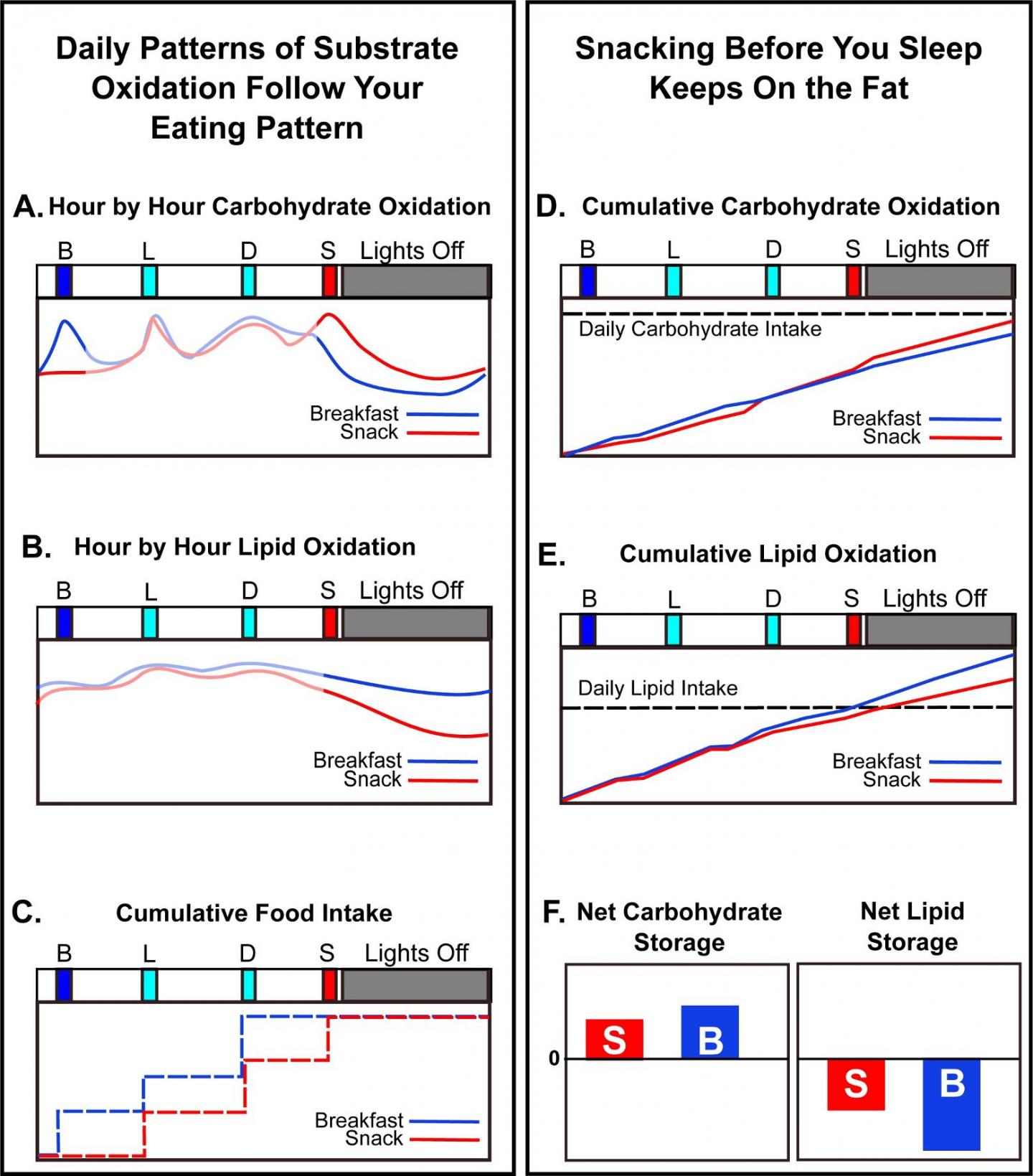
The balance between weight gain and weight gain loss is predominantly determined by what you eat, how much you eat, and by how much exercise you get. But another important factor is often neglected… Published February 27 in the open-access journal PLOS Biology, research conducted by Kevin Kelly, Owen McGuinness, Carl Johnson and colleagues of Vanderbilt University, USA shows that it’s not just how many calories you eat, but WHEN you eat them that will determine how well you burn those calories.

Your daily biological clock and sleep regulate how the food you eat is metabolized; thus the choice of burning fats or carbohydrates changes depending on the time of day or night. Your body’s circadian rhythm has programmed your body to burn fat when you sleep, so when you skip breakfast and then snack at night you delay burning the fat.

The researchers monitored the metabolism of mid-aged and older subjects in a whole-room respiratory chamber over two separate 56-hour sessions, using a “random crossover” experimental design. In each session, lunch and dinner were presented at the same times (12:30 and 17:45, respectively), but the timing of the third meal differed between the two halves of the study. Thus in one of the 56-hour bouts, the additional daily meal was presented as breakfast (8:00) whereas in the other session, a nutritionally equivalent meal was presented to the same subjects as a late-evening snack (22:00). The duration of the overnight fast was the same for both sessions.

Whereas the two sessions did not differ in the amount or type of food eaten or in the subjects’ activity levels, the daily timing of nutrient availability, coupled with clock/sleep control of metabolism, flipped a switch in the subjects’ fat/carbohydrate preference such that the late-evening snack session resulted in less fat burned when compared to the breakfast session. The timing of meals during the day/night cycle therefore affects the extent to which ingested food is used versus stored.

This study has important implications for eating habits, suggesting that a daily fast between the evening meal and breakfast will optimize weight management.

###

In your coverage please use this URL to provide access to the freely available article in PLOS Biology: https://journals.plos.org/plosbiology/article?id=10.1371/journal.pbio.3000622

Contact: Carl Hirschie Johnson, [email protected]

Citation: Kelly KP, McGuinness OP, Buchowski M, Hughey JJ, Chen H, Powers J, et al. (2020) Eating breakfast and avoiding late-evening snacking sustains lipid oxidation. PLoS Biol 18(2): e3000622. https://doi.org/10.1371/journal.pbio.3000622

Funding: This study was supported by a Vanderbilt Discovery Grant (to TP), the Vanderbilt Institute for Clinical and Translational Research (VICTR) award ID# VR9806 (to MB), the Vanderbilt Diabetes Research and Training Center (through the Metabolic Physiology Shared Resource supported by P60-DK020593; to OPM), the National Institute of General Medical Sciences (R35 GM124685 to JJH), and the National Institute of Neurological Disorders and Stroke (R01 NS104497 to CHJ). The funders had no role in study design, data collection and analysis, decision to publish, or preparation of the manuscript.

Competing Interests: The authors have declared that no competing interests exist.

Media Contact
Carl Hirschie Johnson
[email protected]

Original Source

https://journals.plos.org/plosbiology/article?id=10.1371/journal.pbio.3000622

Related Journal Article

http://dx.doi.org/10.1371/journal.pbio.3000622

Tags: Biology
Share12Tweet8Share2ShareShareShare2

Related Posts

Florida Cane Toad: Complex Spread and Selective Evolution

Florida Cane Toad: Complex Spread and Selective Evolution

February 7, 2026
New Study Uncovers Mechanism Behind Burn Pit Particulate Matter–Induced Lung Inflammation

New Study Uncovers Mechanism Behind Burn Pit Particulate Matter–Induced Lung Inflammation

February 6, 2026

DeepBlastoid: Advancing Automated and Efficient Evaluation of Human Blastoids with Deep Learning

February 6, 2026

Navigating the Gut: The Role of Formic Acid in the Microbiome

February 6, 2026
Please login to join discussion

POPULAR NEWS

  • Robotic Ureteral Reconstruction: A Novel Approach

    Robotic Ureteral Reconstruction: A Novel Approach

    82 shares
    Share 33 Tweet 21
  • Digital Privacy: Health Data Control in Incarceration

    63 shares
    Share 25 Tweet 16
  • Study Reveals Lipid Accumulation in ME/CFS Cells

    57 shares
    Share 23 Tweet 14
  • Breakthrough in RNA Research Accelerates Medical Innovations Timeline

    53 shares
    Share 21 Tweet 13

About

We bring you the latest biotechnology news from best research centers and universities around the world. Check our website.

Follow us

Recent News

Evaluating Pediatric Emergency Care Quality in Ethiopia

TPMT Expression Predictions Linked to Azathioprine Side Effects

Improving Dementia Care with Enhanced Activity Kits

Subscribe to Blog via Email

Enter your email address to subscribe to this blog and receive notifications of new posts by email.

Join 73 other subscribers
  • Contact Us

Bioengineer.org © Copyright 2023 All Rights Reserved.

Welcome Back!

Login to your account below

Forgotten Password?

Retrieve your password

Please enter your username or email address to reset your password.

Log In
No Result
View All Result
  • Homepages
    • Home Page 1
    • Home Page 2
  • News
  • National
  • Business
  • Health
  • Lifestyle
  • Science

Bioengineer.org © Copyright 2023 All Rights Reserved.