• HOME
  • NEWS
  • EXPLORE
    • CAREER
      • Companies
      • Jobs
    • EVENTS
    • iGEM
      • News
      • Team
    • PHOTOS
    • VIDEO
    • WIKI
  • BLOG
  • COMMUNITY
    • FACEBOOK
    • INSTAGRAM
    • TWITTER
Thursday, May 21, 2026
BIOENGINEER.ORG
No Result
View All Result
  • Login
  • HOME
  • NEWS
  • EXPLORE
    • CAREER
      • Companies
      • Jobs
        • Lecturer
        • PhD Studentship
        • Postdoc
        • Research Assistant
    • EVENTS
    • iGEM
      • News
      • Team
    • PHOTOS
    • VIDEO
    • WIKI
  • BLOG
  • COMMUNITY
    • FACEBOOK
    • INSTAGRAM
    • TWITTER
  • HOME
  • NEWS
  • EXPLORE
    • CAREER
      • Companies
      • Jobs
        • Lecturer
        • PhD Studentship
        • Postdoc
        • Research Assistant
    • EVENTS
    • iGEM
      • News
      • Team
    • PHOTOS
    • VIDEO
    • WIKI
  • BLOG
  • COMMUNITY
    • FACEBOOK
    • INSTAGRAM
    • TWITTER
No Result
View All Result
Bioengineer.org
No Result
View All Result
Home NEWS Science News Biology

How to keep the nucleus clean

Bioengineer by Bioengineer
February 20, 2020
in Biology
Reading Time: 2 mins read
0
IMAGE
Share on FacebookShare on TwitterShare on LinkedinShare on RedditShare on Telegram

IMAGE

Credit: Guifen Wu and Manfred Schmid, Aarhus University


Cells are small factories that constantly produce protein and RNA molecules by decoding the genetic information stored in the DNA of their chromosomes. The first phase of this decoding, the transcription process, “transcribes” the DNA code into RNA molecules. In humans, and most other organisms, all cells of the body carry the full genetic information of the entire organism, with each individual cell requiring only a small subset of its DNA decoded. Even so, the first decoding phase (transcription) is pervasive and produces a large amount of surplus RNAs.

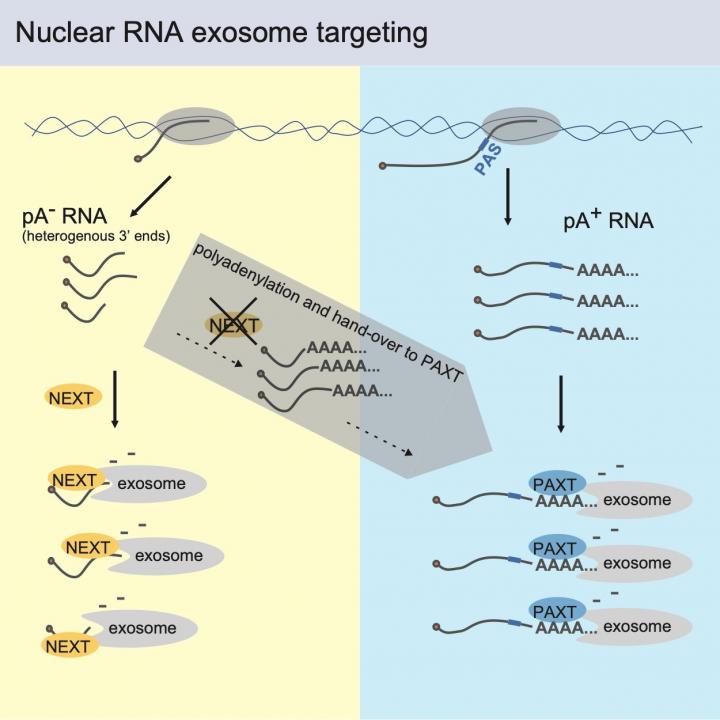
These extraneous RNAs do, however, not accumulate, as they are degraded shortly after their production. This prevents deleterious accumulation of non-functional transcripts that would otherwise be detrimental to cell health. Most of this RNA decay is carried out by the nuclear RNA exosome complex, an RNA 3′-5′ exonuclease, which is recruited to RNA by specific adapters, like the so-called NEXT complex and the PAXT connection. The laboratory of Torben Heick Jensen previously found that NEXT and PAXT aid in decay of different kinds of nuclear RNAs, but how specificity is achieved remained enigmatic.

With their new publication, the research team now reveals that NEXT substrates contain ‘naked’ 3’ends, whereas PAXT substrates harbor so-called poly(A)-tailed 3’ends. Despite this clear division, the study also reveal that the decay systems can co-operate, which helps cells to degrade NEXT substrates, even in the potentially hazardous situation when NEXT activity is decreased. In this case, NEXT targets (which are normally produced without a poly(A) tail and swiftly removed) acquire poly(A) tails – a hallmark of PAXT targets – which subject them to PAXT-mediated decay. In conjunction, this provides a two-layered targeting mechanism for the efficient nuclear sorting of the human transcriptome. An important question now remaining to be answered is how this efficient sorting is coupled to the production (transcription) of RNA.

The findings result from a collaborative project spearheaded by postdoc Guifen Wu and team leader Manfred Schmid from the laboratory of Torben Heick Jensen at the Department of Molecular Biology and Genetics, Aarhus University, in collaboration with Leonor Rib and Albin Sandelin from the Department of Biology and Biotech Research and Innovation Centre, University of Copenhagen. The study was financed by the Novo Nordisk Foundation and the Lundbeck Foundation, and published in the international journal Cell Reports.

###

‘A two-layered targeting mechanism underlies nuclear RNA sorting by the human exosome’ by Guifen Wu, Manfred Schmid, Leonor Rib, Patrik Polak, Nicola Meola, Albin Sandelin, Torben Heick Jensen. Cell Reports.

For further information, please contact

Postdoc Guifen Wu- [email protected]

Teamleder Manfred Schmid- [email protected]

Professor Torben Heick Jensen – [email protected] – mobile: +45 60202705

Department of Molecular Biology and Genetics, Aarhus University, Denmark

Media Contact
Torben Heick Jensen
[email protected]
45-60-20-27-05

Original Source

https://mbg.au.dk/en/news-and-events/news-item/artikel/how-to-keep-the-nucleus-clean/

Tags: BiochemistryBiologyCell BiologyGeneticsMicrobiologyMolecular Biology
Share12Tweet8Share2ShareShareShare2

Related Posts

Early Delivery Improves Outcomes for Mothers and Babies in Hypertensive Pregnancies — Biology

Early Delivery Improves Outcomes for Mothers and Babies in Hypertensive Pregnancies

May 21, 2026
How Atlantic Herring Rewired Their Reproductive Strategy to Thrive in Changing Oceans — Biology

How Atlantic Herring Rewired Their Reproductive Strategy to Thrive in Changing Oceans

May 20, 2026

Study Finds Young Fraser River Chinook Salmon Swimming in Chemical Mixture

May 20, 2026

Thousands of UK Beekeepers Contribute Honey to Advance Environmental Science

May 20, 2026
Please login to join discussion

POPULAR NEWS

  • blank

    New Study Reveals Plants Can Detect the Sound of Rain

    733 shares
    Share 292 Tweet 183
  • ESMO 2025: mRNA COVID Vaccines Enhance Efficacy of Cancer Immunotherapy

    304 shares
    Share 122 Tweet 76
  • Research Indicates Potential Connection Between Prenatal Medication Exposure and Elevated Autism Risk

    846 shares
    Share 338 Tweet 212
  • Breastmilk Balances E. coli and Beneficial Bacteria in Infant Gut Microbiomes

    58 shares
    Share 23 Tweet 15

About

We bring you the latest biotechnology news from best research centers and universities around the world. Check our website.

Follow us

Recent News

Innovative Reusable Brick Walls Revolutionize Construction Industry

Nonlinear Atomic Tunneling Enhanced by Bright Squeezed Vacuum

Label-Free Super-Resolution Imaging of Live Cells

Subscribe to Blog via Email

Enter your email address to subscribe to this blog and receive notifications of new posts by email.

Join 82 other subscribers
  • Contact Us

Bioengineer.org © Copyright 2023 All Rights Reserved.

Welcome Back!

Login to your account below

Forgotten Password?

Retrieve your password

Please enter your username or email address to reset your password.

Log In
No Result
View All Result
  • Homepages
    • Home Page 1
    • Home Page 2
  • News
  • National
  • Business
  • Health
  • Lifestyle
  • Science

Bioengineer.org © Copyright 2023 All Rights Reserved.