• HOME
  • NEWS
  • EXPLORE
    • CAREER
      • Companies
      • Jobs
    • EVENTS
    • iGEM
      • News
      • Team
    • PHOTOS
    • VIDEO
    • WIKI
  • BLOG
  • COMMUNITY
    • FACEBOOK
    • INSTAGRAM
    • TWITTER
Saturday, February 7, 2026
BIOENGINEER.ORG
No Result
View All Result
  • Login
  • HOME
  • NEWS
  • EXPLORE
    • CAREER
      • Companies
      • Jobs
        • Lecturer
        • PhD Studentship
        • Postdoc
        • Research Assistant
    • EVENTS
    • iGEM
      • News
      • Team
    • PHOTOS
    • VIDEO
    • WIKI
  • BLOG
  • COMMUNITY
    • FACEBOOK
    • INSTAGRAM
    • TWITTER
  • HOME
  • NEWS
  • EXPLORE
    • CAREER
      • Companies
      • Jobs
        • Lecturer
        • PhD Studentship
        • Postdoc
        • Research Assistant
    • EVENTS
    • iGEM
      • News
      • Team
    • PHOTOS
    • VIDEO
    • WIKI
  • BLOG
  • COMMUNITY
    • FACEBOOK
    • INSTAGRAM
    • TWITTER
No Result
View All Result
Bioengineer.org
No Result
View All Result
Home NEWS Science News Chemistry

Smart contact lens sensor developed for point-of-care eye health monitoring

Bioengineer by Bioengineer
February 19, 2020
in Chemistry
Reading Time: 2 mins read
0
IMAGE
Share on FacebookShare on TwitterShare on LinkedinShare on RedditShare on Telegram

IMAGE

Credit: DU Xuemin


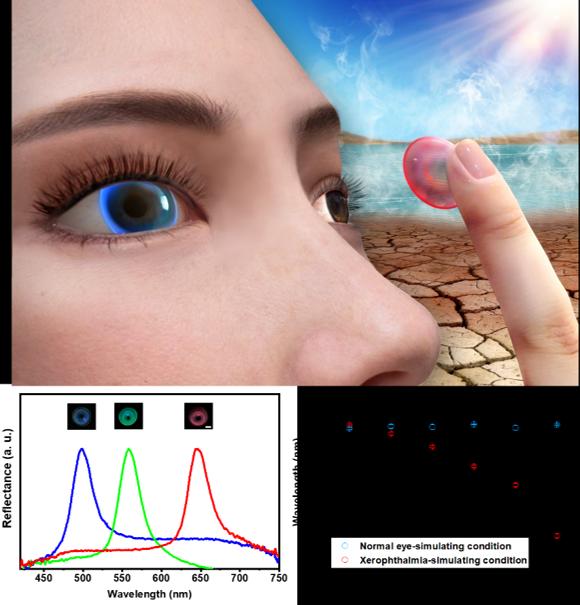
A research group led by Prof. DU Xuemin from the Shenzhen Institutes of Advanced Technology (SIAT) of the Chinese Academy of Sciences has developed a “smart” contact lens that can show real-time changes in moisture and pressure by altering colors. The “smart” contact lens can potentially be used for point-of-care (POC) diagnosis of xerophthalmia and high intraocular pressure disease.

Early diagnosis is important for avoiding severe eye problems, such as exophthalmia – which causes relatively mild symptoms – or glaucoma – which may lead to loss of vision. Such diagnoses rely on facile and reliable monitoring of several features with significant pathologic relevance, such as the amount of tears and intraocular pressure.

However, current methods usually require complex procedures and instruments operated by professionals, causing difficulties for point-of-care (POC) ophthalmic health monitoring.

The “smart” contact lens features periodic nanostructures within the poly(2-hydroxyethyl methacrylate) (pHEMA) hydrogel matrix, resulting in bright, tunable structural colors ranging from red to green to blue.

This structurally colored contact lens sensor is made solely from a biocompatible hydrogel, without the addition of any chemical pigments, thus exhibiting superior biosafety and comfort for wearable applications.

Importantly, the spacing of periodic nanostructures within the pHEMA hydrogel are sensitive to changes in moisture and pressure, leading to real-time color changes in the “smart” contact lens.

“Based on these features, the ‘smart’ contact lens was explored as a means for monitoring xerophthalmia and high intraocular pressure disease. In normal eye-simulation conditions, its color will not change over time; while its color changes from red to blue in the xerophthalmia-simulation condition in about 25 minutes,” said ZHAO Qilong, first author of the study.

Additionally, a linear decrease in the wavelength of the reflectance peak of the “smart” cosmetic contact lens is observed when human intraocular pressure changes in the pathological range.

“This study provides a novel and smart wearable device for timely and facile warning of the risks of xerophthalmia and high intraocular pressure disease. It will also inspire the design of a new generation of wearable devices with colorimetric sensing capabilities for real-time POC monitoring of various human body signs and diseases,” said Prof. DU.

###

The results were published in Journal of Materials Chemistry B.

Media Contact
ZHANG Xiaomin
[email protected]

Original Source

http://english.cas.cn/

Related Journal Article

http://dx.doi.org/10.1039/C9TB02389E

Tags: Chemistry/Physics/Materials SciencesHealth Care Systems/ServicesMaterials
Share12Tweet8Share2ShareShareShare2

Related Posts

blank

Breakthrough in Environmental Cleanup: Scientists Develop Solar-Activated Biochar for Faster Remediation

February 7, 2026
blank

Cutting Costs: Making Hydrogen Fuel Cells More Affordable

February 6, 2026

Scientists Develop Hand-Held “Levitating” Time Crystals

February 6, 2026

Observing a Key Green-Energy Catalyst Dissolve Atom by Atom

February 6, 2026
Please login to join discussion

POPULAR NEWS

  • Robotic Ureteral Reconstruction: A Novel Approach

    Robotic Ureteral Reconstruction: A Novel Approach

    82 shares
    Share 33 Tweet 21
  • Digital Privacy: Health Data Control in Incarceration

    63 shares
    Share 25 Tweet 16
  • Study Reveals Lipid Accumulation in ME/CFS Cells

    57 shares
    Share 23 Tweet 14
  • Breakthrough in RNA Research Accelerates Medical Innovations Timeline

    53 shares
    Share 21 Tweet 13

About

We bring you the latest biotechnology news from best research centers and universities around the world. Check our website.

Follow us

Recent News

Inflammasome Protein ASC Drives Pancreatic Cancer Metabolism

Phage-Antibiotic Combo Beats Resistant Peritoneal Infection

Boosting Remote Healthcare: Stepped-Wedge Trial Insights

Subscribe to Blog via Email

Enter your email address to subscribe to this blog and receive notifications of new posts by email.

Join 73 other subscribers
  • Contact Us

Bioengineer.org © Copyright 2023 All Rights Reserved.

Welcome Back!

Login to your account below

Forgotten Password?

Retrieve your password

Please enter your username or email address to reset your password.

Log In
No Result
View All Result
  • Homepages
    • Home Page 1
    • Home Page 2
  • News
  • National
  • Business
  • Health
  • Lifestyle
  • Science

Bioengineer.org © Copyright 2023 All Rights Reserved.