• HOME
  • NEWS
  • EXPLORE
    • CAREER
      • Companies
      • Jobs
    • EVENTS
    • iGEM
      • News
      • Team
    • PHOTOS
    • VIDEO
    • WIKI
  • BLOG
  • COMMUNITY
    • FACEBOOK
    • INSTAGRAM
    • TWITTER
Tuesday, October 6, 2026
BIOENGINEER.ORG
No Result
View All Result
  • Login
  • HOME
  • NEWS
  • EXPLORE
    • CAREER
      • Companies
      • Jobs
        • Lecturer
        • PhD Studentship
        • Postdoc
        • Research Assistant
    • EVENTS
    • iGEM
      • News
      • Team
    • PHOTOS
    • VIDEO
    • WIKI
  • BLOG
  • COMMUNITY
    • FACEBOOK
    • INSTAGRAM
    • TWITTER
  • HOME
  • NEWS
  • EXPLORE
    • CAREER
      • Companies
      • Jobs
        • Lecturer
        • PhD Studentship
        • Postdoc
        • Research Assistant
    • EVENTS
    • iGEM
      • News
      • Team
    • PHOTOS
    • VIDEO
    • WIKI
  • BLOG
  • COMMUNITY
    • FACEBOOK
    • INSTAGRAM
    • TWITTER
No Result
View All Result
Bioengineer.org
No Result
View All Result
Home NEWS Science News

Improving the electrical and mechanical properties of carbon-nanotube-based fibers

Bioengineer by Bioengineer
February 18, 2020
in Science News
Reading Time: 3 mins read
0
IMAGE
Share on FacebookShare on TwitterShare on LinkedinShare on RedditShare on Telegram

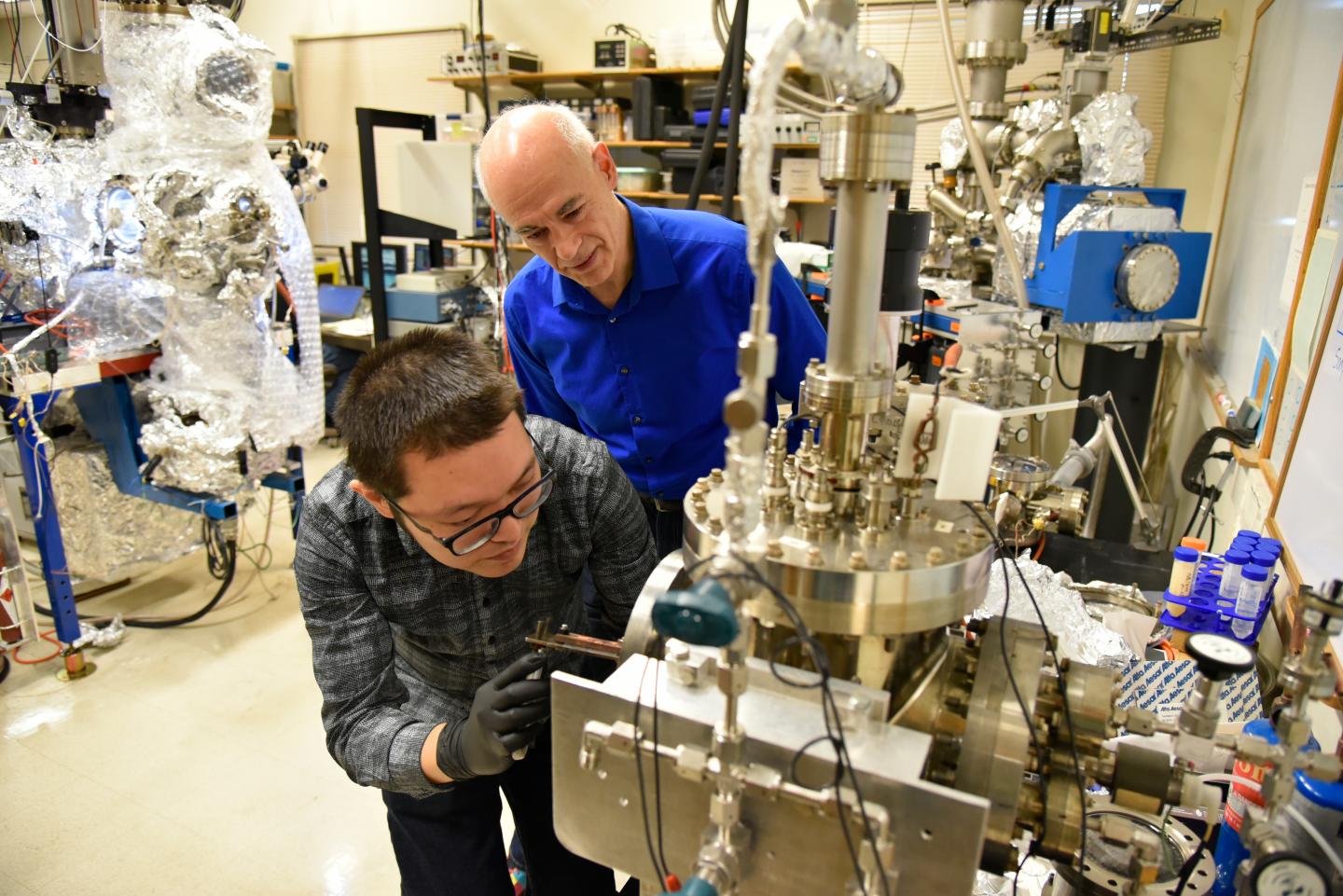
Researchers recently developed a technique that can be used to build carbon-nanotube-based fibers by creating chemical crosslinks; the technique improves the electrical and mechanical properties of these materials
IMAGE

Credit: Doris Dahl, Beckman Institute, University of Illinois

The Lyding Group recently developed a technique that can be used to build carbon-nanotube-based fibers by creating chemical crosslinks. The technique improves the electrical and mechanical properties of these materials.

The paper, “Enhanced Electrical and Mechanical Properties of Chemically Cross-Linked Carbon-Nanotube-Based Fibers and Their Application in High-Performance Supercapacitors,” was published in ACS Nano.

“Carbon nanotubes are strong and are very good at conducting heat and electricity,” said Gang Wang, a postdoctoral research associate in the Lyding lab, which is at the Beckman Institute for Advanced Science and Technology at the University of Illinois at Urbana-Champaign. “Therefore, these materials have wide applications and can be used as strong fibers, batteries, and transistors.”

There are many ways to build materials that have carbon-nanotube-based fibers. “Airplane wings can be made, for example, by embedding these fibers in a matrix using epoxy,” said Joseph Lyding, the Robert C. MacClinchie Distinguished Professor of Electrical and Computer Engineering and a Beckman faculty member. “The epoxy acts as a binder and holds the matrix together.”

However, combining the tubes to make such materials can lead to a loss in important properties. “We came up with a method to bring a lot of that performance back,” Lyding said. “The method is based on linking the individual carbon nanotubes together.”

The researchers dispersed brominated hydrocarbon molecules within the nanotube matrix. When heat is applied, the bromine groups detach, and the molecules covalently bond to adjacent nanotubes.

“When you pass current though these materials, the resistance to the current is highest at the junctions where the nanotubes touch each other,” Lyding said. “As a result, heat is generated at the junctions and we use that heat to link the nanotubes together.”

The treatment is a one-time process. “Once those bonds form, the resistance at the junction drops, and the material cools off. It’s like popcorn going off — once it pops, that’s it,” Lyding said.

The researchers faced many challenges when they were trying to build these materials. “We have to find the right molecules to use and the proper conditions to make those bonds,” Wang said. “We had to try several times to find the right current and then use the resulting material to build other devices.”

“This paper is the first step in making a new class of materials. It is likely that the performance we see now will become better because it has not been explored fully yet,” Lyding said. “We are interested in investigating how strong we can make these materials, how we can improve their electrical conductivity, and whether we can replace copper wires with materials that are 10 times lower in weight and have the same performance.”

###

The study was carried out using seed funding from the Beckman Institute.

Editor’s notes:

To reach Joseph Lyding, call 217-333-8370; email [email protected].

The paper “Enhanced Electrical and Mechanical Properties of Chemically Cross-Linked Carbon-Nanotube-Based Fibers and Their Application in High-Performance Supercapacitors” can be found online and from the Beckman Institute.

Media Contact
Doris Dahl
[email protected]
217-333-2895

Original Source

https://beckman.illinois.edu/about/news/article/2020/02/05/improving-the-electrical-and-mechanical-properties-of-carbon-nanotube-based-fibers

Related Journal Article

http://dx.doi.org/10.1021/acsnano.9b07244

Tags: BiochemistryChemistry/Physics/Materials SciencesElectrical Engineering/Electronics
Share12Tweet8Share2ShareShareShare2

Related Posts

Late HIV Diagnosis Persists in Morocco as TB Coinfection and Early Deaths Mount

Late HIV Diagnosis Persists in Morocco as TB Coinfection and Early Deaths Mount

October 6, 2026
Scientists Redesign Naproxen in Silico to Beat Its Own Side Effects

Scientists Redesign Naproxen in Silico to Beat Its Own Side Effects

October 6, 2026

Spiny Wild Cucumber Found in Tiny Assam Sanctuary Becomes New State Record

October 6, 2026

AI Reads Brain Scans Two Ways at Once to Gauge Neurological Disease Severity

October 6, 2026
Please login to join discussion

POPULAR NEWS

  • Alloys That Shrink Their Own Grains: New PIX Mechanism Refines Metals With Heat Alone

    Alloys That Shrink Their Own Grains: New PIX Mechanism Refines Metals With Heat Alone

    29 shares
    Share 12 Tweet 7
  • Endurance Exercise Reshapes the Liver in Males and Females Through Distinct Molecular Routes

    29 shares
    Share 12 Tweet 7
  • Single Transcription Factor PU.1 Rapidly Converts Fibroblasts into Macrophage-Lineage Cells

    29 shares
    Share 12 Tweet 7
  • New Scale Measures How Ready Nurse Educators Really Are for the AI Era

    29 shares
    Share 12 Tweet 7

About

We bring you the latest biotechnology news from best research centers and universities around the world. Check our website.

Follow us

Recent News

Alloys That Shrink Their Own Grains: New PIX Mechanism Refines Metals With Heat Alone

Endurance Exercise Reshapes the Liver in Males and Females Through Distinct Molecular Routes

Single Transcription Factor PU.1 Rapidly Converts Fibroblasts into Macrophage-Lineage Cells

Subscribe to Blog via Email

Success! An email was just sent to confirm your subscription. Please find the email now and click 'Confirm' to start subscribing.

Join 85 other subscribers
  • Contact Us

Bioengineer.org © Copyright 2023 All Rights Reserved.

Welcome Back!

Login to your account below

Forgotten Password?

Retrieve your password

Please enter your username or email address to reset your password.

Log In
No Result
View All Result
  • Homepages
    • Home Page 1
    • Home Page 2
  • News
  • National
  • Business
  • Health
  • Lifestyle
  • Science

Bioengineer.org © Copyright 2023 All Rights Reserved.