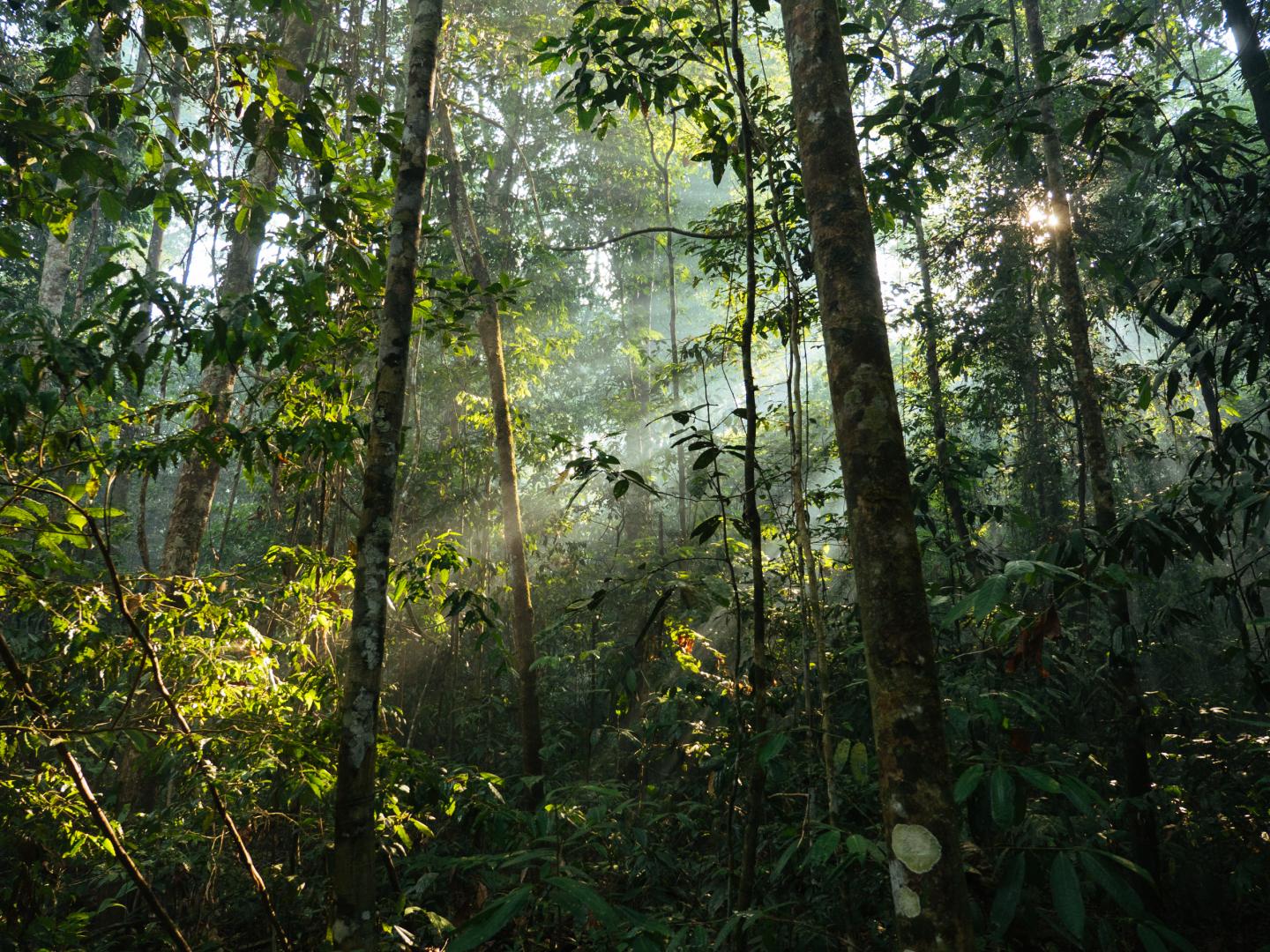
Credit: Adam Ronan, Rede Amazônia Sustentável
The study looked at areas in the Brazilian Amazon with varying levels of disturbance from activities like logging or burning. The researchers found that not only did human disturbance reduce overall tree diversity, it increased the proportion of trees with seeds dispersed by animals as opposed to other mechanisms like wind.
Disturbance also led to a significant shift towards small-seeded species, which are more likely to be dispersed by smaller animals like birds and bats. It is not clear if these trees can support larger fruit-eating animals that specialise in large-seeded plants and are important for their seed dispersal.
The researchers observed similar effects in secondary (re-grown) forests recovering from clear felling. Older secondary forest had functionally similar plants to the most heavily disturbed primary forest.
Dr Joseph Hawes, lead author of the study said: “Previous studies in disturbed tropical forests have often found plant communities are more likely to rely on seeds dispersed by wind and other abiotic mechanisms, rather than fruit-eating animals. In contrast, our study found that disturbance led to tree communities in which a greater proportion of species and individuals rely on animal dispersal.”
There are likely multiple reasons for this shift. Forest fires and selective logging disproportionately affect certain tree species, which can influence dispersal patterns. Hunting can also reduce seed dispersal by large birds and mammals, leaving smaller animals to disperse smaller seeds.
On the implications of a shift towards smaller-seeded tree species, Dr Hawes added: “Smaller-seeded tree species are becoming more prevalent in forests heavily disturbed by human activity. As larger-seeded tree species are also often those with higher wood densities, these changes in forest composition could have longer-term implications for both the carbon storage and drought sensitivity of tropical forests.”
Professor Jos Barlow, co-author said: “This highlights the especially important role played by large-bodied fruit eating animals in the Amazon and helps to underline the need to avoid the loss of these animals and to help encourage their recovery in human-modified forests.”
Dr Ima Vieira, co-author said: “Most forest restoration focusses on the vegetation, but we also need to consider fauna in restoration projects because of their important mutualistic interactions with plants. Our study provides further evidence that fauna are key to restoring biodiversity-rich ecosystems in the Amazon.”
Dr Joice Ferreira, co-author said: “Avoiding forest loss and degradation should be a priority in public policies as the disruption of plant-animal interactions can lead to catastrophic cascading effects. In Brazil, ambitious restoration goals have been proposed (12 million hectares up to 2030). Disregarding the role of biotic interactions could undermine the success of such efforts.”
Tropical forests are fundamentally important for global biodiversity, climate regulation and human livelihoods, but they’re increasingly threatened by human impacts. 80% of tropical forest landscapes currently exist in a modified state, either as degraded primary forest or recovering secondary forest.
“Pressure from agricultural expansion, including cattle ranching and mechanised farming e.g. soya, is high in the eastern Amazon but this pressure is not uniform, and some areas are more affected than others. This is also the case for pressures such as from silviculture plantations, selective logging and fire.” said Dr Hawes.
The functional traits of species are important components of an ecosystem and can support key ecological processes even when species richness is reduced. Compared to other plant traits like leaf area and wood density, reproductive traits are relatively understudied despite their importance to mutualistic relationships and role in recruiting new trees.
In this study the researchers surveyed 230 forest plots across two regions in the Eastern Brazilian Amazon. The plots covered a gradient of disturbance in forests from undisturbed primary forest, to forest that that had been logged, burned, or logged-and-burned. In total the researchers recorded 26,533 live tree stems from 846 tree species.
Using herbariums and research literature, the researchers compiled information on fruit and seed traits like size, type, shape and dispersal method for each species.
The study focussed on changes in plant communities, rather than changes in animal communities in human disturbed forests. The researchers warn that isolating these disturbance-specific relationships will likely be difficult due to the multiple drivers of change in human-modified landscapes.
Outside of seed dispersal method, the researchers did not consider other factors that may influence successful plant recruitment. This was limited by a shortage of information on what constitutes effective seed dispersal by different animal species.
Dr Hawes said: “One of the next steps in understanding the long-term ecological impacts of human disturbances in tropical forests is to build a comprehensive database for plant traits, including measurements such as seed size that were included in our study. We have contributed our data to the TRY Plant Trait Database, a global research effort to compile and provide free and open access to plant trait data.”
Professor Jos Barlow said: “Much of the work was funded by a Brazilian research council grant for visiting professors, and it highlights the importance of long-term scientific collaboration for guiding forest management in the Amazon”.
###
Media Contact
Davy Falkner
[email protected]
44-020-399-48255
Original Source
https:/
Related Journal Article
http://dx.