• HOME
  • NEWS
  • EXPLORE
    • CAREER
      • Companies
      • Jobs
    • EVENTS
    • iGEM
      • News
      • Team
    • PHOTOS
    • VIDEO
    • WIKI
  • BLOG
  • COMMUNITY
    • FACEBOOK
    • INSTAGRAM
    • TWITTER
Tuesday, October 6, 2026
BIOENGINEER.ORG
No Result
View All Result
  • Login
  • HOME
  • NEWS
  • EXPLORE
    • CAREER
      • Companies
      • Jobs
        • Lecturer
        • PhD Studentship
        • Postdoc
        • Research Assistant
    • EVENTS
    • iGEM
      • News
      • Team
    • PHOTOS
    • VIDEO
    • WIKI
  • BLOG
  • COMMUNITY
    • FACEBOOK
    • INSTAGRAM
    • TWITTER
  • HOME
  • NEWS
  • EXPLORE
    • CAREER
      • Companies
      • Jobs
        • Lecturer
        • PhD Studentship
        • Postdoc
        • Research Assistant
    • EVENTS
    • iGEM
      • News
      • Team
    • PHOTOS
    • VIDEO
    • WIKI
  • BLOG
  • COMMUNITY
    • FACEBOOK
    • INSTAGRAM
    • TWITTER
No Result
View All Result
Bioengineer.org
No Result
View All Result
Home NEWS Science News Biology

Scientists reveal catalytic mechanism of lovastatin hydrolase

Bioengineer by Bioengineer
February 14, 2020
in Biology
Reading Time: 2 mins read
0
IMAGE
Share on FacebookShare on TwitterShare on LinkedinShare on RedditShare on Telegram

IMAGE

Credit: LIANG Yajing


Hyperlipidemia, one of the most common threats to human health, refers to an abnormal increase of cholesterol and/or triglycerides in the blood. One effective method for prevention and treatment of the disease is cholesterol-lowering therapy, such as the drug simvastatin.

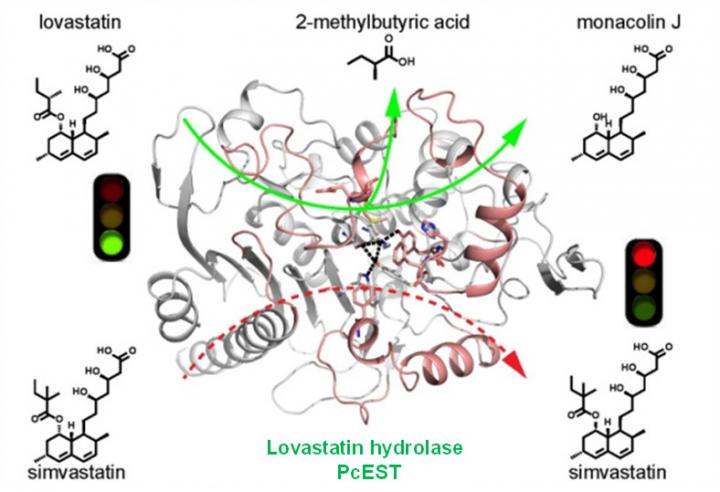
Alkaline hydrolysis of lovastatin to produce monacolin J is an intermediate step to obtain simvastatin. Enzymatic synthesis using a specific and efficient lovastatin hydrolase is one of the alternative methods for green production of monacolin J.

Recently, the research team led by Prof. LU Xuefeng from the Qingdao Institute of Bioenergy and Bioprocess Technology (QIBEBT), Chinese Academy of Sciences (CAS), revealed the catalytic mechanism and structure-function relationship of the specific and efficient lovastatin hydrolase PcEST.

It is the first report describing the mechanism and structure-function relationship of lovastatin hydrolase and provides insights about further lovastatin hydrolase screening, engineering, and commercial applications. The results were published in the Journal of Biological Chemistry.

Structure-based biochemical analyses and mutagenesis assays revealed that the Ser-57 (nucleophile)-Tyr-170 (general base)-Lys-60 (general acid) catalytic triad, together with the hydrogen-bond network around the active site and the specific substrate-binding tunnel determine the efficient and specific lovastatin hydrolysis by PcEST.

Furthermore, using structure-guided enzyme engineering, the researchers developed a PcEST variant, D106A, which improved solubility and thermostability, suggesting a promising application of this variant in industrial processes.

###

This work was supported by the National Natural Science Foundation of China, the Shandong Provincial Natural Science Foundation, the Science and Technology Service Network Initiative of CAS, and the Shandong Taishan Scholarship.

Media Contact
CHENG Jing
[email protected]

Original Source

http://english.cas.cn/

Related Journal Article

http://dx.doi.org/10.1074/jbc.RA119.011936

Tags: BiochemistryBiology
Share12Tweet8Share2ShareShareShare2

Related Posts

Chronic Liver Disease Raises Death Risk in Hospitalized COVID-19 Patients, Iranian Cohort Finds

Chronic Liver Disease Raises Death Risk in Hospitalized COVID-19 Patients, Iranian Cohort Finds

October 6, 2026
New Mapping Method Sorts Europe's Regions Into Industrial Leagues

New Mapping Method Sorts Europe’s Regions Into Industrial Leagues

October 6, 2026

Heartworm’s Bacterial Partner Lingers After Doxycycline Therapy in Brazilian Dogs

October 6, 2026

Dogs With Failing Heart Valves Defy the Odds as Leakage Spontaneously Vanishes

October 6, 2026
Please login to join discussion

POPULAR NEWS

  • Alloys That Shrink Their Own Grains: New PIX Mechanism Refines Metals With Heat Alone

    Alloys That Shrink Their Own Grains: New PIX Mechanism Refines Metals With Heat Alone

    29 shares
    Share 12 Tweet 7
  • Endurance Exercise Reshapes the Liver in Males and Females Through Distinct Molecular Routes

    29 shares
    Share 12 Tweet 7
  • Single Transcription Factor PU.1 Rapidly Converts Fibroblasts into Macrophage-Lineage Cells

    29 shares
    Share 12 Tweet 7
  • New Scale Measures How Ready Nurse Educators Really Are for the AI Era

    29 shares
    Share 12 Tweet 7

About

We bring you the latest biotechnology news from best research centers and universities around the world. Check our website.

Follow us

Recent News

Alloys That Shrink Their Own Grains: New PIX Mechanism Refines Metals With Heat Alone

Endurance Exercise Reshapes the Liver in Males and Females Through Distinct Molecular Routes

Single Transcription Factor PU.1 Rapidly Converts Fibroblasts into Macrophage-Lineage Cells

Subscribe to Blog via Email

Success! An email was just sent to confirm your subscription. Please find the email now and click 'Confirm' to start subscribing.

Join 85 other subscribers
  • Contact Us

Bioengineer.org © Copyright 2023 All Rights Reserved.

Welcome Back!

Login to your account below

Forgotten Password?

Retrieve your password

Please enter your username or email address to reset your password.

Log In
No Result
View All Result
  • Homepages
    • Home Page 1
    • Home Page 2
  • News
  • National
  • Business
  • Health
  • Lifestyle
  • Science

Bioengineer.org © Copyright 2023 All Rights Reserved.