Credit: NINS/IMS
The smallest proteins travel in our cells, completing deeply important tasks to keep our molecular mechanisms moving. They are responsible for transporting cargo, duplicating cells and more. Now, a research team based in Japan has uncovered more about how these proteins move.
They published their results on Jan. 23 in Scientific Reports, a Nature journal. Researchers hope the work on biological molecular motors, such as the kinesin and dynein proteins they study, will lead to the development of synthetic motors that could be applied to autonomous material transportation, mechanical actuation, and other energy conversion means.
“Synthetic molecular motors have great potential to realize novel functions beyond the capabilities of biological molecules,” said paper author Ryota Iino, professor at the Institute for Molecular Science in the National Institutes of Natural Science. “As Richard Feynman said, ‘What I cannot create, I do not understand.’ We strongly believe that we need to create synthetic molecular motors to completely understand their operational and design principles.”
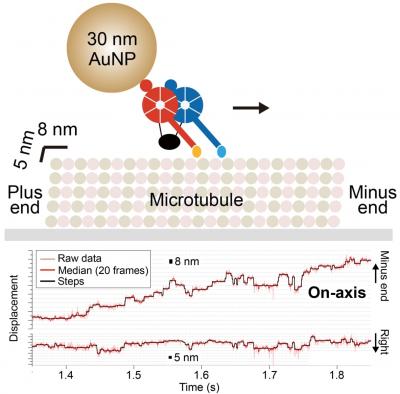
The first step to creating synthetic molecular motors is to fully understand how biological motors move. In order to do this, Iino and his team used high-speed, highly precise imaging to track how a single molecule — specifically dynein — moves along a microtubule, which helps provide structure in cells. The researchers previously used the same imaging technique to study kinesin, which was found to move to with precision along a single rail of a microtubule.
However, they found the dynein moved far more erratically than kinesin.
“In contrast to the precise movement of kinesin, dynein movement involves not only forward steps, but also frequent backward steps and side steps to adjacent rails,” Iino said. “In other words, dynein walks like a drunk person.”
Next, Iino and his team will continue to image dynein in detail, with the goal of understanding how the protein coordinates — or doesn’t coordinate at all — to perform its molecular motor tasks.
“Our result indicates that linear molecular motors do not have to move precisely to achieve an important function of the cargo transport in the cell,” Iino said. “It is important for us to understand both the commonality and diversity in the walking mechanism of the linear molecular motors to eventually realize motors made of synthetic molecules.
###
This work was supported, in part, by the Grants-in-Aid for Scientific Research on Innovative Areas “Molecular Engine” and by Grants-in-Aid for Scientific Research from the Ministry of Education, Culture, Sports, Science, and Technology of Japan.
Other contributors include Jun Ando, Akihiko Nakamura and Mayuko Yamamoto, all of the Institute for Molecular Science in the National Institutes of Natural Sciences. Ando and Nakamura are also affiliated with the Graduate University for Advanced Studies. Other authors include Tomohiro Shima of the Department of Biological Sciences in the Graduate School of Science at The University of Tokyo; Riko Kanazawa, Reiko Shimo-Kon and Takahide Kon, all of the Department of Biological Sciences at the Graduate School of Science at Osaka University.
Media Contact
Ryota Iino
[email protected]
81-564-595-230
Original Source
https:/
Related Journal Article
http://dx.