• HOME
  • NEWS
  • EXPLORE
    • CAREER
      • Companies
      • Jobs
    • EVENTS
    • iGEM
      • News
      • Team
    • PHOTOS
    • VIDEO
    • WIKI
  • BLOG
  • COMMUNITY
    • FACEBOOK
    • INSTAGRAM
    • TWITTER
Saturday, February 7, 2026
BIOENGINEER.ORG
No Result
View All Result
  • Login
  • HOME
  • NEWS
  • EXPLORE
    • CAREER
      • Companies
      • Jobs
        • Lecturer
        • PhD Studentship
        • Postdoc
        • Research Assistant
    • EVENTS
    • iGEM
      • News
      • Team
    • PHOTOS
    • VIDEO
    • WIKI
  • BLOG
  • COMMUNITY
    • FACEBOOK
    • INSTAGRAM
    • TWITTER
  • HOME
  • NEWS
  • EXPLORE
    • CAREER
      • Companies
      • Jobs
        • Lecturer
        • PhD Studentship
        • Postdoc
        • Research Assistant
    • EVENTS
    • iGEM
      • News
      • Team
    • PHOTOS
    • VIDEO
    • WIKI
  • BLOG
  • COMMUNITY
    • FACEBOOK
    • INSTAGRAM
    • TWITTER
No Result
View All Result
Bioengineer.org
No Result
View All Result
Home NEWS Science News Chemistry

Scientists propose new properties in hollow multishell structure

Bioengineer by Bioengineer
February 13, 2020
in Chemistry
Reading Time: 2 mins read
0
IMAGE
Share on FacebookShare on TwitterShare on LinkedinShare on RedditShare on Telegram

IMAGE

Credit: YANG Nailiang

The Chinese puzzle ball is an ornate decorative artwork consisting of several concentric shells that move independently of each other. In the recent decade, Chinese scientists provided a universal method for the fabrication of a conceptually similar micronanoscale structure, called the hollow multishell structure (HoMS).

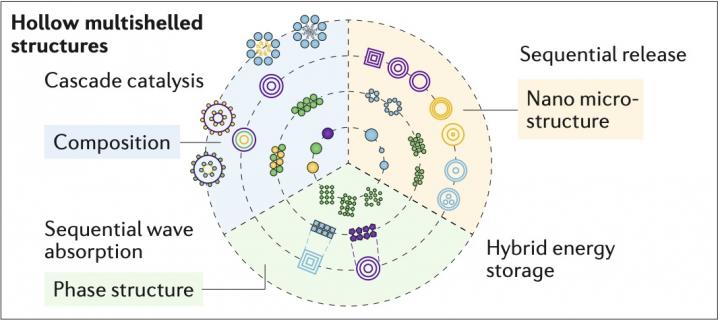
A new study led by Prof. WANG Dan from the Institute of Process Engineering (IPE) of the Chinese Academy of Sciences proposes a novel concept of temporal-spatial ordering and dynamic smart behavior in HoMSs. It was published in Nature Reviews Chemistry on Feb. 11.

Unlike the single shell hollow sphere or nanoparticles, HoMS has potential applications in fields ranging from energy conversion and storage to catalysis, since it avoids easy agglomeration of nanoparticles, maintains the advantage of effective surface area, and benefits the mass transmission.

In the first phase of their work, the group developed a facile sequential templating approach (STA) for the fabrication of HoMS. This approach realized precise control of the shell number, thickness, distance, and facet exposure, thus modulating surface properties and the interface of HoMS materials.

Specifically, multishells separate space into various, relatively isolated subspaces. At the same time, the heterogeneous pores on each shell facilitate the transmission of small molecules.

“When a molecule or electromagnetic wave diffuses through HoMS, it experiences a set order of environments and spends a controllable time in each one,” said WANG. “Based on the understanding of structure property relationship, we name this specific feature of HoMS as ‘temporal-spatial ordering’.”

Interestingly, in the antenna system of cyanobacteria, different antenna pigments are loaded in a certain order to realize the sequential collection of light energy, which is the example for natural temporal-spatial ordering. This specific structure ensures the fast and precise route to accumulate large amount of oxygen to significant amounts for oxygenic life.

“Inspired by nature, we believe the unique structure suggests promising applications for HoMS in sequential electromagnetic wave harvesting, cascade catalytic reactions, sustained drug release, and hybrid energy storage technologies,” said WANG.

The group also proposed another promising proposition: HoMS with isolated spaces in multiple chemical environments could express dynamic smart behavior.

Through chemical modification, HoMSs can bind the target and perhaps also self-evolve to have desired properties at a desired time, which would be highly desirable in chemical engineering and biochemistry fields.

###

Media Contact
LI Xiangyu
[email protected]

Original Source

http://english.cas.cn/

Related Journal Article

http://dx.doi.org/10.1038/s41570-020-0161-8

Tags: Atomic/Molecular/Particle PhysicsChemistry/Physics/Materials Sciences
Share12Tweet8Share2ShareShareShare2

Related Posts

blank

Breakthrough in Environmental Cleanup: Scientists Develop Solar-Activated Biochar for Faster Remediation

February 7, 2026
blank

Cutting Costs: Making Hydrogen Fuel Cells More Affordable

February 6, 2026

Scientists Develop Hand-Held “Levitating” Time Crystals

February 6, 2026

Observing a Key Green-Energy Catalyst Dissolve Atom by Atom

February 6, 2026
Please login to join discussion

POPULAR NEWS

  • Robotic Ureteral Reconstruction: A Novel Approach

    Robotic Ureteral Reconstruction: A Novel Approach

    82 shares
    Share 33 Tweet 21
  • Digital Privacy: Health Data Control in Incarceration

    63 shares
    Share 25 Tweet 16
  • Study Reveals Lipid Accumulation in ME/CFS Cells

    57 shares
    Share 23 Tweet 14
  • Breakthrough in RNA Research Accelerates Medical Innovations Timeline

    53 shares
    Share 21 Tweet 13

About

We bring you the latest biotechnology news from best research centers and universities around the world. Check our website.

Follow us

Recent News

Evaluating Pediatric Emergency Care Quality in Ethiopia

TPMT Expression Predictions Linked to Azathioprine Side Effects

Improving Dementia Care with Enhanced Activity Kits

Subscribe to Blog via Email

Success! An email was just sent to confirm your subscription. Please find the email now and click 'Confirm' to start subscribing.

Join 73 other subscribers
  • Contact Us

Bioengineer.org © Copyright 2023 All Rights Reserved.

Welcome Back!

Login to your account below

Forgotten Password?

Retrieve your password

Please enter your username or email address to reset your password.

Log In
No Result
View All Result
  • Homepages
    • Home Page 1
    • Home Page 2
  • News
  • National
  • Business
  • Health
  • Lifestyle
  • Science

Bioengineer.org © Copyright 2023 All Rights Reserved.