• HOME
  • NEWS
  • EXPLORE
    • CAREER
      • Companies
      • Jobs
    • EVENTS
    • iGEM
      • News
      • Team
    • PHOTOS
    • VIDEO
    • WIKI
  • BLOG
  • COMMUNITY
    • FACEBOOK
    • INSTAGRAM
    • TWITTER
Monday, March 30, 2026
BIOENGINEER.ORG
No Result
View All Result
  • Login
  • HOME
  • NEWS
  • EXPLORE
    • CAREER
      • Companies
      • Jobs
        • Lecturer
        • PhD Studentship
        • Postdoc
        • Research Assistant
    • EVENTS
    • iGEM
      • News
      • Team
    • PHOTOS
    • VIDEO
    • WIKI
  • BLOG
  • COMMUNITY
    • FACEBOOK
    • INSTAGRAM
    • TWITTER
  • HOME
  • NEWS
  • EXPLORE
    • CAREER
      • Companies
      • Jobs
        • Lecturer
        • PhD Studentship
        • Postdoc
        • Research Assistant
    • EVENTS
    • iGEM
      • News
      • Team
    • PHOTOS
    • VIDEO
    • WIKI
  • BLOG
  • COMMUNITY
    • FACEBOOK
    • INSTAGRAM
    • TWITTER
No Result
View All Result
Bioengineer.org
No Result
View All Result
Home NEWS Science News

Modified clay can remove herbicide from water

Bioengineer by Bioengineer
February 12, 2020
in Science News
Reading Time: 3 mins read
0
IMAGE
Share on FacebookShare on TwitterShare on LinkedinShare on RedditShare on Telegram

IMAGE

Credit: Feng Yan et al.


By creating neatly spaced slits in a clay mineral, University of Groningen Professor of Experimental Solid State Physics Petra Rudolf was able to filter water to remove a toxic herbicide. After removing the pollutant by heating the material, the clay can be reused. Together with colleagues from Greece, Rudolf presents this proof of principle study in the journal Environmental Science Nano.

In the Netherlands, a lot of sugar beets are grown. On these fields, the herbicide chloridazon is widely used. This compound is toxic to humans, does not break down in nature and will eventually seep into the groundwater. Chloridazon concentrations in groundwater are currently below the safety threshold but as it is persistent in the environment, they are expected to increase. ‘Water purification plants can break down chloridazon using UV light – but the breakdown products of chloridazon are also toxic,’ explains Rudolf.

Pillars

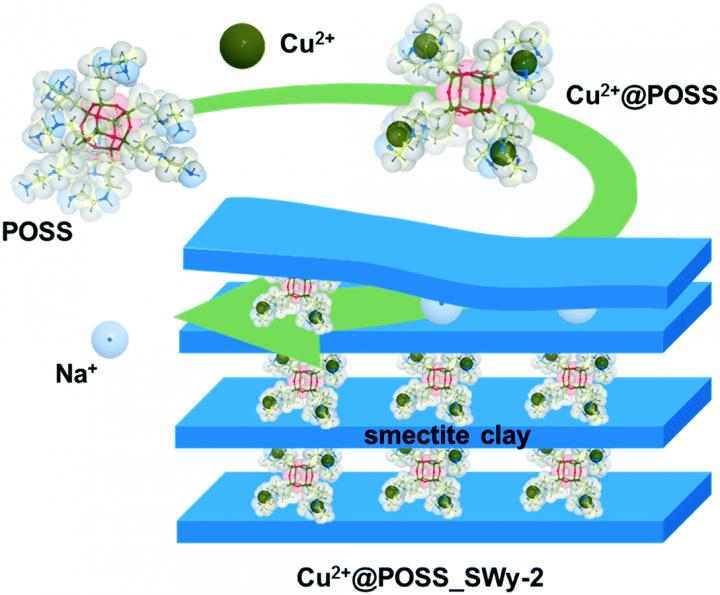
Rudolf has acquired a technique to make well-defined nanocavities in clay, which she adapted to trap the herbicide. ‘Clay is a layered mineral,’ Rudolf explains. ‘The layers have a negative charge and are separated by positive ions. We can replace those with molecular pillars of our own design.’ The natural clays are first washed and then treated with sodium salts. The sodium replaces the natural positive ions between the layers. ‘These sodium ions are surrounded by a water mantle, which pushes the layers slightly further apart. By simply adding the pillar molecules to the water, they will replace the sodium.’

These pillars are usually made of silicon oxide, with an added chemical group that defines the affinity of the cavities. Rudolf: ‘In this case, we added copper ions to attract the chloridazon and its breakdown products.’ The functionalized clay absorbed the herbicide in significant amounts: nearly 900 milligrams per kilogram of clay. ‘This is a good result and we see scope to further increase the absorption.’ Furthermore, Rudolf and her colleagues have shown that the herbicide is removed by heating the clay, which can then be used again.

Groundwater

The first results were obtained using 10 times the highest concentration of chloridazon measured in the environment. Furthermore, the experiments were performed in clean water. ‘So, we need to repeat this in real groundwater, to see if other compounds affect the absorption.’ If all these tests yield positive results, the next question is how to make this clay into a product that can be used in water treatment. ‘The options are to add the clay to water and then retrieve it by filtration, or to build the clay into a membrane,’ explains Rudolf.

By altering the width of the slits and changing the affinity of the pillars, different chemical compounds could be caught by the functionalized clay. ‘We are testing systems to remove two other compounds from water,’ says Rudolf. ‘Furthermore, a similar system could be created using other layered materials, such as graphene oxide.’

###

Reference: F. Yan, K. Spyrou, E. Thomou, S. Kumar, H. Cao, M.C.A. Stuart, Y.T. Pei, D. Gournis and P. Rudolf: Smectite clay pillared with copper complexed polyhedral oligosilsesquioxane for adsorption of chloridazon and its metabolites. Environmental Science: Nano 2020, first online 21 Nov 2019

Media Contact
Rene Fransen
[email protected]

Original Source

https://www.rug.nl/sciencelinx/nieuws/2020/02/aangepaste-klei-haalt-onkruidverdelger-uit-water

Related Journal Article

http://dx.doi.org/10.1039/C9EN00974D

Tags: Biomechanics/BiophysicsChemistry/Physics/Materials SciencesEcology/EnvironmentNanotechnology/MicromachinesPollution/Remediation
Share14Tweet9Share2ShareShareShare2

Related Posts

Prioritize Intensity Over Duration: How Harder Exercise Lowers Disease and Mortality Risks

March 30, 2026
Squirrels Scale Greater Heights to Access Superior Snacks

Squirrels Scale Greater Heights to Access Superior Snacks

March 30, 2026

New Zebrafish Study Sheds Light on Why Haploid Fish Embryos Often Fail to Fully Develop

March 30, 2026

Boron Neutron Capture Therapy: A Breakthrough in Cancer Treatment

March 29, 2026
Please login to join discussion

POPULAR NEWS

  • blank

    Revolutionary AI Model Enhances Precision in Detecting Food Contamination

    96 shares
    Share 38 Tweet 24
  • Imagine a Social Media Feed That Challenges Your Views Instead of Reinforcing Them

    1005 shares
    Share 397 Tweet 248
  • Promising Outcomes from First Clinical Trials of Gene Regulation in Epilepsy

    51 shares
    Share 20 Tweet 13
  • Advancements in EV Battery Technology to Surpass Climate Change-Induced Degradation

    45 shares
    Share 18 Tweet 11

About

We bring you the latest biotechnology news from best research centers and universities around the world. Check our website.

Follow us

Recent News

Prioritize Intensity Over Duration: How Harder Exercise Lowers Disease and Mortality Risks

Squirrels Scale Greater Heights to Access Superior Snacks

New Zebrafish Study Sheds Light on Why Haploid Fish Embryos Often Fail to Fully Develop

Subscribe to Blog via Email

Enter your email address to subscribe to this blog and receive notifications of new posts by email.

Join 78 other subscribers
  • Contact Us

Bioengineer.org © Copyright 2023 All Rights Reserved.

Welcome Back!

Login to your account below

Forgotten Password?

Retrieve your password

Please enter your username or email address to reset your password.

Log In
No Result
View All Result
  • Homepages
    • Home Page 1
    • Home Page 2
  • News
  • National
  • Business
  • Health
  • Lifestyle
  • Science

Bioengineer.org © Copyright 2023 All Rights Reserved.