Credit: ©Science China Press
The cluster of pneumonia cases in Wuhan City, Hubei Province of China was first reported on December 30, 2019 by the Wuhan Municipal Health Commission. The Centers for Disease Control and Prevention (CDC) later determined and announced a novel coronavirus (CoV), denoted as Wuhan CoV (2019-nCoV), had caused the outbreak of the pneumonia. The current public health emergency partially resembles the emergence of the SARS outbreak in southern China in 2002, which led to more than 8,000 human infections and 774 deaths. As of January 15, 2020, there were more than 40 laboratory-confirmed cases of the noval Wuhan CoV infection with one death and multiple exported cases in Japan, and Thailand. Under the current public health emergency, it is imperative to understand the origin and native host(s) of the Wuhan CoV, and to evaluate the public health risk of this novel coronavirus for transmission cross species or between humans.
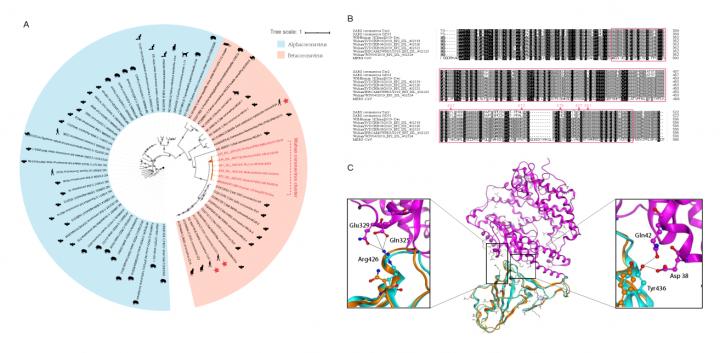
“To understand the origin of the Wuhan CoV and its genetic relationship with other coronaviruses, we performed phylogenetic analysis on the collection of coronavirus sequences from various sources.”, said Professor Pei Hao at Institut Pasteur of Shanghai, the corresponding author of this study. The results indicated that Wuhan CoV belongs to the Betacoronavirus genera, and shares a common ancestor with the SARS/SARS-like coronaviruses (including those causing the 2002/2003 SARS epidemic). Their common ancestor more or less resembles the bat coronavirus HKU9-1. Based on the evolutionary relationship of betacoronavirus, bat is likely the native host of the Wuhan CoV, though it remains likely there is intermediate host(s) in the transmission cascade from bats to humans.
“Furthermore, to evaluate Wuhan CoV health risk for human transmission, we performed structural modeling of its spike protein that is critical for coronavirus-host interaction, and evaluate its ability to mediate human infection.”said Prof. Hao. The binding free energy for Wuhan CoV S-protein to human ACE2 (receptor for human infection) is -50.6 kcal/mol, which is considered as a significant binding affinity to human ACE2, despite a little weaker than that between SARS-CoV S-protein and ACE2 (-78.kcal/mol). The results point to the important discovery that the Wuhan CoV S-protein supports strong interaction with human ACE2 molecules despite its sequence diversity from SARS-CoV S-protein. “So the Wuhan CoV poses significant health risk for transmission cross species or between humans throught the same infection mechanism of the SARS-CoV, e.g. S-protein – ACE2 interaction.”said Prof. Hao.
These important results not only presented for the first time the evidence of human transmissions by the Wuhan novel coronavirus (2019-nCoV), but also were indicative of its infection mechanism that is the same as that of the SARS virus responsible for the 2002/2003 epidemic, depite their considerable divergence in sequences.
###
This work was supported in part by grants from the National Science and Technology Major Projects for “Major New Drugs Innovation and Development” (directed by Dr. Song Li) (2018ZX09711003) of China, the National Key R&D Program (2018YFC0310600) of China, the
National Natural Science Foundation of China (31771412), and Special Fund for strategic bio-resources from Chinese Academy of Sciences (ZSYS-014).
See the article:
Xu, X.T., Chen, P., Wang, J.F., et al. (2020). Evolution of the novel coronavirus from the ongoing Wuhan outbreak and modeling of its spike protein for risk of human transmission. Sci China Life Sci, in press, https:/
This article was published online:
http://link.
http://engine.
Media Contact
Pei, Hao
[email protected]
Related Journal Article
http://dx.