• HOME
  • NEWS
  • EXPLORE
    • CAREER
      • Companies
      • Jobs
    • EVENTS
    • iGEM
      • News
      • Team
    • PHOTOS
    • VIDEO
    • WIKI
  • BLOG
  • COMMUNITY
    • FACEBOOK
    • INSTAGRAM
    • TWITTER
Saturday, February 7, 2026
BIOENGINEER.ORG
No Result
View All Result
  • Login
  • HOME
  • NEWS
  • EXPLORE
    • CAREER
      • Companies
      • Jobs
        • Lecturer
        • PhD Studentship
        • Postdoc
        • Research Assistant
    • EVENTS
    • iGEM
      • News
      • Team
    • PHOTOS
    • VIDEO
    • WIKI
  • BLOG
  • COMMUNITY
    • FACEBOOK
    • INSTAGRAM
    • TWITTER
  • HOME
  • NEWS
  • EXPLORE
    • CAREER
      • Companies
      • Jobs
        • Lecturer
        • PhD Studentship
        • Postdoc
        • Research Assistant
    • EVENTS
    • iGEM
      • News
      • Team
    • PHOTOS
    • VIDEO
    • WIKI
  • BLOG
  • COMMUNITY
    • FACEBOOK
    • INSTAGRAM
    • TWITTER
No Result
View All Result
Bioengineer.org
No Result
View All Result
Home NEWS Science News Health

Artificial intelligence can analyze myoclonus severity from video footage

Bioengineer by Bioengineer
February 7, 2020
in Health
Reading Time: 2 mins read
0
IMAGE
Share on FacebookShare on TwitterShare on LinkedinShare on RedditShare on Telegram

IMAGE

Credit: Neuro Event Labs


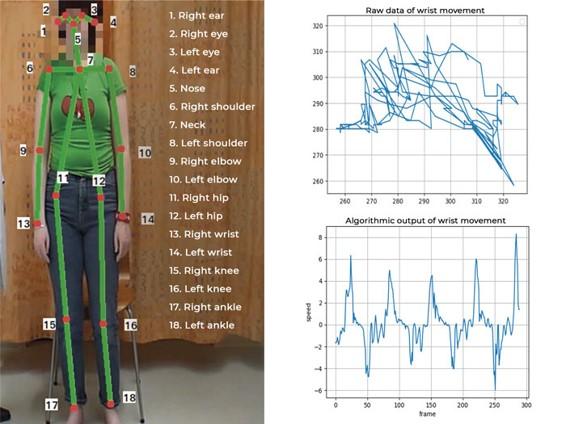
Fast, reliable and automatic assessment of the severity of myoclonic jerks from video footage is now possible, thanks to an algorithm using deep convolutional neural network architecture and pretrained models that identify and track keypoints in the human body. Published in Seizure, the study is a joint effort by the Epilepsy Centre at Kuopio University Hospital, the University of Eastern Finland and Neuro Event Labs.

Myoclonus refers to brief, involuntary twitching of muscles and it is the most disabling and progressive drug-resistant symptom in patients with progressive myoclonus epilepsy type 1 (EPM1). It is stimulus sensitive and its severity fluctuates during the day. In addition, stress, sleep deprivation and anxiety can cause significant aggravation of myoclonic symptoms. Clinical objective follow-up of myoclonus is challenging and requires extensive expertise from the treating physician. Therefore, physicians and the medical industry have been seeking automatic tools to improve the consistency and reliability of serial myoclonus evaluations in order to reliably estimate treatment effect and disease progression.

Unified myoclonus rating scale (UMRS), a clinical videorecorded test panel, is the gold standard currently used to evaluate myoclonus. The researchers analysed 10 videorecorded UMRS test panels using automatic pose estimation and keypoint detection methods. The automatic methods were successful in detecting and tracking predefined keypoints in the human body during movement. The researchers also analysed speed changes and the smoothness of movement to detect and quantify myoclonic jerks during an active seizure. The scores obtained using automatic myoclonus detection correlated well with the clinical UMRS myoclonus with action and functional tests scores evaluated by an experienced clinical researcher.

The study showed that the automatic method involving keypoint detection and pose estimation from video footage reliably quantified myoclonic jerks in EPM1 patients. The automatic quantification of myoclonus correlated well with the clinical evaluation. It also effectively quantified the smoothness of movement, and was sensitive enough to detect small-amplitude and high-frequency myoclonic jerks.

###

For further information, please contact:

Jelena Hyppönen jelena.hypponen (at) kuh.fi

CEO Kaapo Annala kaapo.annala (at) neuroeventlabs.com, https://neuroeventlabs.com

Professor Reetta Kälviäinen reetta.kalviainen (at) uef.fi, tel. +358405839249

Article:
J. Hyppönen, A. Hakala, K. Annala, H. Zhang, J. Peltola, E. Mervaala, R. Kälviäinen Automatic assessment of the myoclonus severity from videos recorded according to standardized Unified Myoclonus Rating Scale protocol and using human pose and body movement analysis. Seizure: European Journal of Epilepsy. https://authors.elsevier.com/a/1aWcP_O5FHQsj9
DOI: 10.1016/j.seizure.2020.01.014

Media Contact
Reetta Kälviäinen
[email protected]
358-405-839-249

Related Journal Article

http://dx.doi.org/10.1016/j.seizure.2020.01.014

Tags: Medicine/HealthneurobiologyRobotry/Artificial Intelligence
Share12Tweet8Share2ShareShareShare2

Related Posts

Phage-Antibiotic Combo Beats Resistant Peritoneal Infection

February 7, 2026

Boosting Remote Healthcare: Stepped-Wedge Trial Insights

February 7, 2026

Barriers and Boosters of Seniors’ Physical Activity in Karachi

February 7, 2026

Evaluating Pediatric Emergency Care Quality in Ethiopia

February 7, 2026
Please login to join discussion

POPULAR NEWS

  • Robotic Ureteral Reconstruction: A Novel Approach

    Robotic Ureteral Reconstruction: A Novel Approach

    82 shares
    Share 33 Tweet 21
  • Digital Privacy: Health Data Control in Incarceration

    63 shares
    Share 25 Tweet 16
  • Study Reveals Lipid Accumulation in ME/CFS Cells

    57 shares
    Share 23 Tweet 14
  • Breakthrough in RNA Research Accelerates Medical Innovations Timeline

    53 shares
    Share 21 Tweet 13

About

We bring you the latest biotechnology news from best research centers and universities around the world. Check our website.

Follow us

Recent News

Phage-Antibiotic Combo Beats Resistant Peritoneal Infection

Boosting Remote Healthcare: Stepped-Wedge Trial Insights

Barriers and Boosters of Seniors’ Physical Activity in Karachi

Subscribe to Blog via Email

Enter your email address to subscribe to this blog and receive notifications of new posts by email.

Join 73 other subscribers
  • Contact Us

Bioengineer.org © Copyright 2023 All Rights Reserved.

Welcome Back!

Login to your account below

Forgotten Password?

Retrieve your password

Please enter your username or email address to reset your password.

Log In
No Result
View All Result
  • Homepages
    • Home Page 1
    • Home Page 2
  • News
  • National
  • Business
  • Health
  • Lifestyle
  • Science

Bioengineer.org © Copyright 2023 All Rights Reserved.