Credit: FEFU press office
Scientists from Far Eastern Federal University (FEFU, Vladivostok, Russia), together with colleagues from FEB RAS, China, Hong Kong, and Australia, manufactured ultra-compact bright sources based on IR-emitting mercury telluride (HgTe) quantum dots (QDs), the future functional elements of quantum computers and advanced sensors. A related article is published in “Light: Science and Applications“.
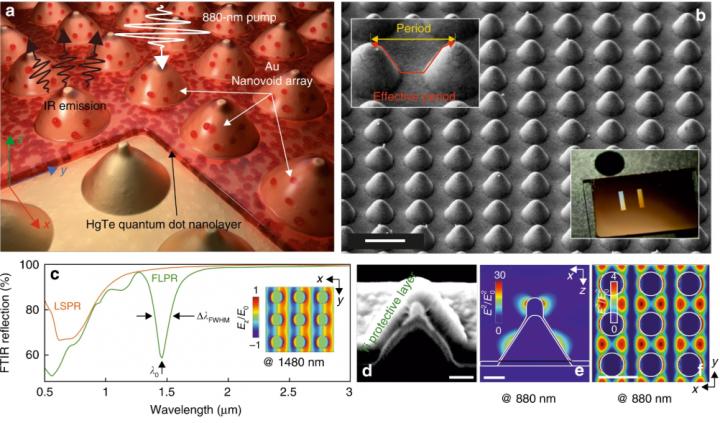
FEFU scientists, together with colleagues from the Far Eastern Branch of the Russian Academy of Sciences and foreign experts, designed a resonant lattice laser printed on a surface of thin gold film that allows to control the near- and mid-IR radiation properties of capping layer of mercury telluride (HgTe) QDs.
The near- and mid-IR spectral range is extremely promising for the implementation of optical telecommunication devices, detectors, and emitters, as well as sensor and next-generation security systems. Recently developed semiconductor QDs represent promising nanomaterials emitting light exactly in this range. However, the main issue is associated with fundamental physical limitations (the Fermi golden rule, Auger recombination, etc.) dramatically decreasing intensity of the IR-emitting QDs.
Scientists from FEFU, and Institute of Automation and Control Processes (IACP FEB RAS) together with foreign colleagues for the first time overcame this limitation by applying a special resonant lattice of nanostructures. Scientists formed the lattice by ultra-precise direct laser printing on the surface of a thin film of gold.
“The plasmon lattice we developed consists of millions of nanostructures arranged on the gold film surface. We produced such lattice using advanced direct laser processing. This fabrication technology is inexpensive comparing to existing commercial lithography-based methods, easily up-scalable, and allows facile fabrication of nanostructures over cm-scale areas. This opens up prospects for applying the developed approach to design new optical telecommunication devices, detectors, and emitters, including the first IR-emitting QD-based microlaser.” – said the author of the work, Aleksander Kuchmizhak, a researcher at the FEFU Center for Virtual and Augmented Reality.
The scientist explains that the resonant lattice converts the pump radiation into a special type of electromagnetic waves referred to as surface plasmons. Such waves, propagating over the surface of the patterned gold film within the capping layer of QDs, provide their efficient excitation boosting photoluminescence yield.
“For the visible spectral range, quantum dots have been synthesizing for several decades. Just a few scientific groups in the world, though, are capable of synthesizing QDs for the near and mid-IR range. Thanks to the plasmon lattice we developed, which consists of plasmon nanostructures arranged in a special way, we are able to control the main light-emitting characteristics of such unique QDs, for example, by repeatedly increasing the intensity and photoluminescence lifetime, reducing the efficiency of non-radiative recombinations, as well as by tailoring and improving emission spectrum.” Said Alexander Sergeev, a senior researcher at IACP FEB RAS.
The scientist noted that quantum dots are a promising class of luminophores. They synthesized by a simple and cost-effective chemical method, this material is durable and unlike organic molecules does not suffer from degradation.
###
The study supported by grants from the Russian Science Foundation (No. 17-19-01325), the Center for Functional Photonics, City University of Hong Kong, and the Innovation and Technology Commission of the Government of Hong Kong (No. ITS / 402/17).
https:/
Media Contact
Alexander Zverev
[email protected]
Related Journal Article
http://dx.