Credit: ©Science China Press
Ferroelectric materials possessing high photoelectric, piezoelectric and dielectric response are widely applied in industrial products, such as transducers, capacitors and memory devices. However, as the development of technology, miniaturization, integration and flexibility are of great importance, which could hardly be fulfilled by traditional bulk ferroelectric materials. Hence, nanoscale ferroelectric domain walls (DWs), with recently found dramatic mechanical, electrical, optical and magnetic properties aside from ferroelectric domains, have become a hotspot.
Despite intriguing properties ferroelectric domain walls have, to put them into use, understanding DW dynamics and developing DW manipulation approaches are urgently needed. It is known that external stimuli, such as electric field, mechanical strain and temperatures, could manipulate DW morphology and stability. Besides, the DW movement could also be affected by inertial properties of the sample as well as intrinsic characteristics of DWs. However, the impact of bound charges, which is one of the foremost characteristics of DWs, is mostly studied theoretically.
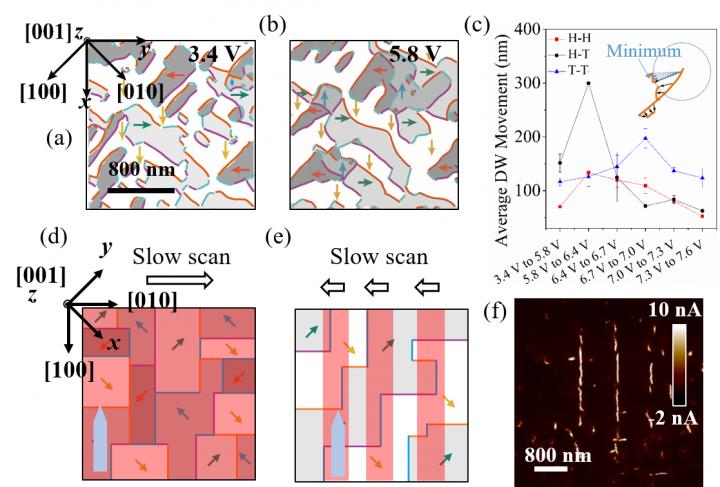
In a new research article published in the Beijing-based National Science Review, scientists at the Nanjing University in Nanjing, China, Rutgers University in New Jersy, USA and at Chinese Academy of Sciences in Shenzhen, China provide direct experimental insight into DW dynamics of differently charged DWs under electric field. It is found via atomic force microscopy that the mobility of differently charged DWs in bismuth ferrite films varies with the electric field.
Under lower voltages, head-to-tail DWs are more mobile than other DWs, while under higher voltages, tail-to-tail DWs become rather active and possess relatively long average length. This is attributed to the high nucleation energy and relative low growth energy for charged DWs. Based on these results, researchers designed a two-step poling approach. They polarize ferroelectric thin films with lower and higher electric field by scanning the surface of the sample with the atomic force microscopy tip. Arrays of well-aligned stripe tail-to-tail DWs are successfully produced as conductive paths, while the orientation of DWs could be changed by varying the scanning direction of the tip. In this way, they achieved the oriented growth and configuration control of ferroelectric DWs.
“Our work unveils the remarkable impact of charge accumulation around DWs on DW mobility, providing a generalizable approach for DW dynamic studies in ferroic materials. The methodology proposed here for the advanced tunability of conductive DWs makes significant progress towards their applications in functional nano-devices”, they claim.
###
This research received funding from the National Key Research Program of China, the State Key Program for Basic Research of China, the National Natural Science Foundation of China, and the Priority Academic Program Development of Jiangsu Higher Education Institutions.
See the article:
Shuyu Xiao, Yaming Jin, Xiaomei Lu, S W Cheong, Jiangyu Li, Yang Li, Fengzhen Huang, and Jinsong Zhu
Dynamics and manipulation of ferroelectric domain walls in bismuth ferrite thin films
Natl Sci Rev; doi: 10.1093/nsr/nwz176
https:/
The National Science Review is the first comprehensive scholarly journal released in English in China that is aimed at linking the country’s rapidly advancing community of scientists with the global frontiers of science and technology. The journal also aims to shine a worldwide spotlight on scientific research advances across China.
Media Contact
Xiaomei Lu
[email protected]
Related Journal Article
http://dx.